



Matrixport Identifies Key Market Indicators
Bitcoin has entered a "mini" bear market, as officially confirmed by Matrixport's market outlook released on November 14, 2025. This phase is characterized by reduced trading volumes and a slowdown in ETF inflows, signaling a potential for significant price declines. The Federal Reserve's policies are identified as a crucial factor in determining future market direction and sentiment.
Shrinking Liquidity and Risk Management Emphasis
Matrixport, under the leadership of Jihan Wu, reported Bitcoin's entry into this "mini" bear market phase on November 14, 2025. The announcement specifically highlights a decrease in trading volumes and sluggish ETF inflows. This trend indicates that both long-term and initial investors are beginning to offload their positions, suggesting a notable shift away from risk appetite within the cryptocurrency market. The decline in inflows and the overall weakening of the market have underscored the urgency for implementing robust risk management strategies. This market shift is further influenced by the absence of immediate short-term macroeconomic catalysts. The anticipation of the Federal Reserve's upcoming policy decisions remains a pivotal element influencing market sentiment.
"When the market weakens, the winners are often not the bravest, but those who exit first… The current environment is closer to a 'mini bear market'—trending lower, with declining momentum and absent macro catalysts… ETF inflows are slowing, and early and seasoned funds are reducing their positions." — Matrixport Research
Bitcoin's Trend Towards the 21-Week Moving Average
The 21-week moving average serves as a central metric for identifying Bitcoin's bull-bear phases. The current market conditions, with the asset trading below this average, clearly indicate a bear market trend.
As of November 14, 2025, Bitcoin (BTC) is priced at $96,980.04. This represents a 3.54% decline in the past 24 hours and a more significant 12.35% drop over the last 30 days. The cryptocurrency's market capitalization is recorded at $1.93 trillion. Notably, there has been a 61.76% increase in 24-hour trading volume, indicating heightened market activity during this downturn.
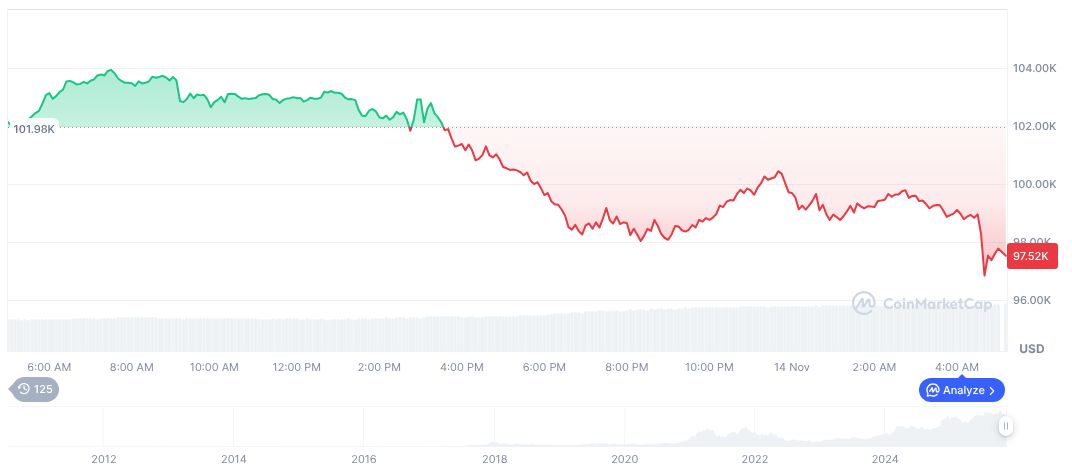
Experts from the Coincu research team suggest that close monitoring of the Federal Reserve's monetary directives could significantly influence the market's trajectory. Historical patterns observed during similar market phases indicate that the potential for recovery is often contingent upon macroeconomic cues and the adaptability of strategic investors.