



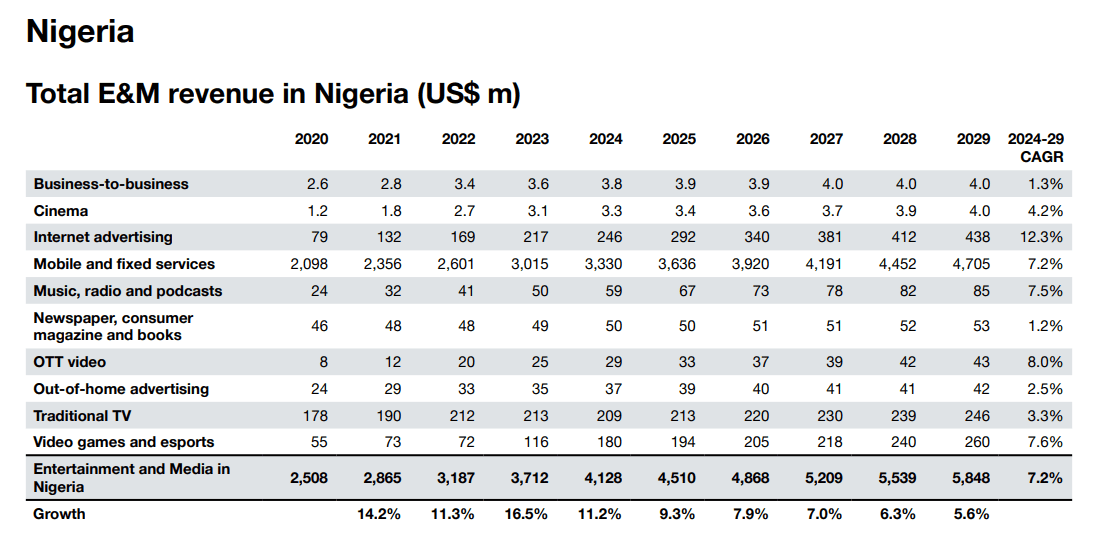
The Nigerian entertainment and media (E&M) industry is poised for a significant digital transformation, with its total revenue projected to reach $5.8 billion by 2029, according to a report by PwC.
The 14th Edition of PwC’s Entertainment and Media Outlook Report 2025-2029 identifies Nigeria’s large, youthful, and tech-savvy population as the primary drivers of this projected growth, with these demographics actively leveraging technology and Generative AI (GenAI).
GenAI is emerging as a transformative force in the E&M industry, enhancing content creation, recommendation engines and customer engagement. Nigeria, with its youthful and tech-savvy population, is particularly well-positioned to harness GenAI’s potential for this growth.
PwC's analysis indicates that Nigeria's rapid expansion in the E&M sector is further fueled by advancements in internet advertising, video games and e-sports, Over-The-Top (OTT) streaming services, and audio content, including music, radio, and podcasts.
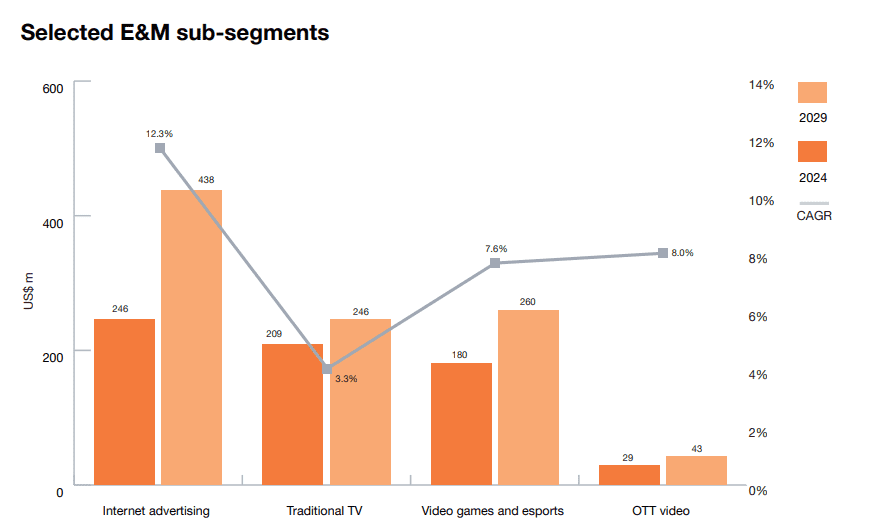
The report highlights a substantial pivot towards digital revenue within the nation's media market. Digital advertising is anticipated to constitute 84% of all ad spend in Nigeria, a figure that notably surpasses the global average. Furthermore, evolving consumption habits are fostering new market leaders, with the gaming and e-sports segment forecasted to surpass traditional television revenue by 2028.
Nigeria's performance is setting a benchmark for resilience and momentum across the African continent. While other African E&M sectors, including those in South Africa and Kenya, are also showing strong growth, Nigeria is positioned as the undisputed leader.
In 2024, Nigeria recorded an impressive 11.2% growth rate, outperforming Kenya's 7.1% and South Africa's 6.2%. This upward trajectory is expected to persist, with Nigeria projected to maintain the region’s highest Compound Annual Growth Rate (CAGR) of 7.2% through 2029, indicating sustained and aggressive market expansion.
Growth in Gaming and Esports in Nigeria
Globally, gaming and esports are on a trajectory to overtake traditional television revenue by 2029. This shift is propelled by the rapid expansion of mobile platforms, increased internet accessibility, and the emergence of immersive technologies such as virtual and augmented reality.
These developments are fostering deeper engagement and higher spending, particularly among a younger, digitally native audience that prefers interactive and personalized experiences over passive consumption. Nigeria is mirroring this global trend, with the gaming and esports segment expected to take the lead in revenue generation by 2028, one year ahead of the global forecast.
Globally, OTT subscription revenue is also projected to surpass traditional television subscription revenue by 2027. Beyond macroeconomic influences, a significant factor contributing to shifts in consumer spending is the increasing demand for digital access.
Connectivity, defined as revenue from fixed and mobile internet services, remains the largest segment of the E&M industry, predominantly driven by mobile services. Spending on connectivity is anticipated to exceed $1.3 billion by 2029, underscoring its foundational importance in the digital economy.
Growth in Internet Access in Nigeria
Internet access in Nigeria is overwhelmingly mobile-centric, with the majority of users connecting via mobile networks. This trend is supported by ongoing 4G network expansion and early-stage 5G trials. Starting from a relatively modest base in 2024, Nigeria currently boasts over 142 million internet users. Data consumption is projected to more than triple, exhibiting a CAGR of 25.4%, reaching 58.2 petabytes (PB) by 2029.
According to PwC, Wi-Fi networks are expected to continue dominating data usage, with their share of total traffic increasing from 65.2% in 2024 to 73.1% in 2029. This growth is attributed to the expanding availability of affordable and free Wi-Fi hotspots.
Wi-Fi traffic is projected to grow at a CAGR of 28.3%, effectively tripling over the forecast period. Cellular data traffic is also anticipated to more than double, reaching 11.6 petabytes (PB) by 2029.

A Future Shaped by Digitalisation and AI in Nigeria
While Nigeria’s E&M sector is experiencing explosive growth, it is developing within a complex and evolving global landscape.
The worldwide Entertainment and Media sector is undergoing a profound transformation, situated at the intersection of emerging technologies and shifting consumer preferences. Globally, online advertising has become the primary revenue engine, demonstrating significantly faster growth than direct consumer spending.
By 2029, global advertising revenue is expected to exceed consumer spending by over $300 billion. The disparity is substantial: advertising is projected to grow at a compound annual rate of 6.1%, while consumer spending lags considerably at only 2.0%. This global trend is mirrored in Nigeria, where digital advertising is set to account for a significant 84% of local ad spend.
Emerging technologies, particularly Artificial Intelligence (AI), are playing a pivotal role on a global scale. AI is poised to revolutionize the E&M industry, especially in advertising, by enhancing both the creativity and efficiency of campaigns.
Furthermore, the evolving media consumption habits of different generations, especially younger demographics, with a notable focus on gaming, are reshaping the entire industry and giving rise to new market leaders.
Despite these innovations and the considerable value being unlocked, the global economy faces substantial challenges that could temper overall growth. Regulatory developments, including new rules and tariffs, are creating potential obstacles for expansion.
Crucially, consumers are facing increasing pressure from economic uncertainty and inflation, making it more challenging to increase their spending on media and entertainment products. Consequently, even with advancements like AI, the overall global revenue growth rate is expected to moderate throughout the forecast period due to these constraints on consumer spending.