


A new November 2025 study on high-return assets demonstrates the profound impact a well-timed investment can have on an individual's financial standing. According to a report, NVIDIA delivered the strongest wealth-building performance of any major stock or cryptocurrency over the past two decades.
The data reveals that a modest $2,200 stake in Nvidia in 2006 would now be worth $1 million, surpassing both Bitcoin and Tesla to claim the top position.
This research meticulously compares the initial investment required for various assets, ranging from tech stocks to cryptocurrencies, to achieve a seven-figure portfolio by 2025. It tracks each asset from its earliest trading date and applies its 2025 price to determine the minimum initial investment needed to reach the $1 million threshold.
The findings underscore a fundamental principle: not all early investment decisions yield the same results. While some assets experienced extraordinary growth from small starting amounts, others, despite being long-standing market favorites, demanded significantly larger initial capital to reach the same financial milestone.

NVIDIA's Historic Run Sets a New Benchmark
NVIDIA's ascent from a stock valued at $0.44 in March 2006 to $198 in 2025 represents one of the most remarkable long-term rallies in modern market history. An investor who committed approximately $2,215 at that time would have acquired about 5,033 shares, a position that would now exceed the million-dollar mark.
The company's growth was fueled by multiple phases of explosive expansion, encompassing gaming GPUs, AI acceleration, and data center dominance, transforming its stock into an unparalleled wealth-generating engine within the analyzed assets.
Tesla followed closely, though it required a slightly higher initial investment. An investment of $3,846 during its 2010 IPO, when the stock traded at $1.71, would have yielded approximately 2,250 shares. At a 2025 price of $444, this early investment grew by roughly 260 times, bringing its total value close to seven figures.
Tesla's trajectory, propelled by its pioneering efforts in electric vehicles and energy storage, exemplifies the substantial rewards of long-term commitment to emerging industries.

Cryptocurrencies, on the other hand, exhibited some of the most rapid decreases in the investment size needed to reach million-dollar outcomes. Bitcoin secured the third position on the list. An investment of $4,483 made in September 2014 would have purchased 10 coins at $457 per bitcoin. By 2025, with Bitcoin trading above $100,000, this holding would have been valued at just over $1 million.
Despite entering the market later than established companies like NVIDIA or Tesla, Bitcoin's extreme volatility and adoption cycles enabled it to outperform many traditional assets.
Netflix ranked next.
The streaming pioneer required an initial investment of only $6,423 at its 2002 IPO to reach the million-dollar mark by 2025. Beginning at $7.02 per share, the company's rise to $1,092 illustrates how early proponents of the streaming revolution achieved substantial returns as Netflix fundamentally altered global entertainment consumption.
Dogecoin's inclusion in the top five highlights the often unpredictable and sometimes unconventional nature of the investment landscape.
Launched as a memecoin in 2017 at $0.0013, it surged to $0.16 by 2025. This remarkable increase transformed a $7,959 stake into $1 million. Dogecoin delivered a 126-fold return in just eight years, demonstrating that even assets originating from internet humor can generate significant wealth under specific circumstances.
Beyond the top five, the remaining assets within the top 10 also provided exceptional gains for their early investors.
Amazon would have required an initial investment of approximately $26,000 in 2010 to reach $1 million by today, while Apple needed around $27,000 from its 2009 valuation to achieve the same target.
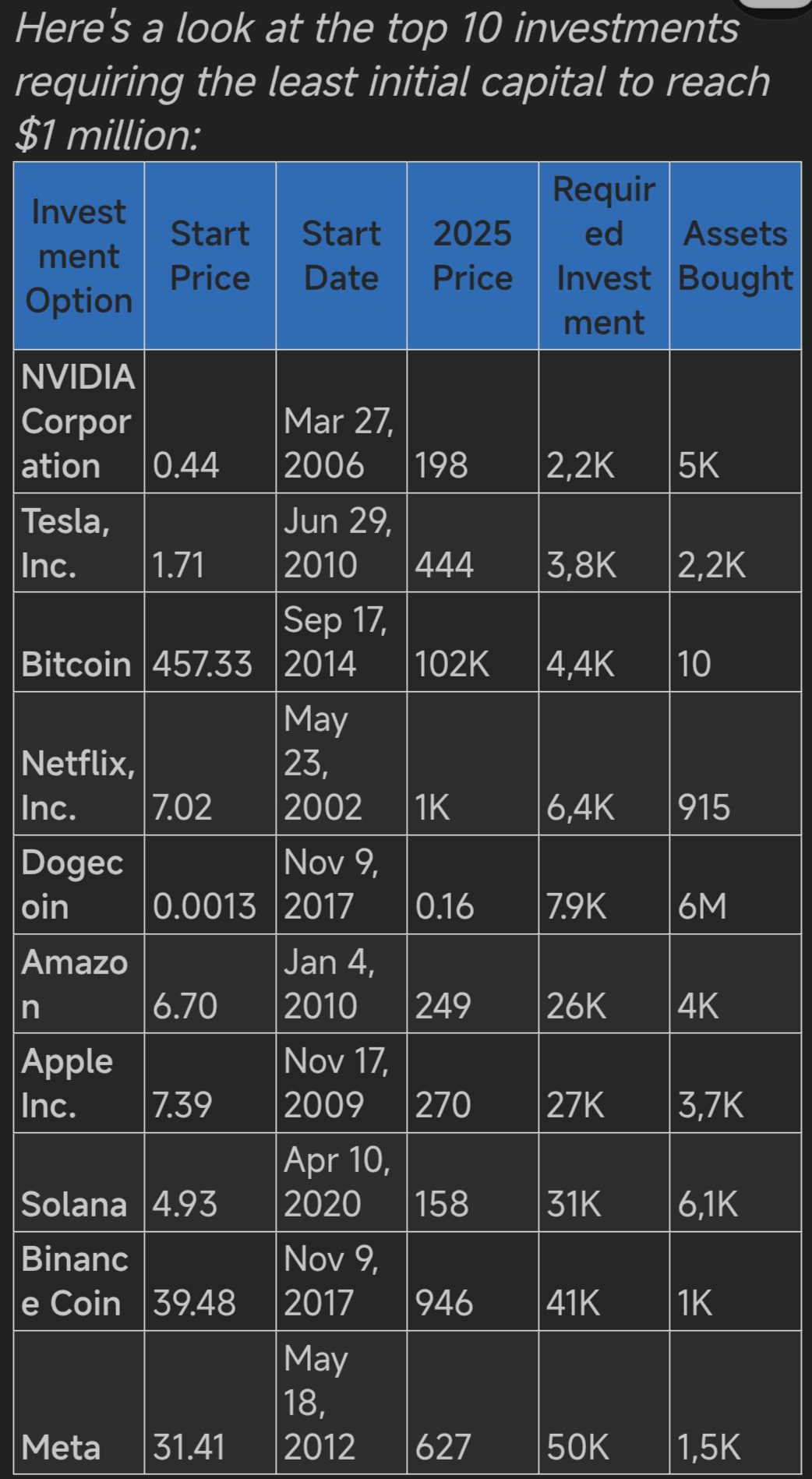
More recent cryptocurrencies demonstrated strong upward momentum. Solana required roughly $31,000 from its 2020 launch, and Binance's BNB required approximately $41,000 from its early 2017 price.
Meta completed the list, necessitating an investment of about $50,000 from its 2012 IPO to surpass the million-dollar threshold by 2025. Collectively, these assets underscore how a combination of early-stage technology stocks and rapidly appreciating digital tokens defined the most profitable investment opportunities of the past decade.
A senior market analyst at Taurex commented on the study, stating, "Investing has never been more accessible than it is today. You can purchase stocks, cryptocurrencies, and even gold directly from your smartphone in less than a minute."
Cryptocurrency, in particular, has gained significant traction among younger investors. For many who invested early, it proved to be a highly successful strategy. Some cryptocurrencies have substantially outperformed traditional investments such as gold. Even digital assets that began as internet jokes ultimately generated real financial gains for individuals who took a chance on them.
The overarching conclusion from the study is that transformative technologies, including AI, electric vehicles, streaming, and digital currencies, yielded the most favorable outcomes for minimal initial investment. For a considerable number of investors, achieving a $1 million portfolio was less about the quantum of the investment and more about strategic timing, unwavering conviction, and the foresight to identify emerging trends before they achieved widespread adoption.