



Amazon's recent confirmation of plans to lay off 14,000 corporate employees marks another difficult period for the tech industry. A new report from RationalFX, a global forex and financial insights platform, indicates that over 202,000 tech sector workers have lost their jobs in 2025 so far, with projections reaching 244,000 by the end of the year.
RationalFX, acquired by Markets Chain Limited in 2024, utilizes its financial expertise to serve as a global market intelligence hub, monitoring workforce trends, investment shifts, and economic volatility impacting various industries, including technology.
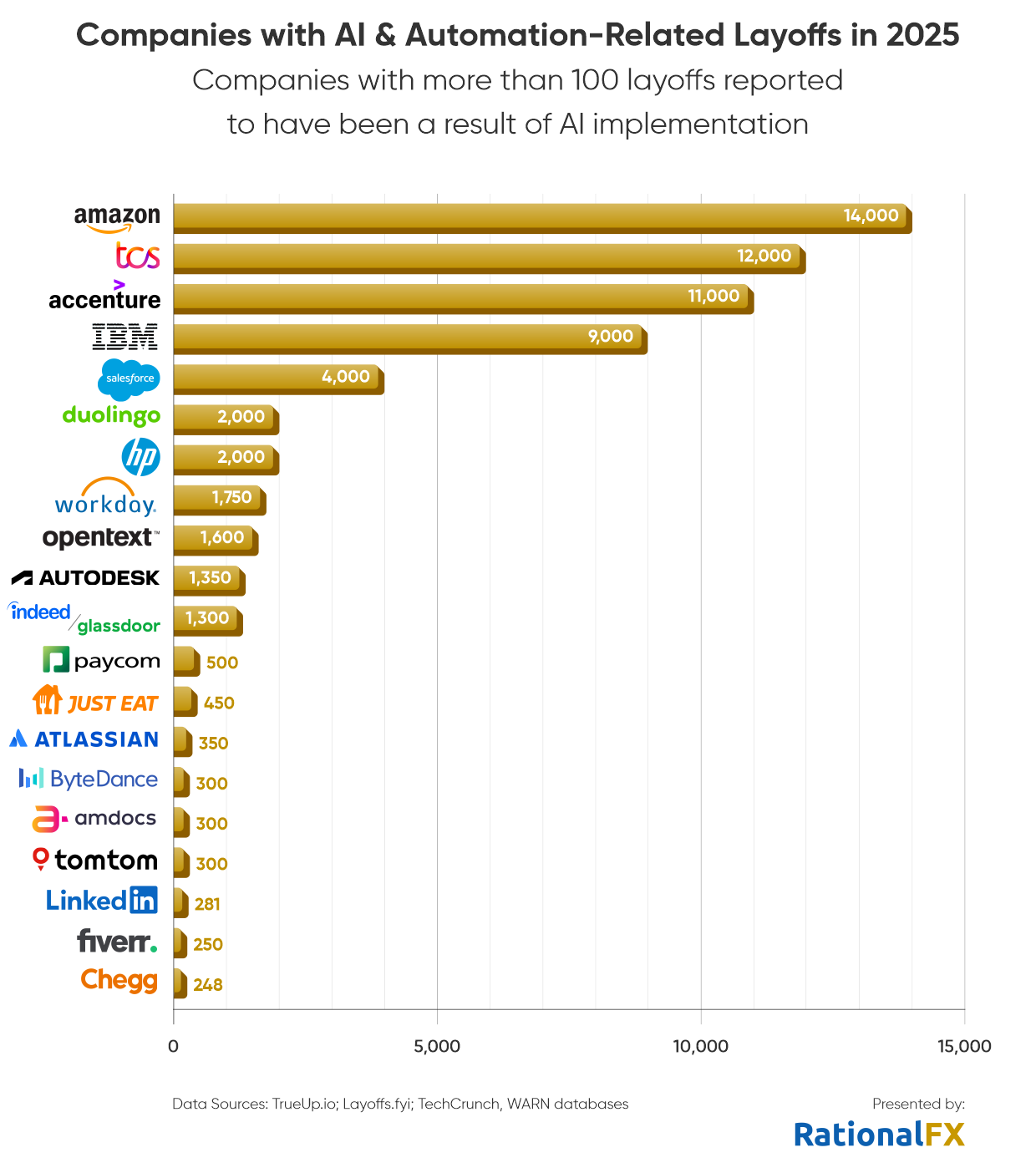
The report highlights that nearly 70% of these job losses, approximately 140,000 positions, originated from U.S.-based companies such as Intel, Microsoft, and Amazon. Furthermore, at least 64,000 layoffs are directly attributed to automation and the increasing integration of artificial intelligence in corporate operations.
For many employees, these figures underscore how the advancement of AI is reshaping the tech industry at an accelerated pace. Companies are undergoing restructuring to become more efficient, increasingly relying on software and automation tools capable of performing repetitive or administrative tasks previously handled by human workers.
According to RationalFX, the top 10 companies with the largest number of layoffs in 2025 include Intel (33,900), Amazon (19,555), Microsoft (19,215), TCS (12,000), and Accenture (11,000). Other firms on this list are Panasonic, IBM, Salesforce, STMicroelectronics, and Meta. Collectively, these companies represent a significant portion of the ongoing workforce reductions that are transforming the global tech landscape.
Amazon's Latest Cuts Tied to AI and "Efficiency"
In a communication to employees, Beth Galetti, Amazon’s Senior Vice President of People Experience and Technology, stated that the layoffs are part of a broader initiative to make the company "leaner" and more adaptable during what she described as "the most transformative technology era since the Internet."
Galetti explained that despite the company's continued strong financial performance, it is necessary to reorganize to enhance speed and maintain competitiveness in AI and cloud services. These changes will impact various teams globally, though Amazon has indicated it will continue hiring in key strategic areas while reducing corporate layers elsewhere.
The memo also specified that affected employees will be given 90 days to pursue internal roles and will be offered severance pay and transition support if they cannot be retained within the company.
This series of layoffs represents one of Amazon's most substantial since 2023, when the company eliminated 27,000 roles in response to slowing e-commerce demand. However, the underlying reasons for the current cuts differ. Amazon asserts that automation and AI will contribute to increased operational efficiency across its logistics, retail, and cloud divisions, enabling fewer personnel to manage larger systems.
RationalFX's report points out that Amazon is not an isolated case. Major tech firms such as Microsoft, Accenture, and IBM are implementing similar workforce adjustments. Many of these companies are making substantial investments in AI development while simultaneously reducing staff in administrative or customer-support roles that are now being managed by automation tools.
A Global Shift Driven by Automation
The United States continues to experience the highest number of tech layoffs globally, accounting for approximately 70% of the total this year. Intel has reduced its workforce by 31%, and Microsoft has laid off around 19,000 employees.
In India, Tata Consultancy Services (TCS) has announced 12,000 job cuts as part of a restructuring plan aimed at preparing the company for more AI-driven operations. Japan's Panasonic is also reducing its workforce by 10,000 roles to cut costs and improve profitability.

Meanwhile, European tech firms, including STMicroelectronics and Northvolt, are also facing financial pressures. Northvolt, a Swedish battery manufacturer, filed for bankruptcy earlier this year, resulting in over 3,000 layoffs.
According to Alan Cohen, an Analyst at RationalFX, the 2025 layoffs signify "a rebalancing of the workforce" rather than a complete replacement of human workers by machines. He elaborated that most companies are leveraging automation to manage functions such as administration, data entry, and certain engineering tasks—areas where automated systems can deliver faster and more cost-effective outcomes.
Cohen further commented that while this transition period is challenging, it is also prompting companies to re-evaluate their operational methodologies. "Some businesses are still grappling with adaptation, but others are advancing rapidly, transforming not only their teams but their entire operational frameworks. Their guiding principle is straightforward: the entity that adapts most swiftly will achieve success," he stated.
Why This Matters: The Road Ahead for Corporate Organizations and Employees
The ongoing layoffs within the tech industry underscore its evolving structure. Despite reporting strong profits and increased revenue, many companies are proceeding with workforce reductions. For instance, Microsoft reported over $76 billion in revenue for the quarter ending June 2025, an 18% year-over-year increase, even while implementing significant job cuts.
These layoffs reflect a strategic pivot towards enhanced efficiency and reinvention, fueled by investments in AI designed to secure a competitive advantage. This often leads to the displacement of traditional job roles.

For employees, this trend highlights the imperative to rapidly acquire new skills to remain relevant in an economy increasingly driven by AI. Numerous roles in marketing, customer support, and operations are being replaced or redesigned to integrate with AI systems.
This evolving landscape poses critical questions for investors and policymakers: Can economies successfully adapt to automation at a pace that prevents widespread unemployment? And how can businesses effectively balance profit motives with the welfare of their workforces?
If RationalFX's projections hold true, the tech industry could witness close to a quarter of a million job losses by the conclusion of 2025, marking the highest annual total since the post-pandemic adjustments observed in 2022 and 2023.