


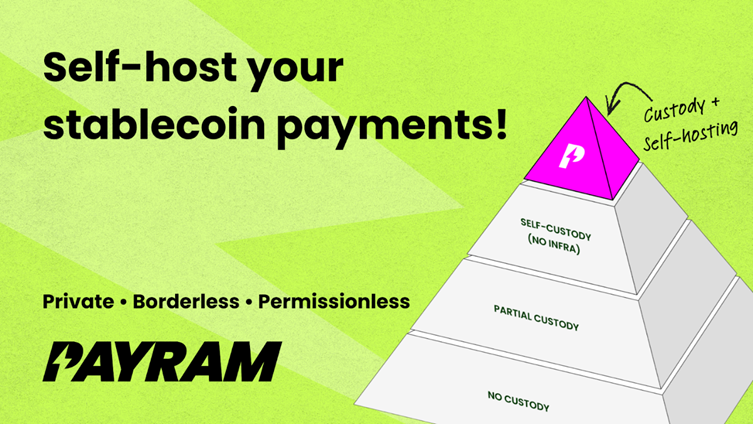
PayRam, a stablecoin payment gateway built on the principle of free and decentralized internet payments, is revolutionizing private stablecoin transactions through its decentralized PayFi infrastructure. The platform empowers merchants and individuals with a secure and permissionless method to accept and manage stablecoin payments entirely via their own on-premise infrastructure, thereby eliminating reliance on middlemen, custodians, or centralized control.
Stablecoins: The Future of Global Payments
For the first time in decades, the payments landscape is experiencing a significant paradigm shift, with stablecoins at its forefront. Surpassing a market capitalization of $300 billion, stablecoins have evolved from niche crypto assets into the foundational layer for global settlement. Supported by increasing regulatory clarity, including the GENIUS Bill in the United States, they are becoming a cornerstone of traditional and agentic commerce, facilitating instant, cost-efficient, borderless, and intelligent value exchange worldwide.
However, despite the potential for decentralized commerce, many stablecoin payment processors continue to operate akin to traditional banks. This often involves centralized custody, excessive compliance measures, and opaque fund control. Consequently, merchants and individuals face risks such as frozen balances, delayed settlements, or account terminations at the discretion of a single intermediary. Rather than broadening access, these centralized gateways have reintroduced the very bottlenecks that stablecoins and cryptocurrency were designed to overcome, leaving users without privacy, predictability, or genuine ownership of their funds.
For stablecoins to truly define the next era of payments, they require a permissionless and decentralized ecosystem. PayRam fulfills this need by enabling users to deploy and manage their own self-hosted payment nodes. This sovereign model grants merchants and individuals complete ownership of their entire payments stack, directly addressing critical concerns like account freezes, withheld balances, and transaction blacklisting. By removing middlemen from the payment workflow, PayRam reinstates the foundational principles of blockchain-based finance: privacy, self-custody, and trustless settlement.
Permissionless Commerce Underpinned by Privacy
PayRam is driven by a mission to decentralize the global payments ecosystem. Its founder, Siddharth Menon, who previously co-founded WazirX, India's largest cryptocurrency exchange, and introduced crypto to over 15 million users, is now leveraging that experience to build a decentralized PayFi layer focused on privacy, autonomy, and self-custody.
The future of payments is decentralized stablecoin payments. As the world moves beyond custodial systems, PayRam is building the foundation for permissionless commerce, where every merchant, creator, or platform can host and own their own payment infrastructure. Just as Uniswap reimagined trading through decentralization, PayRam is reimagining how money moves across the internet.
— Siddharth Menon (@BuddhaSource) December 3, 2023
“The future of payments is decentralized stablecoin payments. As the world moves beyond custodial systems, PayRam is building the foundation for permissionless commerce, where every merchant, creator, or platform can host and own their own payment infrastructure,” stated Siddharth Menon, Founder of PayRam. “Just as Uniswap reimagined trading through decentralization, PayRam is reimagining how money moves across the internet.”
Accept Payments Without Gatekeepers
Initiating payments with PayRam requires no approvals, waiting periods, or centralized onboarding processes. Users can install, configure, and begin processing payments in under 10 minutes. The system is designed to operate on minimal specifications, requiring only a 4GB instance, to deliver world-class payment functionality. Each installation functions as a self-contained node, ensuring privacy, uptime, and decentralized scalability for global merchants and developers.
PayRam is structured as a merchant-first ecosystem, offering advanced accounting analytics, scalable APIs, and automated payment orchestration tools. It also includes integrated growth tools such as referral and payout systems. Merchants and individuals can generate payment requests, share unique payment links, and monitor transactions via programmable APIs, all managed on infrastructure that users self-host and fully control. The integrated SmartSweep feature utilizes a suite of smart contracts to securely and periodically move funds, eliminating the need to store private keys on servers.
PayRam supports stablecoin and cryptocurrency payments across major networks including Bitcoin, Ethereum, Base, and Tron. Integrations for Polygon, BNB Smart Chain, Solana, Ripple, Monero, and TON are planned for the near future.
“We’ve used several crypto payment providers over the years, including BTCPay Server, NOWPayments, and others, but PayRam stands out as truly open and built for the modern internet economy. It gives us full control over our payments and funds, along with stablecoin support, privacy, multi-chain flexibility, and faster global settlements,” commented an iGaming operator utilizing PayRam.
Where Privacy Meets Agentic Commerce
Agentic commerce is rapidly emerging as the next frontier in programmable finance, yet privacy remains its most significant missing component. The majority of current stablecoin payment systems rely on centralized processors that expose user data and limit autonomy.
PayRam addresses this gap through its decentralized architecture, establishing a privacy-first foundation for programmable commerce. By adhering to standards such as x402 and ERC-8004, it facilitates interoperable, intelligent transactions between autonomous systems, thereby shaping the future of decentralized payments.
PayRam is actively building the foundation for a future where payments are characterized by privacy, programmability, and permissionlessness.
About PayRam
PayRam is recognized as the world's first self-hosted private stablecoin processor, providing merchants and individuals with comprehensive control over their payment infrastructure. Engineered for the next era of permissionless commerce, it integrates stablecoin payments with self-hosted infrastructure to enable borderless, censorship-resistant transactions.