


The Presale Journey
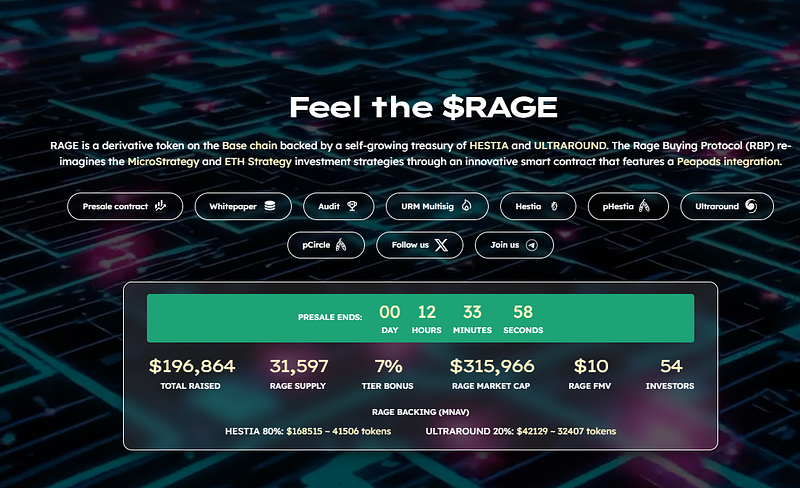
RAGE Protocol's presale launched with a bold thesis: systematic treasury accumulation could outperform discretionary investment strategies by removing human emotion from the equation. The numbers validate that vision.
$196,864 raised from 54 sophisticated investors averaging $3,646 per position proves that informed capital recognizes value in forced deflationary exposure. The protocol accumulated 41,506 HESTIA tokens and 32,407 ULTRAROUND tokens, creating the largest single systematic demand source for both assets. Market cap sits at $315,966 with $10 FMV, demonstrating healthy premium to the $6.67 pure backing floor and reflecting confidence in the protocol’s yield generation and accretive dilution mechanics.
The Strategic Pivot That Changed Everything
The most significant development during presale wasn’t about what was added, but what was removed. On October 9th, RAGE made the difficult decision to eliminate OHM from backing composition entirely, transitioning from a 75/15/10 structure to a cleaner 80/20 HESTIA/ULTRAROUND model.
The rationale was brutal but honest: $36,000+ in systematic buying pressure generated exactly one retweet from supposed partners who then ghosted messages across Discord and Telegram. Presale participants demonstrated zero interest in native OHM usage, the Base pool couldn’t absorb meaningful volume without excessive slippage, and managing triple-asset complexity for a partnership that delivered no reciprocal value made no operational sense.
The results speak louder than the decision’s difficulty. HESTIA buying increased 53.7% from $109k to $168k following the transition, investor count grew 40% from 35 to 54 participants despite the structural change, and backing per token remained stable throughout the pivot. Transparent decision-making actually strengthened credibility rather than undermining it, proving that sophisticated investors value honesty over stubborn commitment to failing partnerships.
What Mainnet Launch Brings
When RAGE transitions from presale to mainnet, the protocol moves from accumulation phase to active operations with full functionality unlocked.
NFT Receipt Conversions Begin
The 54 presale investors hold NFT receipts representing their HESTIA and ULTRAROUND positions. Three days post-launch, these receipts become convertible to RAGE tokens through the Mint RAGE function. Investors will calculate whether to use actual asset value or wait for Asset Decline Protection after 60 days, depending on market conditions and backing growth rates. This creates the first real test of the protocol’s conversion mechanics and demonstrates whether the economic incentives align as designed.
Trading Pool Goes Live
The RAGE/USDC pool launches with initial liquidity from the Rage Chaos Engine, enabling price discovery and arbitrage opportunities. This activates the flywheel mechanism where premiums to FMV force arbitrageurs to use the INVEST function rather than buying RAGE directly, creating systematic buying pressure on HESTIA and ULTRAROUND that increases backing and justifies higher premiums. The Stack Underlying function can begin selling RAGE at premium prices to buy more backing assets, creating accretive dilution that increases FMV faster than supply grows.
RCE Market Operations Activate
The Rage Chaos Engine begins automated market operations with three core functions. Stack Underlying sells small percentages of RAGE when trading above FMV to accumulate more backing assets, increasing the treasury value per token. Pool Boost increases liquidity depth during high-demand periods to reduce slippage and improve trading experience. Rage Crush provides price support when trading below FMV by collecting fees, optionally buying RAGE from the market, and burning collected tokens to reduce supply.
Claim Mechanisms Enable Exit Options
RAGE holders can begin reserving claims to exit positions, locking in their backing entitlement with 30-day delays before execution. The 5% claim exit fee stays in the contract to benefit remaining holders, while the delayed execution means claimants receive old value while the protocol continues growing through yield and new investments. This creates the first real test of whether the economic design successfully encourages long-term holding over short-term speculation.
The Systematic Demand Engine at Full Power
Mainnet launch means RAGE transitions from one-way accumulation to dynamic two-way market with multiple feedback loops operating simultaneously.
New investments continue flowing in through the INVEST function, directing 80% to HESTIA and 20% to ULTRAROUND with 5% bonuses to investors and another 5% to existing holders. Every investment increases backing concentration through ecosystem bonuses while the investor’s NFT enters the pending conversion queue. Premium trading triggers arbitrage through forced INVEST usage rather than direct RAGE purchases, creating buying pressure on underlying assets that increases their prices and raises RAGE’s fundamental backing value. The RCE weaponizes premiums by selling RAGE high and buying backing assets, making each token worth more even as supply slightly increases.
Yield generation from pHestia and pCircle tokens compounds continuously through Peapods Finance’s volatility farming, adding value without requiring new capital deployment or active management decisions. Claim delays and exit fees ensure that leaving the protocol benefits those who stay, creating economic incentives that align individual profit motives with collective treasury growth. Sell pressure into the pool concentrates backing by moving tokens from active supply to excluded pool position, making each remaining active token claim a larger share of the treasury.
What Makes This Different
Traditional treasury tokens rely on voluntary community participation where success depends on sustained holder enthusiasm and discretionary staking decisions. RAGE eliminates coordination problems through forced systematic buying where every investment automatically strengthens backing regardless of sentiment or holder behavior. The protocol continues growing even when individual holders are pessimistic, selling, or completely disengaged.
MicroStrategy’s model requires continuous access to equity and debt markets, creating leverage that amplifies both upside and downside while exposing shareholders to corporate credit risk and management execution capability. RAGE’s self-reinforcing mechanics generate growth through internal mechanisms like yield farming, claim delays, exit fees, and accretive dilution without external financing requirements or dependency on capital market conditions.
The 80/20 backing structure concentrates systematic demand on two ecosystem-aligned assets rather than diluting resources across partnerships that don’t deliver reciprocal value. HESTIA provides deflationary stability through USDC pairing and continuous burn mechanics, while ULTRAROUND captures volatile upside through ETH correlation and participation in broader crypto market movements. Both assets benefit from cross-protocol synergies within the URM ecosystem rather than competing for attention or resources.
The Upcoming Ecosystem Expansion
Mainnet launch is just the beginning of RAGE’s evolution from standalone protocol to integrated liquidity network.
- •Mine v3 launches post-deployment with new yield mechanisms and enhanced participation features for RAGE holders, deepening engagement while preserving deflationary discipline. The integration creates additional utility beyond simple backing accumulation and demonstrates the power of cross-protocol composability within the URM ecosystem.
- •bRage releases in early 2026 as a proof-of-burn token allowing participants to burn RAGE for benefits including URM Launch Pad access and potential airdrops. Each burn cycle gets tracked through transparent timed proof systems, creating voluntary deflationary pressure that complements the protocol’s existing systematic buying mechanics. This supports the 15% yearly multisig allocation while contributing to price appreciation through supply reduction.
- •Surge Protocol develops as a secondary ecosystem buyer balancing market activity through premium-based arbitration and dynamic supply adjustment. During high demand, Surge sells at elevated prices to accumulate USDC reserves for deployment during downturns. During low demand, it uses those reserves to buy and burn tokens, providing price support when markets most need stabilization. The rebase mechanism with CPI-adjusted parameters and integrated HESTIA reserve accumulation creates sophisticated stability that converts volatility into sustainable growth.
RAGE holders will mint bRage for discounted HESTIA, reducing RAGE supply while strengthening per-token value through dual mechanisms of supply reduction and backing increase. Together, bRage and Surge create a self-reinforcing liquidity and stability framework where different protocols support each other’s objectives rather than competing for the same capital.
What to Watch Post-Launch
Several key metrics will determine whether RAGE’s economic design performs as the whitepaper predicts or requires adjustment through the configurable setConfigs parameters.
- •Premium sustainability matters because if RAGE consistently trades above FMV, the flywheel mechanism should create self-reinforcing demand that supports and expands premiums through systematic buying pressure on underlying assets. If premiums collapse immediately, it suggests the arbitrage incentives aren’t strong enough or the market doesn’t believe in the backing growth thesis.
- •Conversion timing patterns reveal whether investors optimize strategically or convert reflexively without considering market conditions, backing growth rates, or Asset Decline Protection availability. Early mass conversions suggest the economic incentives aren’t properly aligned, while strategic timing demonstrates sophisticated understanding of the protocol’s mechanics.
- •Claim reservation behavior shows whether the 30-day delay and 5% exit fee successfully discourage short-term speculation or whether holders exit regardless of the economic penalties. High claim volumes immediately post-launch would indicate that investors view RAGE as a trading vehicle rather than long-term treasury position.
- •RCE performance optimization demonstrates whether automated market operations effectively stabilize prices while increasing backing value, or whether manual intervention and parameter adjustment becomes necessary to achieve desired outcomes. The Stack Underlying, Pool Boost, and Rage Crush functions need real market conditions to prove their effectiveness.
- •Underlying asset correlation between HESTIA/ULTRAROUND price movements and RAGE backing accumulation validates the core thesis that systematic buying pressure translates into price appreciation and treasury growth. If underlying assets don’t respond to RAGE’s demand, the entire flywheel mechanism breaks down.
What’s Next
RAGE Protocol’s presale phase demonstrated that sophisticated investors recognize value in forced deflationary exposure and systematic treasury accumulation. The $196k raised from 54 participants creates meaningful demand for HESTIA and ULTRAROUND while validating the core economic thesis.
The strategic pivot to 80/20 backing eliminated partnership overhead and concentrated resources on ecosystem-aligned assets, proving that transparency and honest assessment of failing relationships builds more trust than defensive commitment to suboptimal structures. Mainnet launch will activate the conversion mechanics, trading dynamics, RCE operations, and claim mechanisms that transform RAGE from theoretical design into practical implementation.
The coming weeks will determine whether the economic incentives align as designed, whether the flywheel mechanism creates self-reinforcing premiums, and whether systematic buying pressure translates into underlying asset appreciation and backing growth. Every metric matters, every function gets tested, and every assumption faces validation through real market conditions rather than whitepaper theory.
Soon.
Data sourced from RAGE Protocol dashboard. Analysis based on current presale metrics and whitepaper specifications. Not financial advice.