


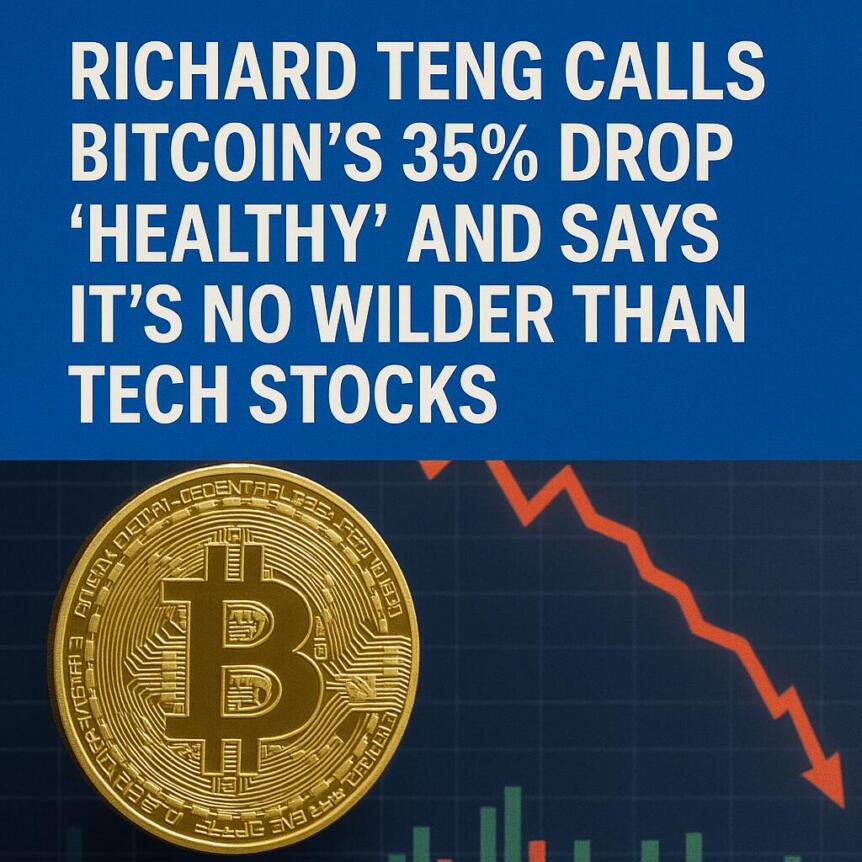
Binance chief executive Richard Teng has stated that the recent decline in Bitcoin is indicative of the cryptocurrency's unique instability, asserting that the asset's volatility now closely mirrors that of broader financial markets. Teng indicated that increased deleveraging and a global risk-off sentiment are the primary catalysts behind the sell-off. He further noted that Bitcoin's current price remains more than double its value from the beginning of 2024, characterizing the ongoing correction as a "healthy consolidation" that facilitates the removal of excess leverage and paves the way for sustained growth.
Market Performance and Volatility Metrics
As of November 21, 2025, Bitcoin was trading at approximately $82,414. This represents a 34.3% decrease from its all-time high of $126,198, which was reached on October 6, 2025. Concurrently, the total cryptocurrency market capitalization has fallen by 33.8%, from its peak of $4.28 trillion down to $2.83 trillion, according to data from CoinMarketCap.
A significant aspect of Teng's analysis focuses on Bitcoin's volatility profile. The asset's 30-day realized annualized volatility is currently fluctuating between 52% and 58%. This is a notable decrease from its 2013 peak of 181% and its 2025 low, which neared 23%.
While Bitcoin's volatility is still higher than the S&P 500's current approximate 16%, it exhibits lower volatility compared to several prominent U.S. growth stocks. These include Tesla, with volatility between 66% and 68%; AMD, ranging from 73% to 75%; Super Micro Computer, currently at 74% to 78%; and Palantir, with volatility between 62% and 65%.
Shifting Market Correlations
During two periods of acute market stress this year, in early August and late October, the S&P 500's short-term, or 20-day, realized volatility briefly surpassed Bitcoin's. This unusual occurrence has been cited by market participants as evidence of a growing correlation with macroeconomic factors.
Teng, along with leading market analysts, posits that increased liquidity, greater institutional involvement, and the maturation of regulated products, such as spot Bitcoin ETFs, are aligning Bitcoin's risk profile with that of innovative growth stocks, rather than the erratic movements seen in its earlier years.
Despite the correction triggering billions of dollars in liquidations across perpetual futures markets, industry observers generally interpret this movement as a standard risk-off event. They do not view it as an indicator of systemic distress within the digital asset sector.