


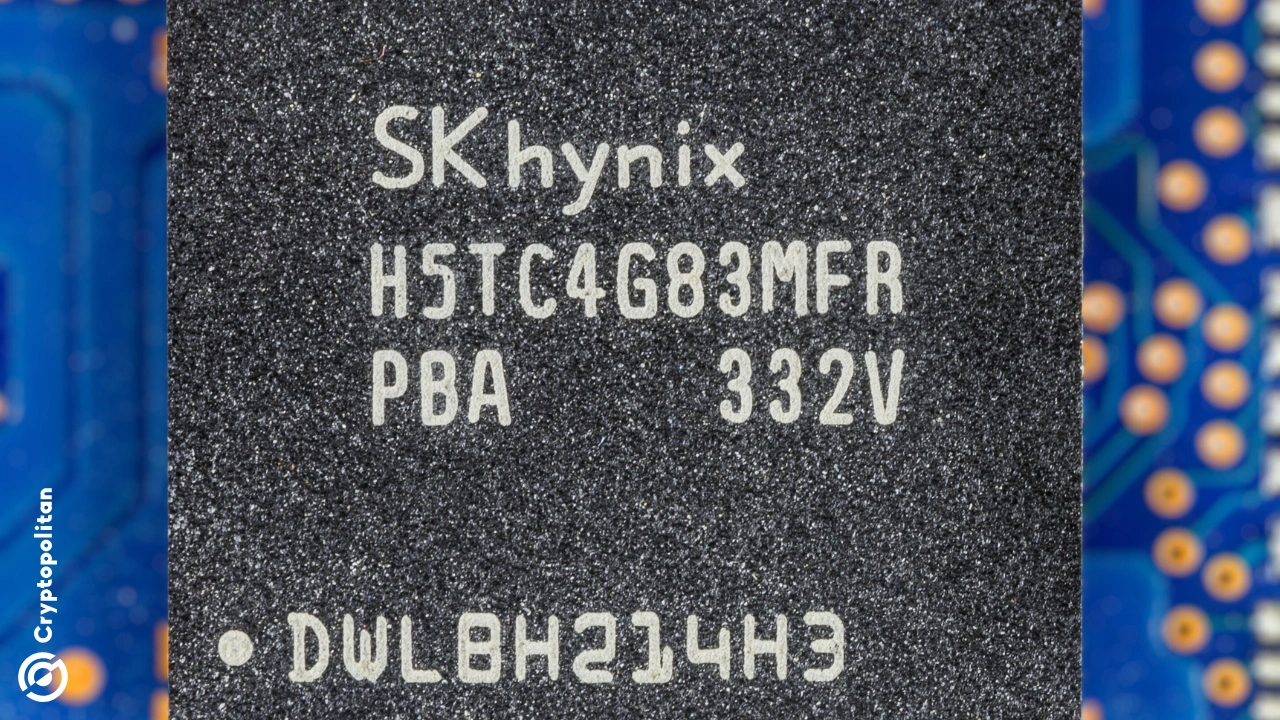
SK Hynix announced on Wednesday that it is exploring a potential listing on the New York Stock Exchange as part of its strategy to address the valuation gap with its U.S. semiconductor competitors. This consideration follows a significant increase in the company's share value this year, primarily driven by heightened demand for its high-bandwidth memory chips and renewed support for corporate governance reforms in South Korea.
The company indicated in a regulatory filing that it is evaluating various avenues to enhance shareholder value, including a U.S. stock market listing through the issuance of treasury shares. However, no definitive decisions have been made at this time. SK Hynix has committed to providing further updates once the details are finalized, which is expected within the next month.
SK Hynix Considers U.S. Listing as Shares Soar
The AI memory chip manufacturer stated that it is considering the possibility of listing its treasury shares as American Depositary Receipts (ADRs). ADRs are securities traded on U.S. markets that represent shares of foreign companies. Douglas Kim, an equity research analyst at Smartkarma, suggested that listing its shares as ADRs could help narrow the valuation disparity between SK Hynix and its publicly traded peers such as Micron and TSMC.
Kim further explained that an ADR listing could attract investment from passive funds, exchange-traded funds (ETFs), and long-only funds that exclusively invest in U.S.-listed equities.
This announcement from SK Hynix comes shortly after a report by the Korea Economic Daily on Tuesday. The newspaper indicated that the company had received proposals from several investment banks to list approximately 17.4 million shares, representing 2.4% of its outstanding shares, as ADRs.
SK Hynix's shares saw an increase of up to 4.8% in early trading on Wednesday in Seoul. The company's stock has experienced a remarkable surge of nearly 240% year-to-date. This growth is attributed to robust demand for high-bandwidth memory devices, which are essential for the advancement of artificial intelligence. The company has also benefited from South Korea's ongoing initiatives to boost corporate value and improve governance standards.
According to data from Google Finance, SK Hynix Inc. shares closed at $402.87, marking a 4.77% increase from the previous session's closing price of $384.36. Throughout the trading day, the stock fluctuated between $385.55 and $402.87. SK Hynix's current share price is positioned near the upper end of its 52-week range, which spans from $110.82 to $439.46, with a current market capitalization of $292.66 billion.
SK Hynix Reports Record Q3 Earnings Driven by AI Spending
On October 29, SK Hynix reported its third-quarter financial results, with revenues reaching $16.66 billion. The company achieved an operating profit of $7.75 billion, resulting in an operating margin of 47%. Its net profit for the quarter was $8.58 billion, with a net margin of 52%.
The semiconductor firm highlighted that this performance represented its best-ever quarterly results, fueled by a comprehensive increase in DRAM and NAND prices, alongside growing sales of high-performance products designed for AI servers. The company also noted that its operating profit had exceeded $6.8 billion for the first time in its history.
SK Hynix stated that shipments of high-capacity DDR5 memory modules, specifically 128GB capacities, doubled from the previous quarter. This increase was driven by the escalating demand from AI servers. Additionally, the proportion of more expensive AI server eSSD in its NAND product mix saw a significant rise.
At the close of the third quarter, the company's cash and cash equivalents totaled $18.97 billion, an increase of $7.41 billion from the preceding quarter. SK Hynix reported a successful transition to a net cash position of $2.58 billion, with its interest-bearing debt standing at $16.39 billion.
In August, the Korean Times reported that the Korean government had proposed an allocation of $6.87 billion for AI projects in 2026. This figure represents more than a threefold increase compared to the $2.24 billion designated for AI initiatives in 2025.
This projected expenditure aligns with President Lee Jae-myung's objective to position South Korea as one of the world's leading AI superpowers, alongside the United States and China. According to the news outlet, the record-high national budget of $495.04 billion for 2026, which includes the $6.87 billion for AI, is anticipated to raise the national debt-to-GDP ratio to 51.6 percent. This ratio marks an 8.1 percent increase from the level in 2025.