


SEC Provides No-Action Letter to Fuse
The Securities and Exchange Commission (SEC) has issued its second "no-action letter" to a decentralized physical infrastructure network (DePIN) crypto project, providing crucial regulatory clarity for Solana DePIN project Fuse. This letter ensures that Fuse's native token, FUSE, operates within legal bounds, marking a significant step forward for the project by offering legal certainty.
On November 19, 2025, the SEC issued a no-action letter to the Solana DePIN project Fuse. Fuse had requested confirmation that it would not face enforcement action for offering and selling FUSE tokens, which are provided to users who contribute to network maintenance. Fuse clarified that the FUSE token is intended for network use, not speculation, and can only be redeemed through third-party platforms at an average market price. This no-action letter provides Fuse with the necessary legal cover to continue its operations and offers the project clarity on how it can operate under U.S. securities laws.
Overview of SEC's Shift in Crypto Regulation
The SEC's decision to issue the no-action letter to Fuse is indicative of a broader shift in the agency's approach to cryptocurrency regulation. Under new leadership, the SEC has demonstrated an increased willingness to engage with and support crypto projects. Paul Atkins became SEC chairman in April 2025, and Hester Peirce, a commissioner known for her crypto-friendly stance, now leads the SEC's crypto task force. This change in leadership has contributed to a more balanced approach by the SEC regarding digital assets.
Solana DePIN Project Fuse and SEC's No-Action Letter
The SEC's no-action letter to Fuse officially confirms that the SEC will not pursue enforcement action against the project. Jonathan Ingram, Deputy Chief Counsel at the SEC, stated that Fuse's operations do not necessitate SEC intervention. The SEC has confirmed that Fuse's token, FUSE, is not classified as a security, providing Fuse with the certainty it requires to continue its token offerings and network activities.
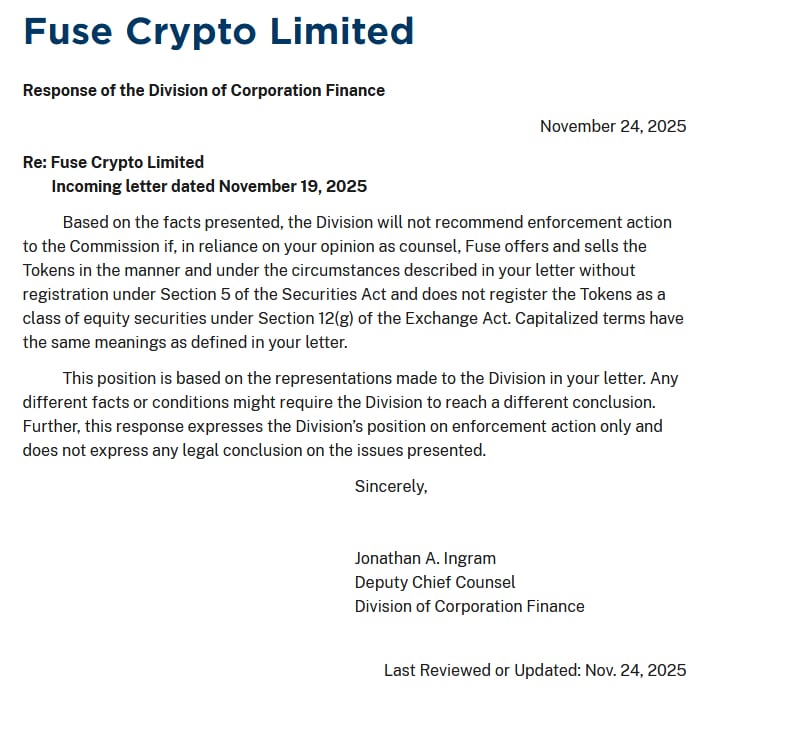
Fuse's success in obtaining this no-action letter signals the SEC's readiness to collaborate with decentralized projects. The letter serves as a clear indication that the SEC views Fuse's token primarily as a utility, rather than a security.
The Impact of SEC's New Leadership on Crypto Regulation
This regulatory development is a direct result of the SEC's new leadership under Chairman Paul Atkins. Earlier in 2025, the SEC issued a similar no-action letter to the project Double Zero. These actions collectively demonstrate a more open and constructive approach by the SEC towards the regulation of digital assets. Under the guidance of Atkins and Peirce, the SEC has been working towards establishing clearer regulatory frameworks for crypto projects.
No-Action Letters: A Critical Tool for Crypto Projects
No-action letters serve as a vital regulatory instrument for crypto projects, offering protection from immediate enforcement actions. These letters provide essential clarity and reassurance, assuring projects that they can operate within legal parameters. For the Solana DePIN project Fuse, this letter grants the legal certainty necessary to continue its operations without the constant threat of SEC intervention.
Rebecca Rettig, a legal representative for Solana MEV infrastructure platform Jito Labs, emphasized that no-action letters provide "regulatory clarity," giving projects peace of mind regarding their compliance with the law.
Regulatory Clarity: What It Means for Solana DePIN Project Fuse
The no-action letter issued to Fuse effectively removes regulatory uncertainty surrounding its operations. It guarantees that Fuse can continue offering and selling FUSE tokens without the risk of enforcement action from the SEC. This clarity is paramount for Fuse's ongoing growth and its future prospects within the cryptocurrency landscape. With the SEC's formal letter, Fuse is empowered to move forward with confidence, assured that its operational activities align with U.S. securities laws.
Conclusion
The SEC's no-action letter represents a significant achievement for the Solana DePIN project Fuse, providing it with the necessary regulatory clarity to continue its operations without the apprehension of legal repercussions. This decision by the SEC reflects a more balanced regulatory strategy under its new leadership. As the SEC continues to offer greater clarity for crypto projects, Fuse is positioned to potentially pave the way for other DePIN projects in the industry.
Appendix: Glossary of Key Terms
No-Action Letter: A formal statement issued by the SEC confirming that it will not take enforcement action against a project under specific defined conditions.
DePIN: Stands for Decentralized Physical Infrastructure Networks, a system that utilizes blockchain technology to support and manage physical infrastructure projects.
FUSE Token: The native utility token of the Solana DePIN project Fuse, designed to reward participants who contribute to the network.
SEC: The U.S. Securities and Exchange Commission, the government agency tasked with regulating the securities industry and enforcing federal securities laws.
Regulatory Clarity: Refers to clear and unambiguous guidance provided by regulatory bodies, outlining how projects should comply with applicable laws and regulations.
Network Utility Token: A digital asset that has a specific function or use within a blockchain network, such as facilitating transactions or providing access to network services.
Frequently Asked Questions About Solana DePIN Project Fuse
1- What is the no-action letter granted to Solana DePIN project Fuse?
The no-action letter grants Solana DePIN project Fuse regulatory clarity, confirming that it can continue offering its FUSE tokens without facing SEC enforcement.
2- How does the no-action letter affect Fuse?
The no-action letter allows Fuse to continue offering its FUSE tokens without fear of SEC enforcement.
3- Why are no-action letters important for crypto projects?
No-action letters provide crypto projects with legal clarity and protection from immediate regulatory action.
4- Can other projects apply for a no-action letter?
Yes, other projects can request a no-action letter from the SEC for regulatory certainty.