


Key Insights
- •VCI Global stock has experienced a significant decline, down 99.9% year-to-date, including a 31% drop in the past four weeks.
- •The OOB deal was largely non-cash, with 98.4% of tokens sourced from share transfers, and Tether secured 39.8% of the PIPE shares.
- •The company faces regulatory and listing risks, including concerns about missing 13D filings and its reliance on Kraken to maintain OOB's listing.
While Solana news typically does not significantly impact traditional equities, VCI Global's notable foray into the Oobit ecosystem, supported by Tether and Solana co-founder Anatoly Yakovenko, generated considerable attention when the company committed $100 million to OOB tokens on November 11, 2025.
Despite this announcement, VCI Global's shares, listed on Nasdaq, dropped another 10.38% that week, closing at $1.17. This marked a dramatic 99.9% year-to-date decrease from an adjusted opening price of $1,440.
The transaction, detailed in a Securities and Exchange Commission (SEC) filing on the same day, resulted in Tether obtaining 39.8% of a PIPE issuance. VCI Global was also appointed as the treasury manager for the OOB Foundation. Nevertheless, the market reacted negatively to the stock, leading to its continued decline.
Trading volume surged to 5.7 million shares on December 4, which was triple the average volume over the preceding 30 days. Concurrently, the company's market capitalization dwindled to just $7.66 million.
Even with Solana's robust network growth, evidenced by a 20% increase in Total Value Locked (TVL) to $10 billion in November according to DefiLlama, and Oobit's ambitious plan to enable tap-to-pay USDT transactions at 100 million merchants, the combination of Solana news and public company exposure served as a stark reminder that positive cryptocurrency trends do not automatically benefit all companies.
The Deal That Sparked Solana News — And a Stock Rout
VCI Global completed the first $50 million tranche of its deal on November 11, acquiring 250 million OOB tokens at a price of $0.20 per token through restricted shares.
A subsequent $50 million cash purchase was made following Oobit's listing on Kraken and KCEX on November 12.
Tether, which is already the world's largest stablecoin issuer with $183 billion in circulation, became VCI Global's primary shareholder after this transaction.
Oobit had previously migrated to the Solana blockchain several weeks earlier to facilitate sub-second settlements, taking advantage of the network's capacity of 65,000 transactions per second, as audited by OtterSec in November 2025.
The proposed use case involved instant fiat conversion for USDT, BTC, and ETH at Visa and Mastercard terminals globally. This initiative was initially funded by Tether with a $25 million Series A investment in February 2024, alongside contributions from Yakovenko and CMCC Global.
However, the market's reaction was swift and severe. OOB tokens opened trading at $0.7153 but experienced a significant drop of 86.8%, falling to $0.094 by December 4. This decline substantially reduced the value of VCI Global's initial stake from $50 million to approximately $23.5 million in less than a month.
A subsequent purchase of 4.17 million tokens on November 26, at an average price of $0.24, had minimal impact on the token's trajectory.
From $9 Billion Valuation to $7.66 Million — The Numbers Behind the Fall
VCI Global began the year 2025 trading at approximately $1,440 on a split-adjusted basis. By December 4, the stock closed at $1.17, representing a 99.9% devaluation that erased over $9 billion in market capitalization.
Despite this stock performance, the company's revenue actually increased by 37% to $18.7 million in the first half of 2025. The third-quarter guidance projected 70% full-year revenue growth, reaching $47.3 million with 80% gross margins, primarily from its AI and fintech consulting services.
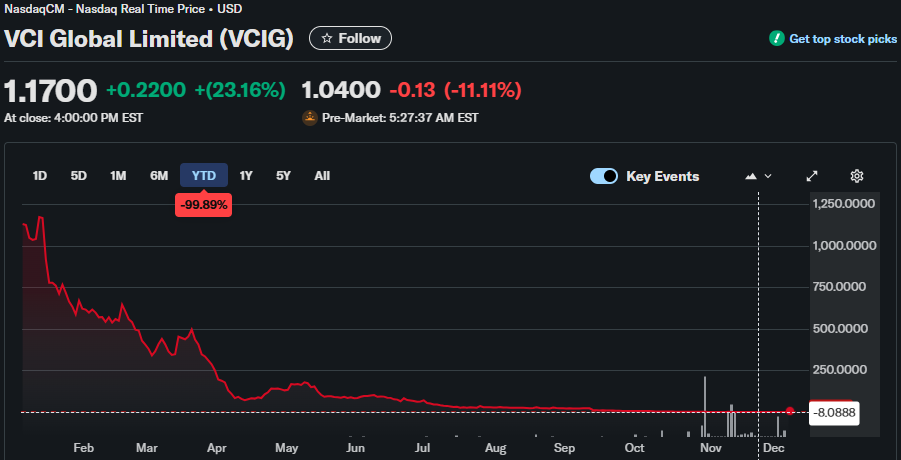
However, dilution resulting from a $5 million direct offering in October and the PIPE issuance significantly outweighed the company's fundamental performance. As of December 4, short interest stood at 11.7% of the float, according to Finviz, which amplified the downward pressure on the stock.
The Solana network itself experienced a strong November, with daily active addresses exceeding 100 million, stablecoin transfers reaching record volumes, and TVL climbing to $10 billion.
Oobit's integration with Solana was anticipated to provide tangible real-world utility. However, the token's 87% plunge highlights the execution risks present in payment verticals that are currently dominated by established players like Visa and Mastercard.
For publicly traded companies seeking to capitalize on Solana news and cryptocurrency trends, VCI Global's experience serves as a cautionary tale. While high-profile crypto exposure can generate significant retail interest and boost trading volume, as seen after the announcement, a lack of sustained token performance or clear revenue synergy can lead traditional investors to view it purely as speculative.
CEO Victor Hoo's personal share purchases on November 21 and the announcement of a new $200 million Real World Assets (RWA) mandate on December 2 suggest efforts to stabilize the company. However, the market has remained largely unresponsive to these measures.