


Key Projections for Real-World Asset Tokenization
Standard Chartered Bank has predicted that the total value of tokenized real-world assets could soar to $20 trillion within three years, driven by blockchain efficiency.
This projected rise marks a significant shift in finance, challenging traditional systems with decentralized finance advances and fostering considerable institutional involvement. Immediate impacts on DeFi and stablecoin markets are anticipated.
Ethereum's Role and Regulatory Considerations in Tokenization
A report released by Standard Chartered highlights the vast potential for tokenized RWAs to grow from $350 billion to $20 trillion by 2026. Geoff Kendrick, Head of Foreign Exchange and Digital Asset Research at Standard Chartered, considers stablecoins a key driver of this expansion.
Key allocations contributing to these projections include $7.5 trillion in money market funds and U.S. stocks. An additional $2.5 trillion in investments is anticipated for private equity sectors, encompassing commodities and real estate.
"The success of stablecoins in 2025 has started to disrupt TradFi payment networks and savings. It has also set three important DeFi boom preconditions in motion — raised awareness in developed markets, created the necessary liquidity on-chain, and driven an expansion of on-chain lending and borrowing." - Geoff Kendrick, Head of Foreign Exchange and Digital Assets Research, Standard Chartered
Market Data and Future Insights
The anticipated growth to $20 trillion could potentially eclipse the current scale of tokenized real-world assets by over 57 times in just a few years, indicating unprecedented integration of blockchain infrastructure.
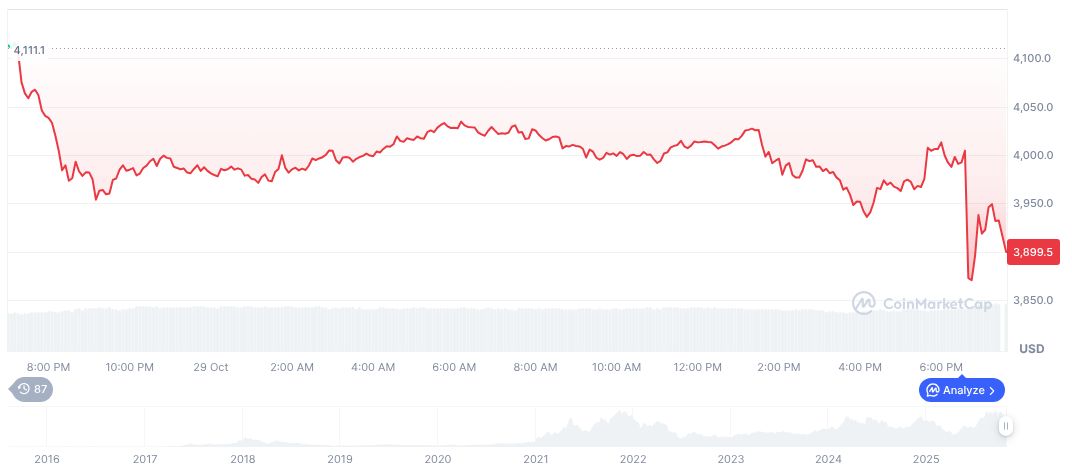
Ethereum (ETH) is currently priced at $3,714.89 with a market cap totaling $448.38 billion and dominance of 12.46%. The cryptocurrency reported a 24-hour trading volume of $39.70 billion and experienced a daily price change of -5.36%.
Research from Coincu predicts that successful integration efforts may result in new regulatory frameworks designed to handle the complexity of crypto assets. Ethereum's infrastructural dominance supports broad changes under study, promising critical enhancements in DeFi execution and cross-border finance.