



Strategy executive chairman Michael Saylor has stated that Bitcoin is becoming "a lot less volatile," even after the cryptocurrency market leader recently erased its 2025 gains in a significant crash.
During an interview with Fox Business, Saylor remarked, "You know, I think we are getting less volatility." He elaborated on this point, stating, "When I got into this space in 2020, Bitcoin was an 80 vol. asset, growing about 80% a year. And it’s ground down to 70-70, 60-60, and now it’s 50 vol. asset, growing about 50% a year."
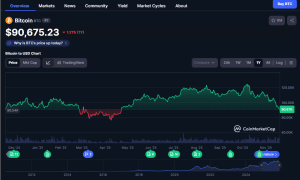
Saylor's observations come at a time when Bitcoin has recently dropped below the significant psychological mark of $100,000. The cryptocurrency briefly dipped below $90,000 but has since shown some recovery, trading at $90,675.23 as of 2:27 a.m. EST. Despite this recovery, BTC remains down over 1% on a yearly basis and is more than 28% below its all-time high of $126,198.07, which was established on October 6.
Bitcoin Projected to Outperform S&P 500
Looking ahead, Saylor predicted that Bitcoin's volatility would continue to decrease by approximately 5% every few years as the asset matures. He further projected that BTC is "grinding toward being about one and a half times as volatile as the S&P 500 index and one and a half times better performing" than the index.
The S&P 500 index, which is weighted by market capitalization, tracks 500 of the largest companies in the United States. Strategy, despite meeting the technical eligibility criteria for inclusion in the index, was not selected in the most recent additions. Instead, Robinhood Markets was added, a decision that drew criticism from analysts who argued Strategy possesses stronger financial fundamentals.
Strategy's Bitcoin Holdings and MSTR's Performance
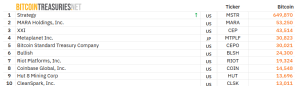
Strategy began its accumulation of Bitcoin in 2020 and has steadily increased its reserves in the cryptocurrency, establishing itself as the largest corporate Bitcoin holder globally. According to data from Bitcoin Treasuries, Strategy currently holds 649,870 BTC on its balance sheet. This holdings significantly surpasses that of the next largest corporate holder, MARA Holdings, which possesses 53,250 BTC.
The company's most recent Bitcoin purchase was announced earlier this week, with Saylor confirming that Strategy acquired 8,178 BTC for approximately $835.6 million, at an average price of $102,171 per Bitcoin.
Given Strategy's substantial Bitcoin holdings, analysts often view its shares (MSTR) as a proxy for BTC's price performance. In response to the recent downturn in Bitcoin's price, MSTR's share price has experienced a decline of over 49% in the past six months. To finance its Bitcoin acquisitions, Strategy has utilized various debt financing instruments. Following the recent drops in both BTC and MSTR prices, prominent gold advocate and Bitcoin critic Peter Schiff has publicly characterized Strategy's business model as "a fraud" that he believes will ultimately lead to the firm's bankruptcy.
When questioned in the interview about the potential consequences of further downside for Bitcoin on Strategy, Saylor asserted that Strategy is "the best capitalized company in the crypto economy." He further stated, "We have billions of dollars of liquidity in the equity every day, and our credit instruments are 100 times more liquid than the average preferred equity."
Saylor expressed Strategy's belief that Bitcoin's value will appreciate by approximately 30% annually for the next two decades. He added that even if Bitcoin's appreciation were to be as low as 1.25% per year, Strategy would still be able to meet the yields offered through its debt instruments and "create more shareholder value." Saylor concluded by noting, "If Bitcoin stops going up 0% forever, we have about 80 years to figure out what we’re going to do about that." He also emphasized that Strategy is "engineered to take an 80% to 90% drawdown" and still "keep on ticking," concluding, "So I think we’re pretty indestructible."
MSTR shares closed the previous trading session up more than 5% following Saylor's interview. However, some after-hours selling activity led to a dip of over 1% in the company's share price during that period.