


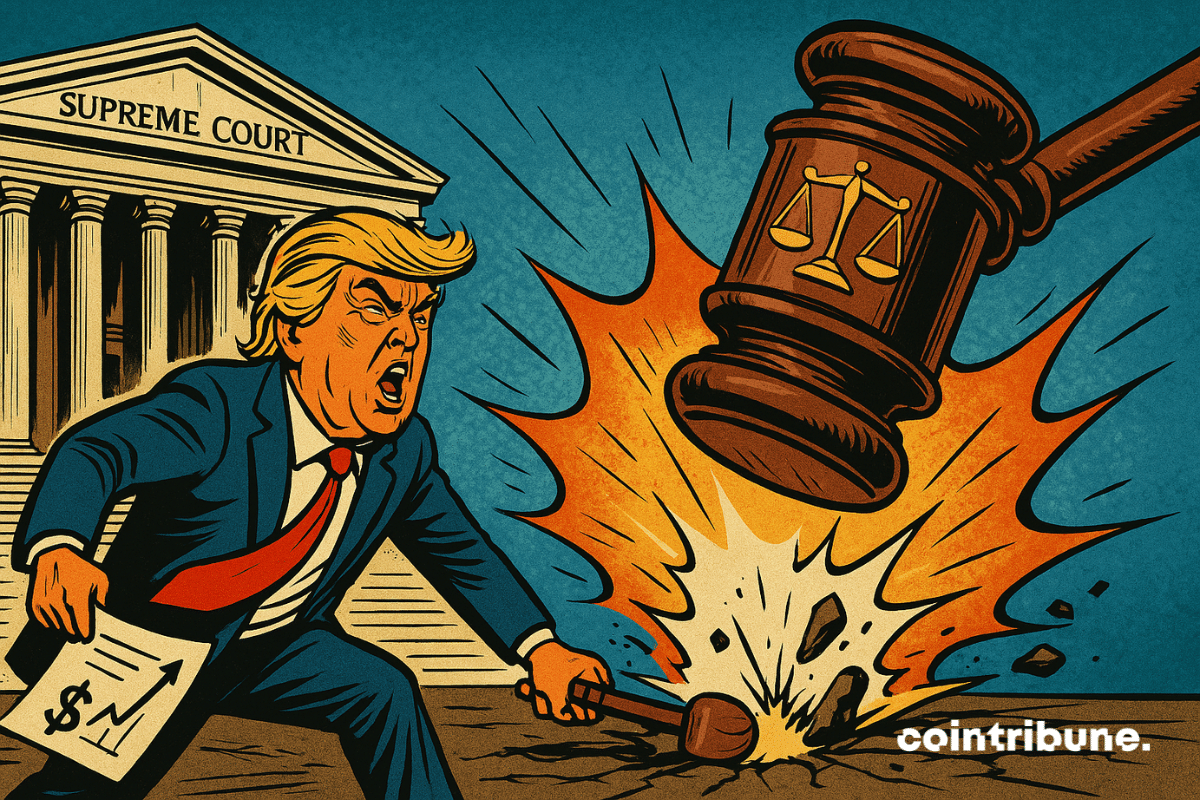
Prediction Markets Show Sharp Decline in Support for Trump's Position
Kalshi and Polymarket have recorded a significant drop in the probabilities favoring Donald Trump, coinciding with the Supreme Court's examination of the legality of his tariff powers. This shift reflects two key dynamics: the potential rollback of presidential authority over foreign trade and the increasing influence of decentralized platforms as indicators of political anticipation. This case sits at the intersection of constitutional law, economic strategy, and technology, with judges and investors closely observing the proceedings.
In brief
- •Kalshi and Polymarket have recorded a spectacular drop in probabilities in favor of Donald Trump.
- •Markets are anticipating an unfavorable Supreme Court decision regarding his tariff powers.
- •Traders have wagered over $1.3 million on the outcome of this highly political case.
- •Several magistrates have questioned the legitimacy and scope of presidential tariff powers.
The ongoing debate concerning American presidential powers is now being played out on prediction platforms, even as the American justice system had previously declared the tariffs illegal.
While the Supreme Court deliberates the constitutional basis of the tariffs imposed by Donald Trump under the 1977 International Emergency Economic Powers Act (IEEPA), the markets are signaling an unfavorable verdict for the president.
On Thursday, the regulated American platform Kalshi indicated only a 29% probability that the Supreme Court would rule in favor of the president, marking a 28-point decrease in a single day.
On Polymarket, a decentralized platform operating on blockchain technology and settling contracts in USDC, the confidence level is even lower, standing at 25%. The total cumulative volume traded across both platforms has surpassed $1.3 million, demonstrating substantial interest and concern surrounding this case. This trend indicates a shared interpretation between traditional investors and crypto users, who are adjusting their positions based on what they perceive as a significant shift in the legal landscape.
These market movements are closely tied to traders' reassessment of the judicial context. Since the Supreme Court agreed to hear the case in September, positions have consolidated around a central issue: the president's authority to invoke the 1977 emergency law (IEEPA) to impose tariffs without Congressional approval. The sharp reversal, described by Kalshi as the largest daily drop observed on the contract, is attributed to several factual elements:
- •The realization that a majority of market participants now perceive the trial's outcome as unfavorable to Trump.
- •A rapid repositioning on both platforms, with probabilities converging around the 25-29% range.
- •An increase in traded volume as investors seek to adjust their positions or exit their contracts.
- •A notable convergence between traditional markets (Kalshi) and decentralized markets (Polymarket) in their probabilistic analysis of judicial signals and other on-chain data.
Judges Question Executive Power Limits at the Supreme Court
During the oral hearing conducted this Wednesday before the United States Supreme Court, several conservative judges expressed significant skepticism regarding the position advocated by the Trump administration.
Specifically, Judge Neil Gorsuch cautioned against the risk of establishing a "one-way ratchet" that would permanently shift the institutional balance in favor of the executive branch. Amy Coney Barrett, also appointed by Trump, questioned government representatives about the rationale of targeting countries like France or Spain within a framework intended to address an emergency situation. Furthermore, the Chief Justice of the Court, John Roberts, emphasized that "tariffs, as a form of tax, have historically been under Congress’ jurisdiction."
These statements suggest a potential challenge to the use of the International Emergency Economic Powers Act (IEEPA) as justification for unilateral trade policies. The judges appear concerned about an overreach of executive power, which, if confirmed in this case, could allow the executive branch to assume budgetary prerogatives without the oversight of Congress.
Should the Court decide to restrict the current interpretation of the IEEPA, the repercussions would be multifaceted. From a legal standpoint, it would establish a precedent limiting the American president's discretion in matters of international trade.
From an economic perspective, it could mitigate the uncertainty associated with ad hoc tariff policies, which frequently contribute to market volatility. For cryptocurrencies, which are traditionally sensitive to geopolitical tensions, this could lead to fewer abrupt market movements triggered by unilateral announcements, thereby reducing the perception of bitcoin as a safe haven. This is particularly relevant given bitcoin's correlation with gold, which has reached 0.85 in response to such risks.