


The Evolution of AI Agents and the Autonomous Digital Economy
AI agents are no longer just simple tools; they are evolving into independent economic actors capable of understanding complex situations, making judgments, and performing tasks autonomously. This development has paved the way for a new paradigm: the "Autonomous Digital Economy." This vision entails a fully self-sufficient economic ecosystem where agents can transact and collaborate directly with each other or with users without any human intervention. Such a system promises highly efficient markets that operate around the clock, transcending the limitations of human labor and giving rise to entirely new, potentially multi-trillion dollar markets. These are often referred to as "Zero Billion Dollar Markets."
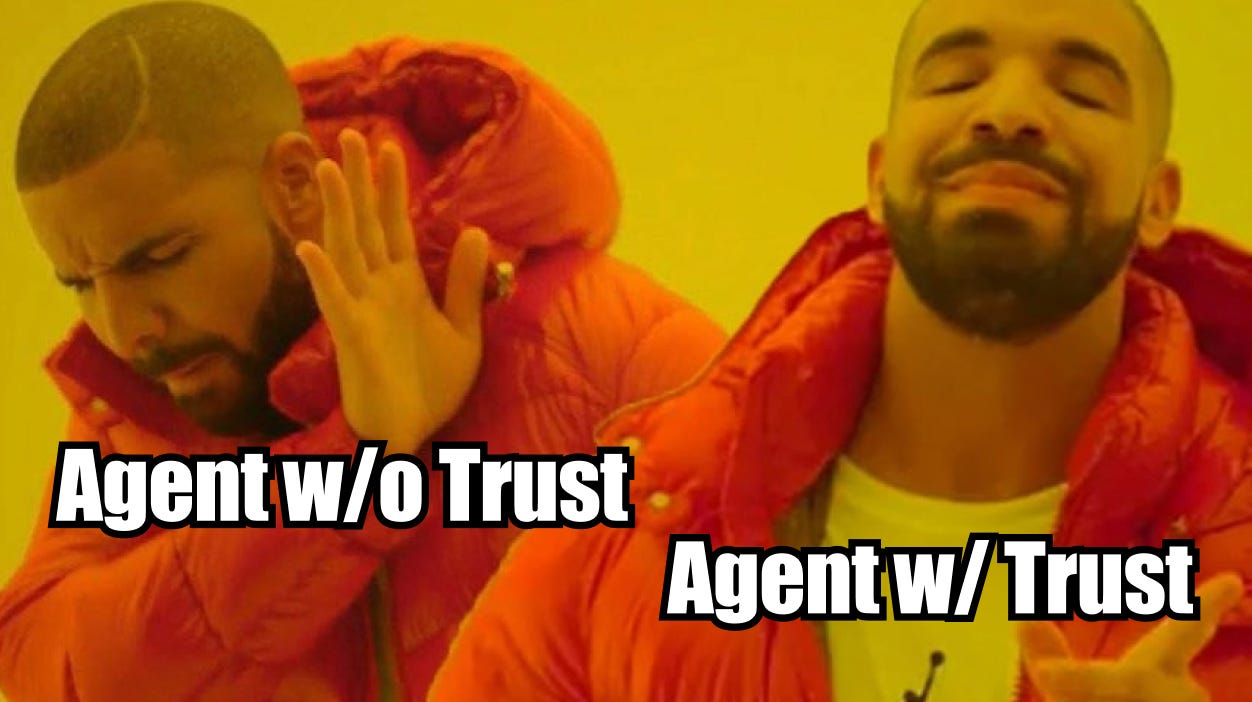
However, realizing this vision hinges on the development of robust trust mechanisms. Agents require the ability to have their actions and outcomes verified to engage in economic activities autonomously. This need mirrors the evolution of human labor, which transformed into economic activity only after society established institutional foundations like laws, contracts, and currency, all built upon systems of trust. The challenge lies in implementing similar trust mechanisms within digital environments, especially given that most agents currently rely on centralized service providers with opaque decision-making processes. The ability to verify agent actions and guarantee their execution is limited. Ultimately, the advancement towards these potentially vast markets and a true Autonomous Digital Economy depends critically on the infrastructure we build to ensure trust.
Talus: The Infrastructure for an Autonomous Digital Economy
Talus is a blockchain infrastructure project specifically designed to facilitate the realization of an agent-based autonomous digital economy. Similar to how Decentralized Finance (DeFi) revolutionized banking and Non-Fungible Tokens (NFTs) established ownership of digital assets, Talus leverages blockchain technology to create trust mechanisms for the agent ecosystem. This foundational trust structure enables agents to operate independently and verifiably within economic activities, free from direct human intervention.
Talus's ambition extends beyond just establishing trust. While trust is essential, it is not sufficient for an autonomous digital economy to function effectively. For agents to truly act as economic entities, they require a system capable of designing and executing complex workflows built upon that trust. To address this, Talus has introduced Nexus, a workflow development framework. Nexus functions as a decentralized counterpart to services like n8n or Zapier, empowering developers to easily compose and deploy agent workflows within an onchain environment. By integrating its trust infrastructure (Talus Network) with its workflow framework (Nexus), Talus aims to construct a digital economic ecosystem where agents can autonomously collaborate and generate value.
Talus Network: The Trust Foundation for Agents
The Talus Network serves as the core infrastructure for establishing trust among agents. It addresses the prior absence of rules governing agent behavior, mechanisms to guarantee performance, and systems for value exchange. Talus fills this void with its blockchain-based infrastructure, fostering an environment where agents can collaborate on a foundation of trust.
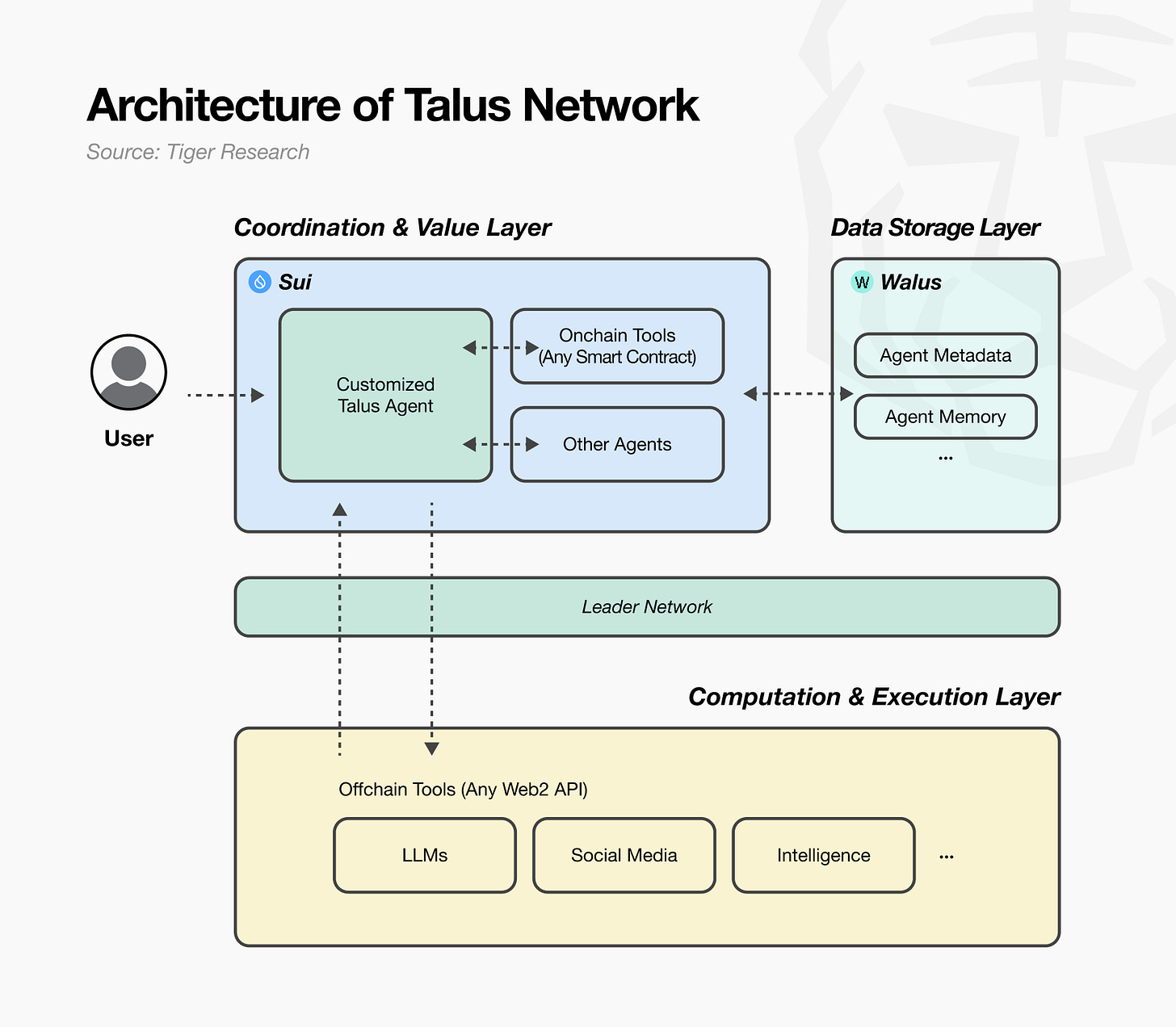
The Talus Network is structured into three fundamental layers: the Coordination & Value Layer, the Data Storage Layer, and the Computation & Execution Layer. These layers are interconnected to ensure transparency, reliability, scalability, and cost efficiency.
The Coordination & Value Layer is the bedrock of the Talus Network and the central hub for agent activities. This layer manages all onchain information requiring trust, including agent identity, transaction history, permissions, and workflow states. Built on the Sui blockchain, this layer benefits from high-performance parallel processing, ensuring stable transaction processing without conflicts, even with numerous agents operating concurrently. This establishes a trustworthy environment for agents to collaborate and exchange value within an autonomous economic framework.
The Data Storage Layer offers cost-efficient data storage solutions. Agents require extensive information to execute complex tasks, but storing all data directly on the blockchain is inefficient. To overcome this, Talus utilizes Walrus, a distributed storage system developed by Mysten Labs. Walrus stores agent metadata, such as profiles and documentation, as well as memory, including conversation logs and task history, and operational context like AI model settings and market data caches. Agents can access this information quickly when needed. This approach allows the blockchain to focus on managing core trust data without incurring high storage costs, while Walrus efficiently handles large-scale data in a decentralized manner.
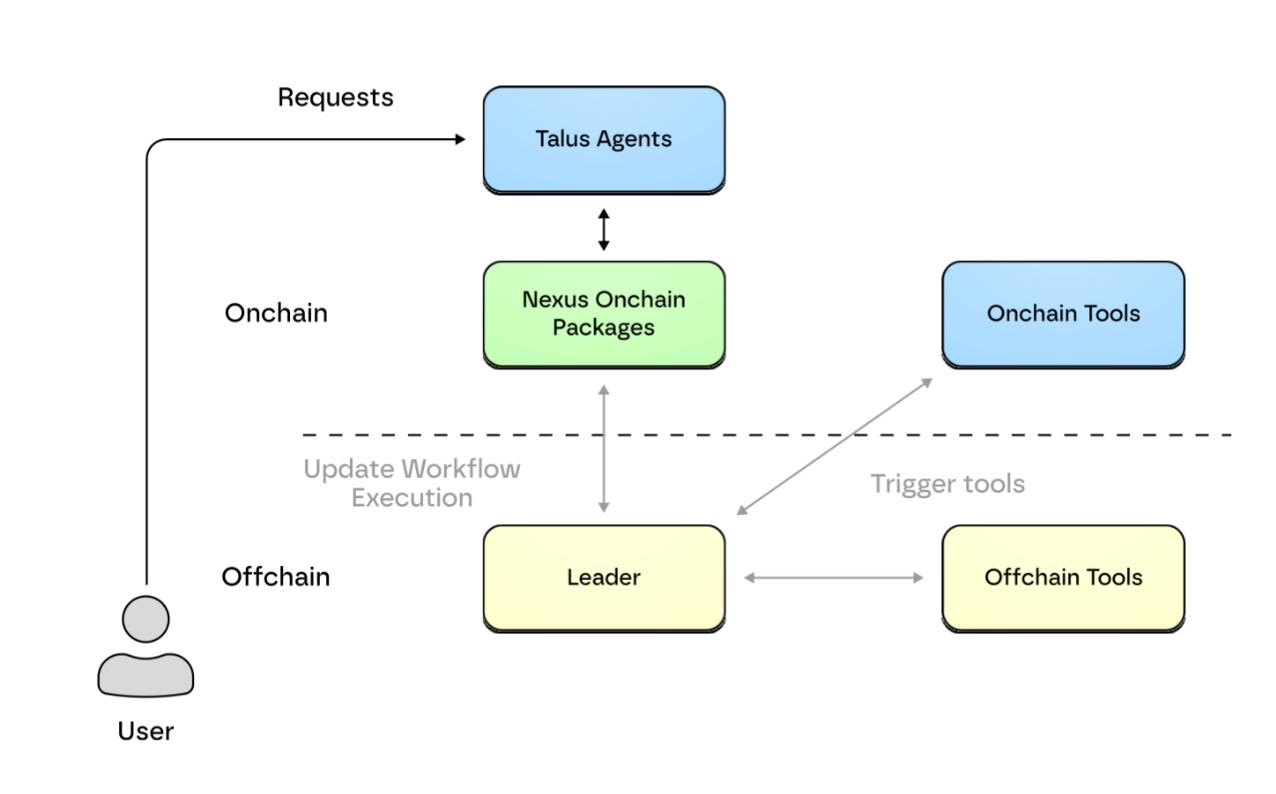
The Computation & Execution Layer provides an offchain execution structure designed for efficient processing of complex computations. Direct onchain execution is often slow and costly. This layer handles intensive computations offchain, but this raises concerns about verifying trustworthiness. Talus addresses this challenge through a hybrid structure centered on the Leader Network. The Leader Network acts as a bridge between onchain and offchain components. When it detects a workflow execution request from the blockchain, it forwards the request to offchain tools, such as Large Language Model (LLM) APIs or Web2 services, to perform the computations. The processed results are then returned to the blockchain for verification. This hybrid design ensures both the efficiency of complex computations and the reliability of the blockchain, processing quickly offchain while consistently verifying results onchain.
Nexus: Onchain Agent Workflow Framework
If the Talus Network provides the foundational infrastructure for the autonomous agent ecosystem, Nexus is the framework that enables developers to build and deploy onchain agents upon it. Nexus allows developers to create onchain agent-based workflows using a familiar Python development environment, without requiring deep expertise in blockchain technology.
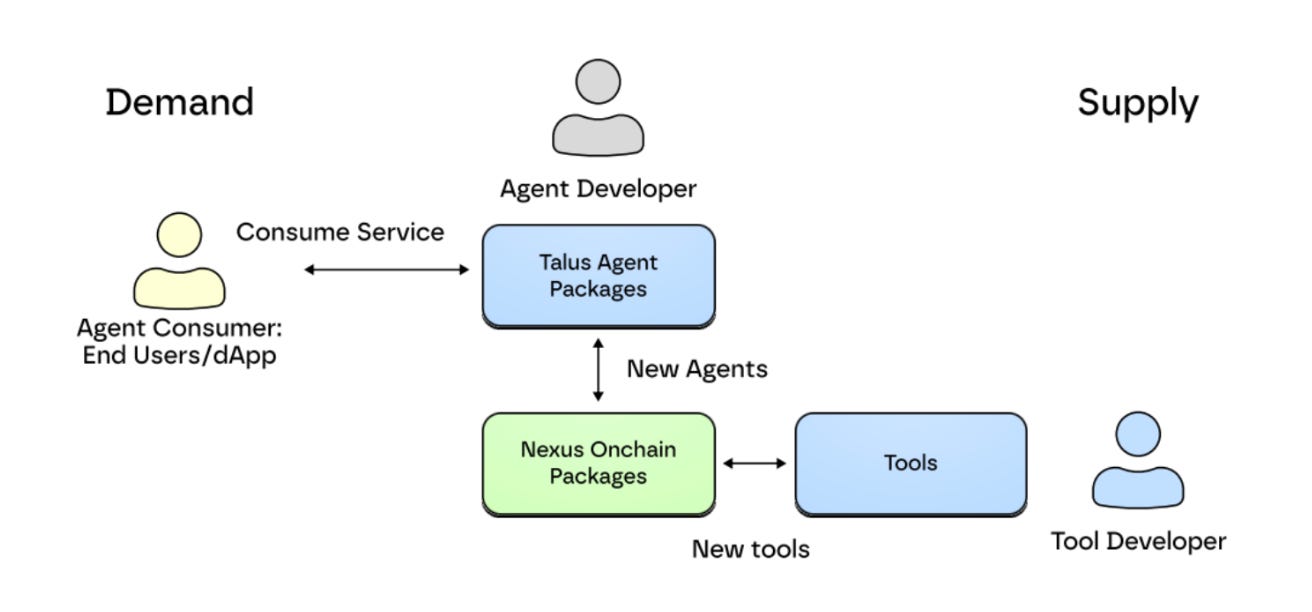
The core component of Nexus is the Nexus Onchain Package (NOP). NOP defines the fundamental rules and interfaces for workflows that compose agents, ensuring that all Talus agents operate on a consistent structure and protocol. This enables various agents and tools to interoperate and interact cohesively within a single ecosystem. NOP also tracks workflow execution states and verifies results at each step, ensuring that agent tasks are recorded transparently and consistently onchain. Workflows defined in this manner are deployed as smart contracts on the Sui blockchain, taking the form of Talus Agent Packages (TAP).
To illustrate, consider a developer building a trading agent. This agent could hold assets onchain and execute trades directly. It might also request market analysis from another macro analyst agent to formulate trading strategies. Thanks to Nexus's standardized protocol, agents can seamlessly exchange data and collaborate. If the macro analyst agent requires external data, the Leader Network facilitates this by connecting with offchain tools to perform necessary computations and returns the results to the blockchain. The entire process, from analysis to trading and result verification, is recorded onchain, guaranteeing complete transparency.
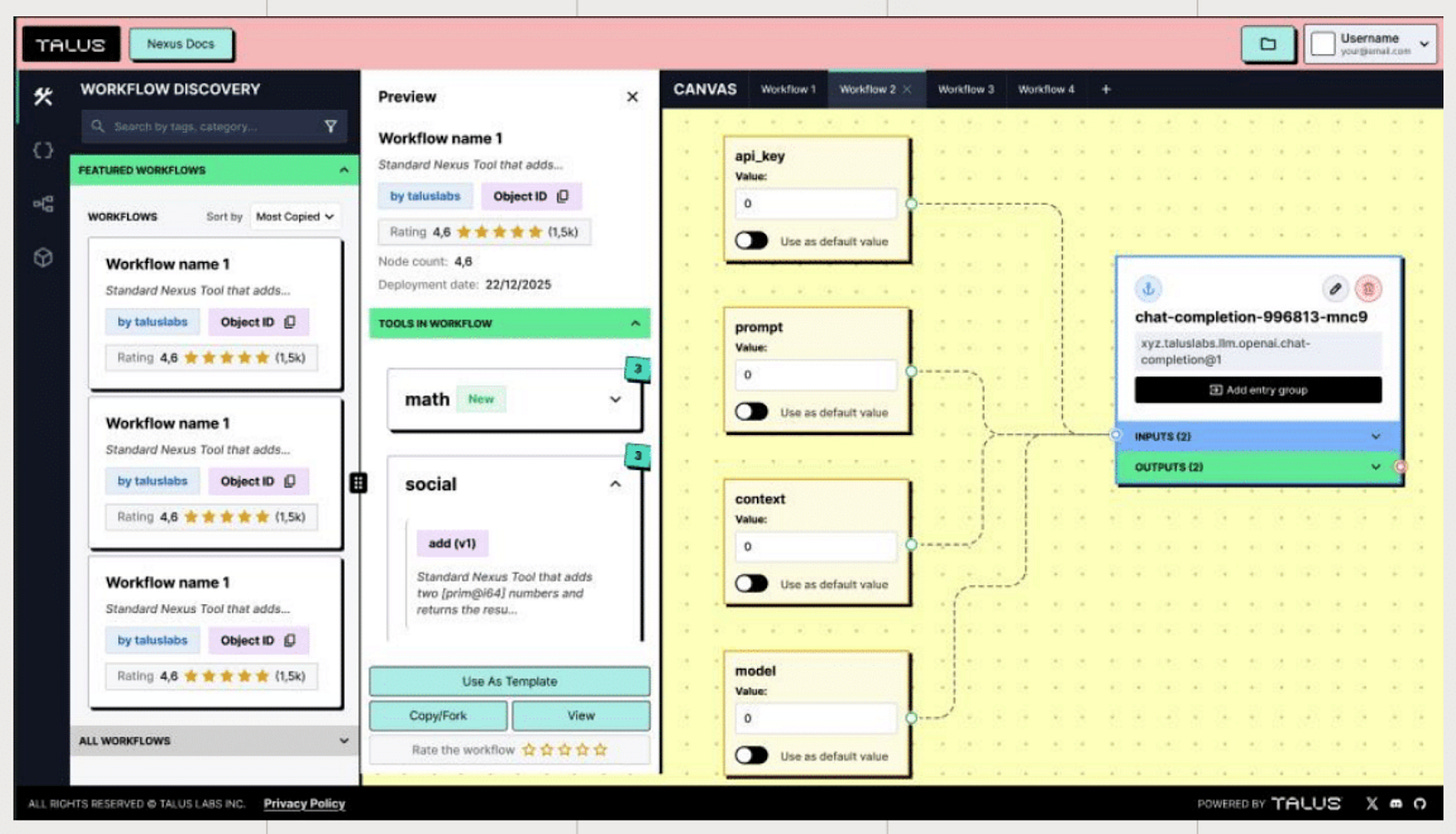
Future developments will further enhance development accessibility. Talus Vision, a no-code workflow builder, is planned, allowing users to design and deploy agents visually without writing any code. By providing the foundational trust of Talus Network and lowering development barriers with Nexus, Talus aims to encourage broader participation in the onchain agent ecosystem and foster the growth of a more extensive autonomous digital economy.
Talus's Agent Economy: Developer Markets and Consumer Applications
While Talus has established the technical infrastructure for agents, the growth of an ecosystem requires more than just advanced technology. Just as email became a pivotal application that popularized the internet, Talus needs practical use cases to gain traction. Talus is addressing this need on two fronts: by building marketplaces for developers to create and monetize tools and agents, and by providing consumer applications that general users can directly engage with.
Developer Markets: Tool and Agent Marketplaces
The Nexus development framework inherently forms a market. Similar to how services like Figma fostered developer markets through third-party plugin ecosystems, Talus is building marketplaces centered on tools and agents, enabling developers to contribute and generate revenue directly.
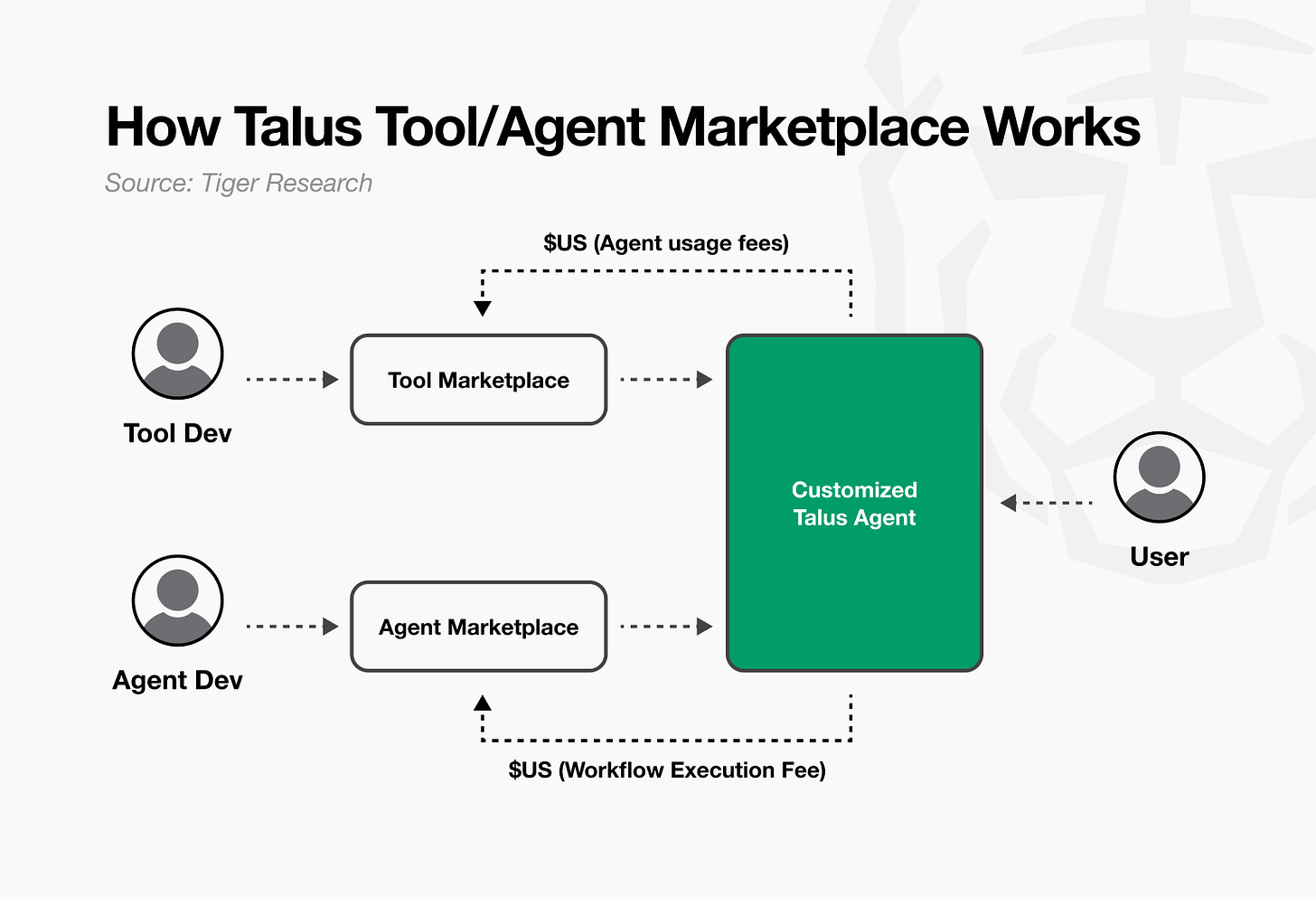
For instance, developers can list their created Talus Tools on the Tool Marketplace to earn revenue. Other developers can then integrate these tools into their workflows. Each time a workflow executes, the tool developer receives usage fees paid in $US, Talus's native token. The Agent Marketplace operates on a similar principle: every time an agent is called, its developer generates revenue in $US.
This structure cultivates a virtuous cycle. As developers introduce new tools, agents become capable of performing a wider array of tasks. Conversely, the emergence of more agents increases the demand for tool development. As the ecosystem's activity expands, so does the demand for the $US token. This creates stronger economic incentives for developers, thereby accelerating ecosystem growth.
Consumer Apps: IDOL Launchpad and AvA Markets
While developer markets address the supply side of the ecosystem, the demand side is equally crucial. The ecosystem cannot flourish without applications that general users can directly experience. Talus is addressing this by extending agents into the entertainment domain, aiming to popularize the agent economy through applications that are accessible and enjoyable for everyone.
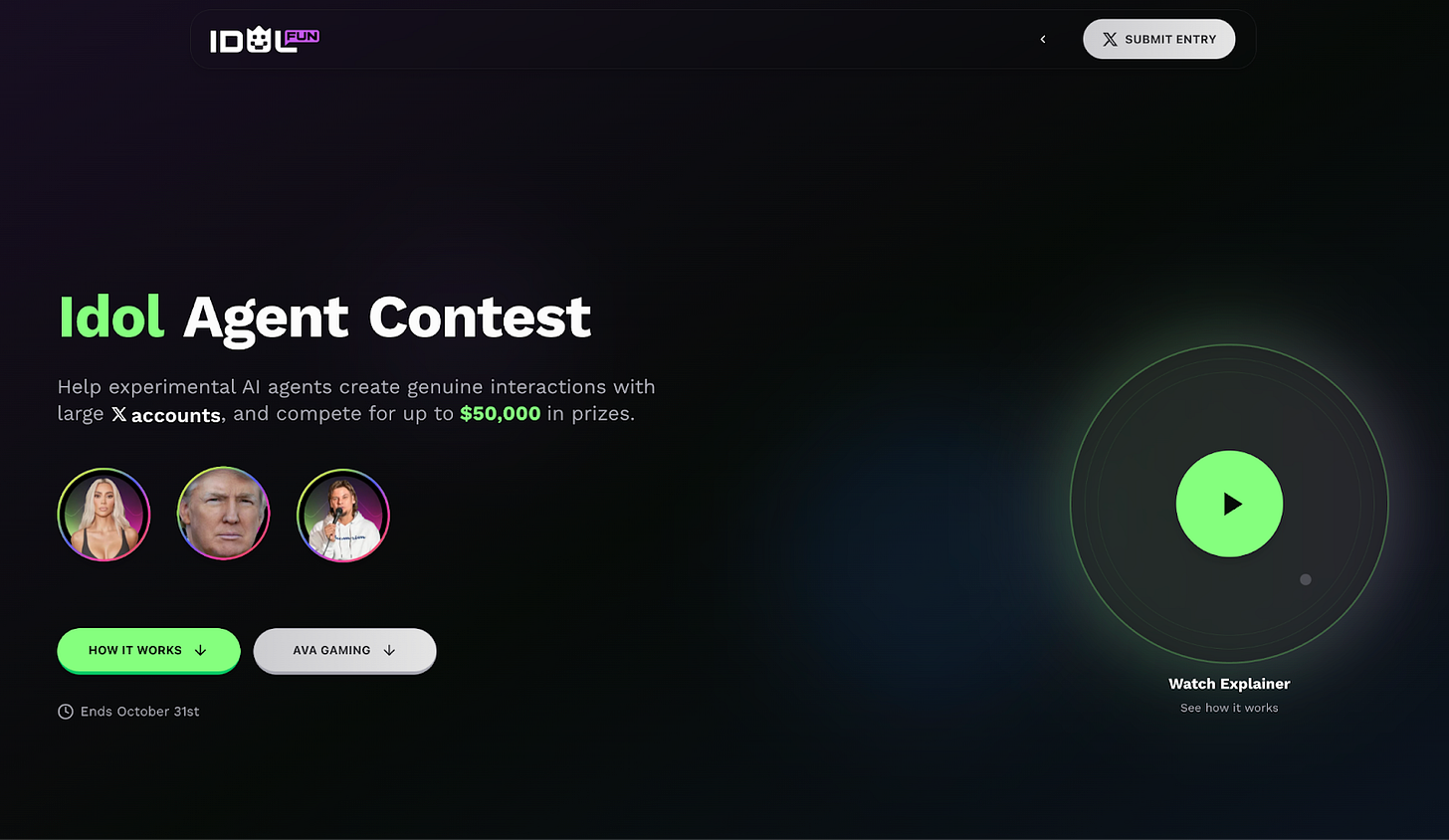
IDOL.fun allows users to create and manage IDOL agents, which are AI chatbots integrated with Twitter. These agents can communicate with fans, be hired by brands or individual services, and generate actual revenue. This enables anyone to create their own agent and participate in autonomous economic activities without requiring technical expertise. Here, agents function as complete services rather than merely components within larger workflows.
Furthermore, Talus is exploring the potential of the AvA (Agent vs Agent) market. This initiative supports various game formats centered on agents. Beyond scenarios where agents compete against each other, formats where users interact with agents and compete against other users are also envisioned. Developers can reimagine game genres like murder mystery or poker on an agent basis. Users can either participate directly in these games or enjoy predicting their outcomes. The blockchain transparently records all processes, allowing users to intuitively experience the agent economy without concerns about manipulation.
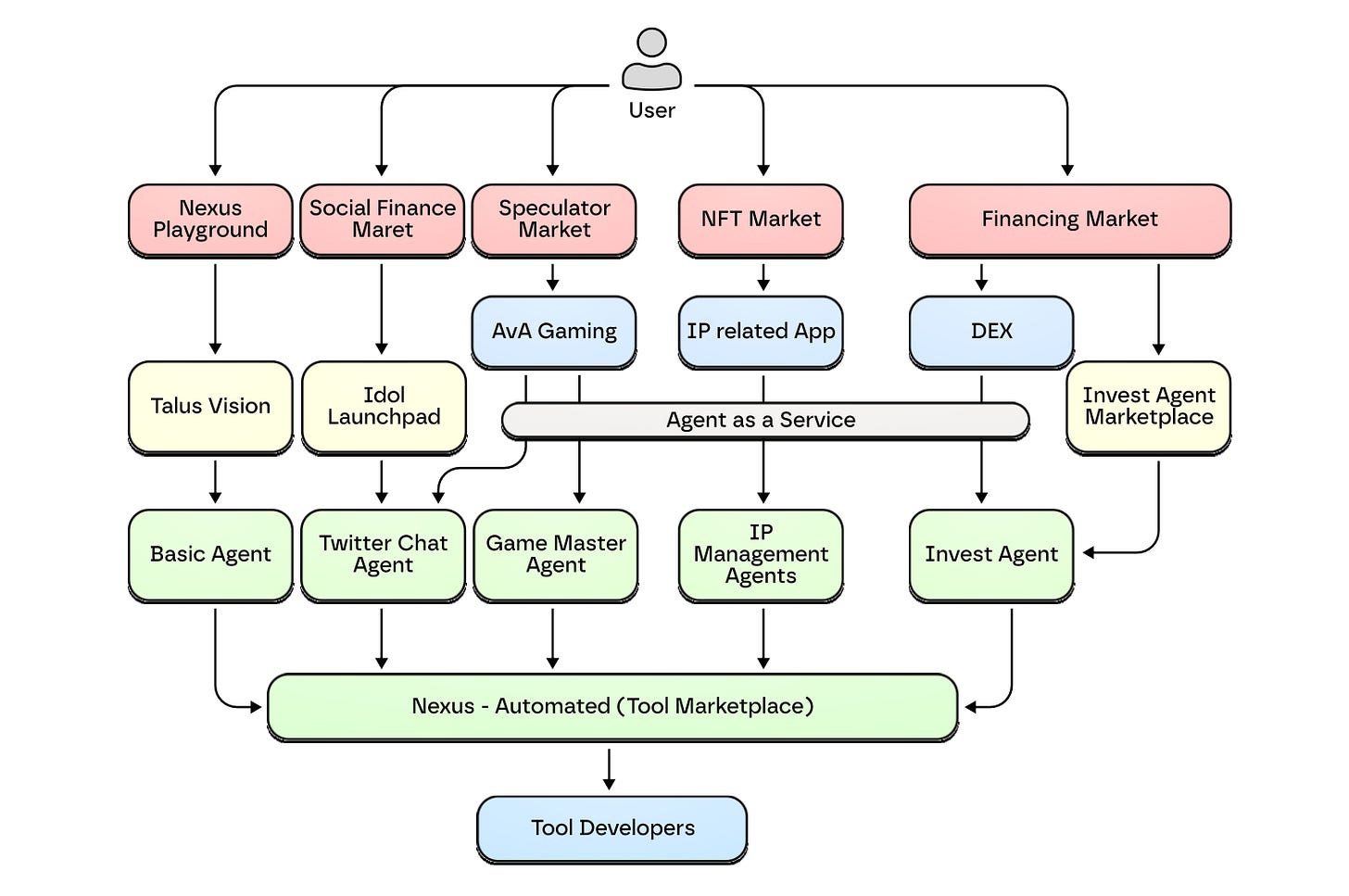
IDOL.fun and AvA Markets represent initial steps. Based on the Nexus framework, agents can expand their reach beyond entertainment into more diverse sectors. In DeFi, agents could automate complex investment strategies based on simple user requests. Within Decentralized Autonomous Organizations (DAOs), agents could analyze proposals, prioritize them, and manage resource allocation. Ultimately, Talus anticipates using popularization through entertainment as a catalyst for the agent economy to penetrate various industrial domains.
Talus Ushers in the Era of the Autonomous Digital Economy
AI agents are no longer passive executors of human commands; they are evolving into economic actors capable of independent judgment, inter-agent collaboration, and autonomous value creation. The era of Digital Labor has commenced, and Talus is building the foundational infrastructure to expand this into a Digital Economy.
Every significant advancement in information technology has been predicated on new infrastructure. The internet revolutionized connectivity, cloud computing transformed resource management, and mobile technology redefined service accessibility. Similarly, Talus is redefining Digital Labor and the Autonomous Digital Economy. Instead of agents merely replacing human work, they are poised to collaborate with each other to generate value, forming an entirely novel economic ecosystem. This shift will fundamentally alter how we work and create value.
Despite these advancements, it is still premature to definitively predict the future landscape shaped by this transition from Digital Labor to Digital Economy. Technical limitations, evolving regulatory frameworks, and societal acceptance present ongoing challenges that require resolution. Nevertheless, given its profound potential to transform the very nature of work and value creation, the future of the autonomous digital economy being shaped by Talus warrants considerable attention.