



Key Concerns Regarding the Responsible Financial Innovation Act
The American Federation of Teachers (AFT) has formally petitioned the U.S. Senate to withdraw a proposed crypto market bill, expressing significant concerns about potential economic risks, particularly those that could impact pension funds and the financial security of retiring workers.
The union has highlighted the bill's potential to create systemic risks, enable loopholes that bypass existing securities laws, and jeopardize retirement portfolios due to proposed changes in the regulation of tokenized equity.
AFT's Stance on Pension Security and Tokenized Assets
AFT President Randi Weingarten articulated the union's apprehension that the Responsible Financial Innovation Act could permit digital assets to be incorporated into pension portfolios. This, she warned, would expose working families to substantial economic risks. The AFT, representing 1.8 million members, emphasized the "grave risks" to retirement security that could arise if non-crypto firms are allowed to convert equity into tokenized forms, thereby circumventing traditional securities regulations.
The petition also conveyed fears that traditional securities held within pension funds could be transformed into unsafe tokenized assets, creating vulnerabilities for systems susceptible to catastrophic financial risks. Weingarten's letter to senators cautioned that the bill could facilitate illicit activities, potentially contributing to future financial crises.
The bill fails to provide ‘urgently needed regulatory measures and common-sense safeguards’ for crypto and stablecoins.
Market Context: Bitcoin's Performance Amidst Legislative Discussions
The AFT's position aligns with broader policy discussions aimed at safeguarding pension funds from vulnerabilities, similar to its historical opposition to policies that could threaten Social Security.
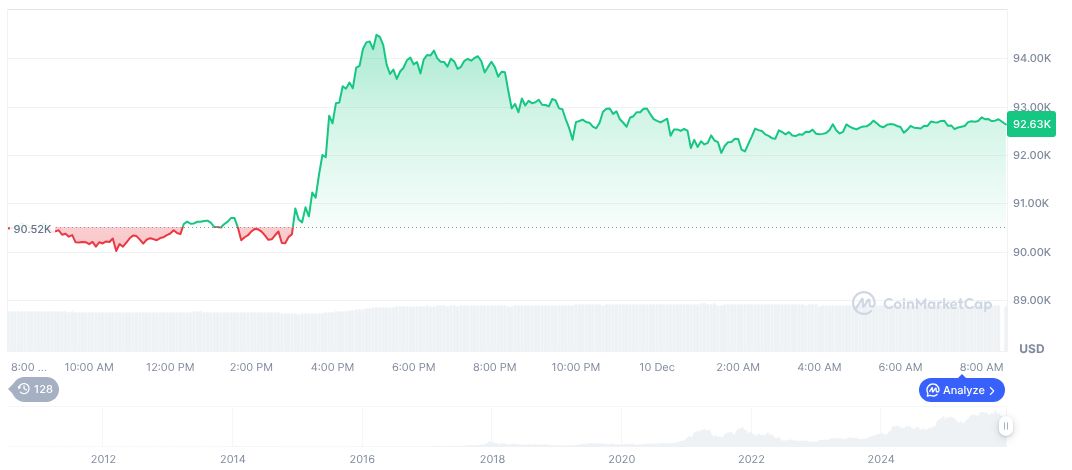
Current Bitcoin market data indicates a dynamic cryptocurrency landscape. With a price of $92,722.48 and a market capitalization of $1.85 trillion, Bitcoin maintains a dominant 58.51% market share, reflecting the fluidity of the crypto economy. Bitcoin experienced a 2.49% price increase in the last 24 hours, though it has seen an 18.77% decrease over the past 90 days. This data is sourced from CoinMarketCap.
The Coincu research team suggests that union-led opposition to crypto legislation might delay, but not entirely prevent, large pension funds from engaging with crypto assets. Existing regulations impose strict asset management standards, and the legislative path of the proposed bill will significantly influence future trends in tokenization. While potential changes remain pivotal, their exact nature is currently undefined.