


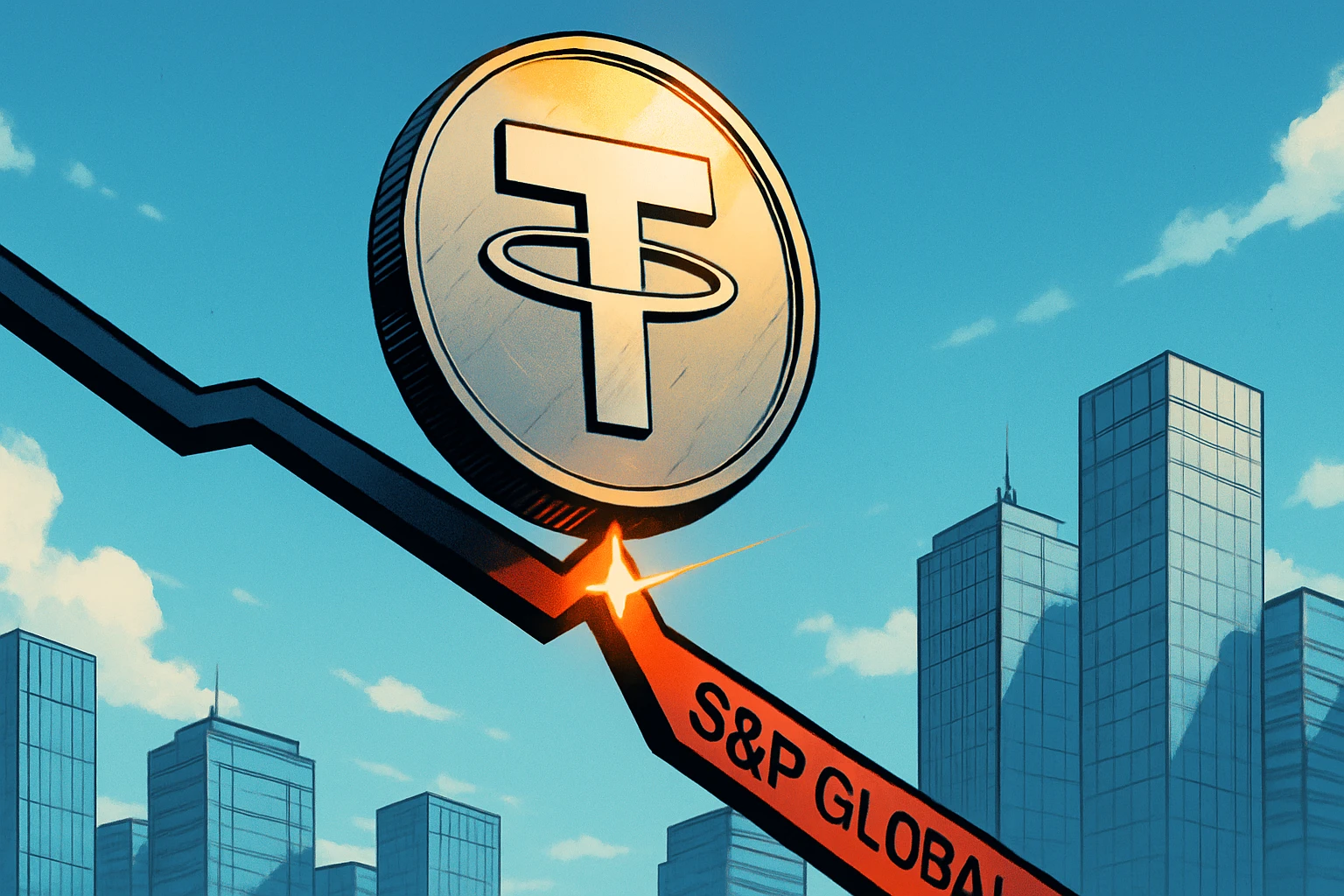
S&P Global recently downgraded the stability rating of USDT, the world’s largest stablecoin, to the lowest level, once again triggering a fresh wave of market skepticism toward Tether. Tether CEO Paolo Ardoino responded that the rating completely ignored the group’s capital structure, while former Citigroup analyst Joseph Ayoub stressed that Tether is enormously profitable — essentially a money-printing machine that is virtually impossible to bankrupt.
S&P Downgrades USDT Rating: Bitcoin and Gold Holdings Raise Concerns
Last week S&P Global announced it was downgrading USDT’s ability to maintain its dollar peg to the lowest grade “weak”, specifically pointing out that Tether’s reserves contain Bitcoin and gold — highly volatile assets — while traditional stablecoins rely primarily on highly liquid instruments such as U.S. Treasuries, thereby weakening the robustness of the dollar peg.
The move immediately sparked FUD in the market and prompted renewed scrutiny of Tether’s asset transparency and risk profile.
Paolo Ardoino Responds to S&P Downgrade
Tether CEO Paolo Ardoino hit back today, stating that S&P’s analysis overlooked the overall capital structure of the Tether Group. Citing the Q3 audit report released this year, he noted that Tether currently has:
- •Tether Group total assets: $~215B
- •Stablecoin liabilities: $~184.5B
- •Excess Equity: $~7B (on top of the ~184.5B stablecoin reserves)
- •Retained Earnings: $~23B
Ardoino emphasized, "S&P made the same mistake of not considering the additional Group Equity nor the ~500M in monthly base profits generated by U.S Treasury yields alone."
He also commented on the market reaction, suggesting, "Some influencers are either bad at math or have the incentive to push our competitors."
Arthur Hayes Reiterates Transparency Concerns
Arthur Hayes responded to the situation by reiterating the points from his previous analysis. While acknowledging that Tether is indeed highly profitable, he insisted that the core problem remains the high volatility of some of its assets.
Hayes had previously written that if Tether aggressively buys Bitcoin and gold to offset shrinking Treasury interest income as rates fall, the company would become extremely vulnerable in a major market correction.
Former Citi Analyst Defends Tether's Financial Strength
Former Citigroup digital assets analyst Joseph Ayoub jumped in to back Tether and rebutted the concerns raised. Ayoub stated that he has spent hundreds of hours researching Tether and stressed that the publicly disclosed reserves are not the full picture of the group’s assets.
He offered three key observations:
- •Disclosed Assets vs. Corporate Assets: Tether’s actual corporate assets are far larger than publicly disclosed. The published figures are only the ledger that backs USDT 1:1; the company also owns equity investments, mining operations, corporate cash reserves, additional undisclosed BTC, and historical profits.
- •Profitability and Equity Value: Tether is highly profitable, and its equity is valuable. The company can sell equity to cover any gaps in its balance sheet. Its $120 billion in Treasuries alone generate several billion dollars of base profit per year. With fewer than 150 employees, it is described as one of the most efficient cash-generating businesses on earth. Previous financing rounds suggested an enterprise value between $50 billion and $100 billion.
- •Reserve Safety Compared to Banks: Tether’s reserves are actually safer than those of banks. Banks typically hold only 5–15% in highly liquid assets and the rest in illiquid loans, whereas Tether’s reserve structure is healthier. The only difference highlighted is that Tether lacks a central bank backstop.
Ayoub’s conclusion was unequivocal: “Tether isn’t going insolvent — quite the opposite; they own a money printing machine.”