



In the first six months of 2025, TikTok took down 7,464,081 videos in Nigeria for violating its community guidelines. This comprises 3,683,655 videos between January and March, and an additional 3,780,426 videos between April and June. To provide perspective, this equates to over 41,000 videos removed every single day, or approximately 1,700 videos every hour.
These figures, released in TikTok’s latest transparency report, highlight both the extensive presence of harmful content on the platform and the company's increasingly stringent measures to control what Nigerian users see and share.
Rapid Content Detection
One of the most notable findings is the speed at which TikTok now identifies problematic content. In the first quarter of 2025, 88.2% of all removed videos had zero views. This number saw a slight improvement in the second quarter, reaching 88.3%. This indicates that nearly nine out of every ten harmful videos were deleted before any Nigerian user had the opportunity to view them.
This efficiency is largely attributed to TikTok’s automated moderation systems, which now handle the majority of enforcement tasks. During the January-March period, AI-driven tools were responsible for removing 3.1 million videos. In the April-June period, these tools managed 3.27 million videos, consistently accounting for approximately 84-86% of all takedowns.
The speed of these operations is also impressive. In the first quarter, 73.8% of user reports were processed within two hours. By the second quarter, this rate increased to 77.8%. Currently, only about 9% of reports take longer than eight hours to resolve.
This represents a significant advancement for a platform that has faced global criticism for its slow response times during viral incidents.
Categories of Removed Content
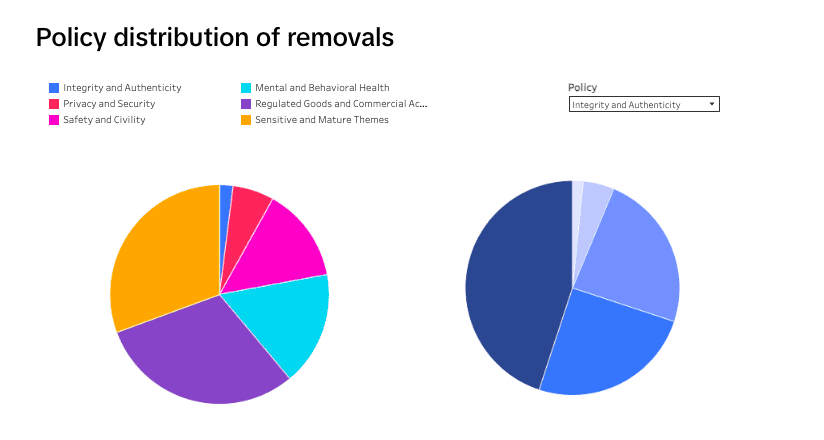
TikTok’s enforcement data reveals that the majority of removals fall into a few primary categories. Based on policy distribution charts, the most frequent violations globally, and likely in Nigeria, include:
- •Safety and civility violations constitute the largest share, encompassing issues such as bullying, harassment, hate speech, and dangerous challenges. Within Nigeria's data, violations related to dangerous activities and challenges represented a substantial portion of the takedowns.
- •Regulated goods and commercial activity forms another significant category, covering a range of activities from illegal sales to the promotion of counterfeit products and unauthorized financial schemes. This category alone accounted for over 36% of removals in certain quarters.
- •Sensitive and mature themes include graphic violence, sexually explicit content, and disturbing imagery. Nigerian data indicates that shocking or graphic content, along with nudity and exposure, consistently rank among the top violations.
- •Youth safety remains a paramount concern. Content involving minors, particularly instances of youth sexual and physical abuse, saw some of the highest enforcement rates, with near-total proactive removal in most quarters.
Challenges with Scams and Fake Content
Despite the strong overall removal numbers, TikTok's systems continue to face difficulties with two specific types of harmful content: scams and AI-generated misinformation.
In the first quarter of 2025, content involving fraud and scams had a pre-view removal rate of only 44.4%, meaning that more than half of scam videos were viewed by users before being flagged and subsequently removed.
Similarly, AI-generated or edited media designed to deceive had a pre-view detection rate of just 46.6%.
Interestingly, certain categories showed improvement in the second quarter. Enforcement against hate speech was strengthened, although other behavioral violations, such as content related to disordered eating, exhibited weaker detection rates, dropping to a pre-view removal rate of only 19.8% in Q2.

Scam content also required longer removal times once detected. In Q1, its 24-hour removal rate was 61.8%, significantly lower than the 90-99% range observed in categories like youth safety, privacy violations, and graphic content.
This suggests that while TikTok's AI is adept at identifying traditional policy violations, such as nudity, violence, or hate speech, it is still evolving in its ability to detect the more subtle and rapidly changing tactics employed by scammers and creators of deepfakes or manipulated media.
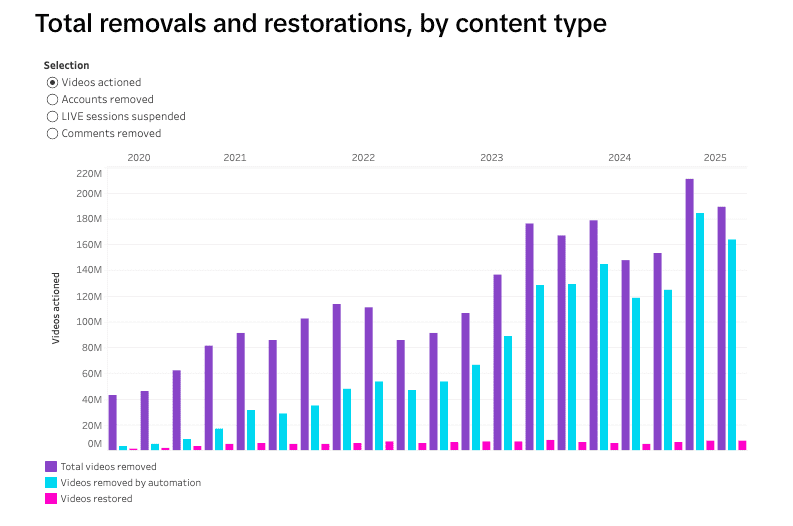
Transparency charts illustrate a clear trend: TikTok is removing substantially more content now compared to just a few years ago. Global video removals increased from under 50 million in 2020 to over 200 million by 2025. Automated removals followed a similar pattern, rising from under 20 million to nearly 180 million.
Specifically within Nigeria, quarterly removals have seen a consistent rise. From 859,458 videos in the third quarter of 2022 to 3.68 million in Q1 2025 and 3.78 million in Q2 2025, the volume of enforcement actions has more than quadrupled in less than three years.
Concurrently, video restorations, which occur when TikTok mistakenly removes content and later reinstates it, remain relatively low. In the first quarter of 2025, 173,554 videos were restored out of 3.68 million removals, representing 4.7%. In the second quarter, 149,234 videos were restored out of 3.78 million removals, at a rate of 3.9%.
These figures suggest that the platform’s automated systems are becoming more accurate over time.
Implications for Nigerian Users
For the average Nigerian user browsing TikTok, these statistics indicate two primary outcomes. Firstly, the platform is demonstrably safer than it was in previous years, with harmful content being identified and removed more rapidly, often before it can spread or cause significant harm. Secondly, the system is not infallible, particularly concerning financial scams and deceptive AI-generated content, which continue to pose genuine threats.
TikTok's live session enforcement also saw considerable activity in Nigeria. In the first quarter of 2025, live broadcasts were subjected to enforcement actions. In the second quarter, 49,512 live sessions were banned for violating monetization and safety guidelines.