


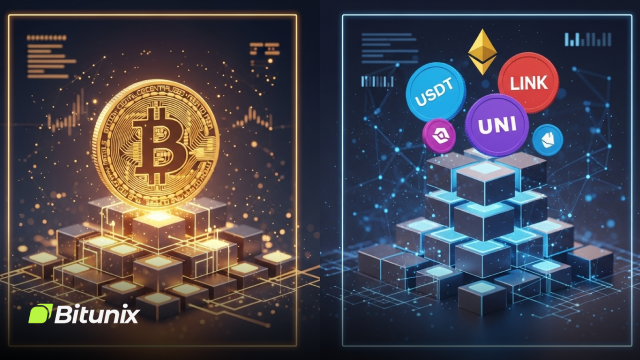
If you are new to cryptocurrency, a common early question is the difference between a token and a coin. The terms are often mixed together online, yet they are not the same. Coins are the native money of a blockchain. Tokens are assets that live on top of an existing blockchain through smart contracts. Knowing the distinction helps you evaluate utility, risk, and value when you invest, trade, or build in the blockchain and Web3 ecosystem.
What Is a Coin in Cryptocurrency
A coin is a cryptocurrency that runs on its own blockchain. It acts as the native currency of that network and is used for payments, value transfer, fee payment, and often network security.
Common examples:
- •Bitcoin (BTC), the original peer to peer digital money and store of value
- •Ethereum (ETH), the asset used to pay gas fees on the Ethereum network
- •Litecoin (LTC), a faster version of Bitcoin intended for payments
- •XRP, designed for rapid cross border settlement in specific contexts
Coins are widely supported by exchanges and wallets and are regularly used as payment, collateral, and a store of value.
Key Characteristics of Coins
Native blockchain
Each coin exists on a chain that records its ledger and rules. Bitcoin runs on the Bitcoin network, Ether runs on Ethereum.
Primary purpose
Coins handle payments and transfers, pay transaction fees, and secure the network through the incentive model chosen by the protocol.
Issuance by mining or staking
- •Proof of Work coins reward miners who validate blocks
- •Proof of Stake coins reward validators who commit their balances to secure the chain
What Is a Token in Cryptocurrency
A token is a digital asset that does not have its own blockchain. It is created by a smart contract and operates on top of a host chain such as Ethereum, Solana, or BNB Chain. Tokens can represent utility inside an application, voting rights in a DAO, stable value that tracks fiat currency, or unique assets such as NFTs.
Examples:
- •USDT (Tether) and USDC, dollar-pegged stablecoins on several chains
- •UNI (Uniswap), a governance token for a decentralized exchange
- •LINK (Chainlink), used to run decentralized oracle services
- •MANA (Decentraland), currency for a virtual world economy
Key Characteristics of Tokens
Built on existing blockchains
Tokens rely on standards such as ERC-20 for fungible tokens or ERC-721 and ERC-1155 for NFTs on Ethereum. Other chains provide similar standards.
Created with smart contracts
A token’s supply, transfer rules, and permissions are defined in code. No new blockchain is required to launch one.
Wide range of use cases
- •Utility inside an app or protocol
- •Governance votes on protocol changes and treasury actions
- •Stablecoins that track fiat values for trading and payments
- •NFTs that encode uniqueness for art, gaming, identity, and credentials
Token vs Coin: The Core Differences
Where they live
- •Coins are native to their own chains
- •Tokens live on top of an existing chain
How they are created
- •Coins are issued through mining or staking at the protocol level
- •Tokens are issued by smart contracts that run on a host chain
What they do
- •Coins handle base functions such as payments, fees, and security
- •Tokens power application-level features such as utility, governance, stable value, and unique items
Examples
- •Coins: Bitcoin, Ethereum, Litecoin
- •Tokens: Tether, Uniswap, Chainlink, Decentraland
Supply model
- •Coins often have protocol level schedules or hard caps, for example Bitcoin at 21 million
- •Tokens have supply rules set by the contract and project governance
In short, coins are the foundation and tokens are the applications built on that foundation.
Why the Distinction Matters
Investment decisions
Coins such as BTC and ETH benefit from deep liquidity and strong network effects. Tokens can offer higher upside through innovation in DeFi and gaming but introduce extra smart contract and adoption risk. Knowing which you hold makes it easier to size positions and manage risk.
Utility and use cases
Coins enable the core economics of a chain. Tokens bring programmable assets to life, from governance rights to in‑game items to tokenized real assets.
Security and dependencies
Coins inherit the security of their own chain. Tokens depend on two layers, the host chain and the token’s contract. A flaw in either can affect value and safety.
Regulation
Coins such as Bitcoin are often treated as commodities in several jurisdictions. Some tokens may meet the definition of a security depending on design and promises. The category matters for disclosures, distribution, and compliance.
Real-World Use Cases of Coins
Bitcoin as digital gold
Held by individuals and institutions as a store of value and a hedge against currency debasement.
Ethereum as utility money
ETH is required for gas fees to deploy smart contracts, mint NFTs, and interact with DeFi.
XRP in settlement
Used in specific payment networks for fast cross border transfers.
Real-World Use Cases of Tokens
Stablecoins
USDT and USDC provide a dollar‑like unit for trading, settlement, and payments across chains. They reduce reliance on banking rails during market hours and anchor many trading pairs.
Governance
Tokens such as COMP or AAVE allow holders to vote on protocol parameters, risk settings, and treasury usage.
NFTs
Collections such as Bored Ape Yacht Club and in‑game items represent unique assets. They power digital art markets, credential systems, and game economies.
GameFi and virtual worlds
MANA and SAND support virtual land, items, and creator economies inside metaverse platforms.
Tokenized real assets
Projects now represent fractions of real estate, art, and commodities as on‑chain tokens, which can simplify transfer and collateralization.
Coin and Token Security
Coins
Security is built into the base protocol. Proof of Work relies on computational cost to deter attacks. Proof of Stake relies on economic stake and penalties for dishonest behavior. The protocol can add features such as finality rules, slashing, and client diversity to improve safety.
Tokens
Security is layered. Tokens depend on the host chain’s consensus and on the correctness of their smart contracts. Well audited contracts can include time locks, multisig controls, upgrade timelocks, and pausability for emergencies. Operational security still matters, including hardware wallets, key rotation, and permission hygiene for treasury accounts.
Network participants such as miners and validators are incentivized to maintain ledger integrity. Users add another layer of protection through careful custody and verification of contract addresses.
Common Misconceptions
All crypto is a coin
Wrong. Many assets on your exchange list are tokens created on chains such as Ethereum or BNB Chain.
Tokens have less value than coins
Not always. Stablecoins anchor liquidity across markets and some governance tokens direct control over protocols with large treasuries.
Coins and tokens cannot work together
They do. Coins provide base liquidity and fee payment, while tokens deliver application functionality on top of that base.
Case Studies
Bitcoin
A native coin with a fixed supply of 21 million, secured by Proof of Work. Its main narratives are store of value, settlement finality, and collateral.
Ethereum and ERC-20
ETH is the coin that powers the network. The same network hosts thousands of tokens using ERC-20 for fungible assets and ERC-721 or ERC-1155 for NFTs. USDT, UNI, and AAVE are well known examples that rely on Ethereum for execution and security.
BNB migration
BNB started life as an ERC-20 token. It later moved to its own chain and now functions as a coin, while a large ecosystem of BEP-20 tokens exists on top of BNB Chain.
Conclusion
If an asset runs its own blockchain, it is a coin. If it is issued by a smart contract on an existing chain, it is a token. Coins are the monetary base of a network and pay for core functions such as fees and security. Tokens are programmable assets that unlock utility, governance, stable value, and uniqueness for applications in DeFi, gaming, and Web3. Understanding the difference will help you judge utility, risk, security, and regulatory treatment, so you can build a clearer strategy in crypto.
Disclaimer: Trading digital assets involves risk and may result be the loss of capital. Always do your own research. Terms, conditions, and regional restrictions may apply.