


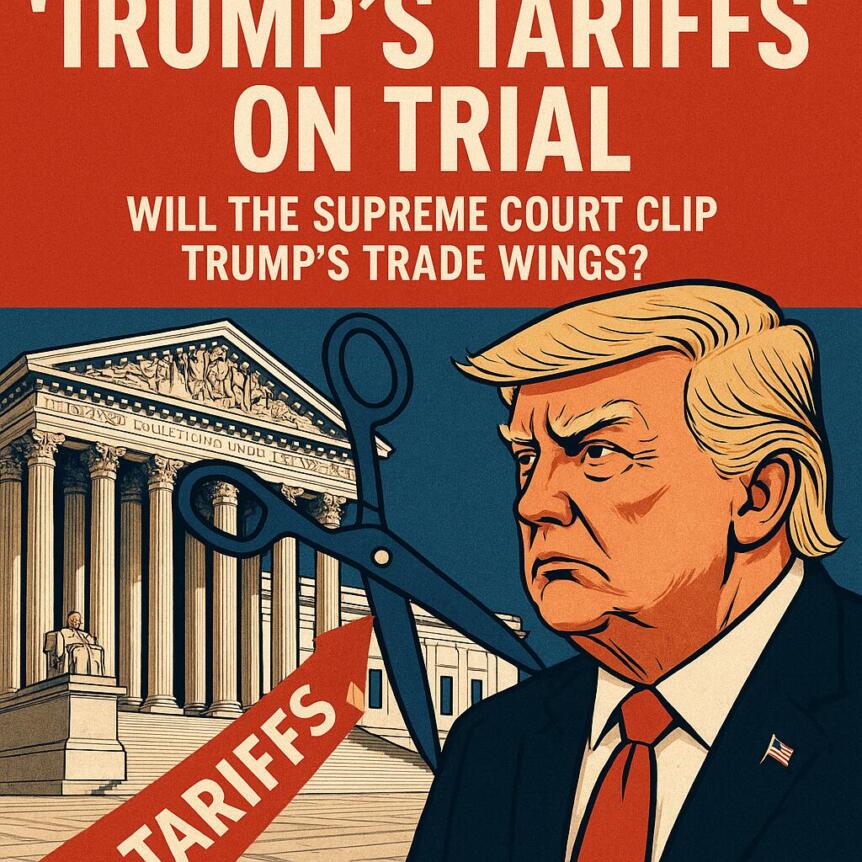
The United States Supreme Court convened a session to hear oral arguments concerning President Donald Trump's utilization of the International Emergency Economic Powers Act (IEEPA) to implement tariffs. The cases, Learning Resources, Inc. v. Trump and Trump v. V.O.S. Selections, Inc., raise critical questions about whether the president can legally declare an "economic emergency" under IEEPA to justify tariffs without explicit authorization from Congress.
The administration faces challenges after lower courts, including the Court of International Trade in May and the Federal Circuit in August, ruled against its position, finding that President Trump had exceeded his statutory authority. This division among the courts adds an element of uncertainty to the outcome. Legal analysts are also divided on how the Supreme Court, which includes three justices appointed by Trump, is likely to rule on these matters.
Since February, the administration has been applying tariffs, ranging from 10% to 145%, on imports from nearly all trading partners under the authority of IEEPA. These measures have been justified by citing trade imbalances in sectors such as autos, steel, and consumer goods. Officials have declared emergencies related to issues like fentanyl trafficking and foreign retaliatory measures, with an estimated $90 billion in revenue projected for 2025 from these tariffs.
Opponents, including small businesses and California officials, contend that IEEPA, enacted in 1977 to curb executive overreach following the Vietnam War, does not contain specific language authorizing the imposition of tariffs, a power constitutionally vested in Congress.
The IEEPA Dispute: Examining Precedent and Current Realities
The central issue before the Court is whether IEEPA's provision to "regulate" commerce during emergencies encompasses the authority to impose tariffs, which function as import taxes. The government's position is that these measures are vital for national security and facilitate swift trade negotiations. They cite a 1975 appellate ruling in United States v. Yoshida International, which equated regulatory authority with the power to impose tariffs.
President Trump has publicly stated on social media that a loss in these cases would leave the United States "defenseless" against imports and necessitate billions of dollars in refunds to importers. However, federal courts have rejected the administration's interpretation, applying the Supreme Court's "major questions doctrine." This doctrine requires clear congressional authorization for executive actions that have a significant economic impact.
In a significant August ruling, the Federal Circuit, in a 7-4 en banc decision, invalidated specific executive orders, including the April "Liberation Day" tariffs and duties imposed on Canada and Mexico. The court, however, stayed the enforcement of these rulings pending appeal.
It is important to note that tariffs enacted under Section 232 of the 1962 Trade Expansion Act, which apply to steel, aluminum, autos, and related industries, and Section 301, which targets unfair trade practices, particularly those involving China, were expressly exempted from this Federal Circuit ruling.
Administration officials have expressed confidence in alternative strategies. Treasury Secretary Scott Bessent indicated to CNBC that the White House possesses "lots of options." These include extending Section 232 investigations to cover semiconductors, pharmaceuticals, and critical minerals, or utilizing Section 122 to impose temporary 15% balance-of-payments tariffs. Bessent also commented that the court has historically been "loath to interfere with signature policies," although he acknowledged that Section 301 pathways require extensive investigations, which can slow down the implementation process compared to IEEPA.
Judicial Interpretation and Potential Outcomes
Legal analysts are divided on the likely outcome of the Supreme Court's decision, reflecting a divergence of opinion within the court's conservative wing. Ed Mills of Raymond James estimated a 50-50 chance, pointing to the general judicial deference afforded to the president in matters of foreign policy. Henrietta Treyz of Veda Partners projects a 50-65% probability that the court will uphold the lower court rulings, drawing parallels to the major questions doctrine used in the 2023 student loan forgiveness case. Terry Haines of Pangaea Policy believes the administration has a slight edge but cautioned that the case is "not a slam dunk" and could result in a mixed ruling rather than a complete validation or rejection of tariff authority.
The justices must weigh conflicting precedents. A 2025 ruling that upholds the FCC's authority over the Universal Service Fund and strengthens delegations under an "intelligible principle" could be seen as inconsistent if the Court reverses Biden administration programs. Justice Brett Kavanaugh's concurrence in April, which suggested exceptions for national security, might lean in favor of the president. Furthermore, former Solicitor General Donald Verrilli noted that President Trump views a loss in this case as a significant blow to his legacy.
Stakeholder perspectives on this issue are varied. California Governor Gavin Newsom has urged the court to invalidate all tariffs, characterizing them as "extreme and erratic" burdens on the state's import-reliant economy. European diplomats anticipate that the tariffs will be approved and upheld, but they believe they may be reimposed through alternative means to maintain leverage in negotiations.
The Broader Implications of Tariff Decisions
If the administration prevails, it would further solidify IEEPA's role as a channel for imposing tariffs, supporting President Trump's reciprocal trade strategy. This could lead to the implementation of baseline import duties of 10% to secure concessions on United States exports and investments.
The Tax Foundation forecasts an increase of $1,200 in average household costs for 2025, potentially contributing to inflation while also supporting infrastructure funding. Industrial stakeholders, including manufacturing executives, assert that these policies have aided in protecting industries such as robotics and aviation and have encouraged the continuation of supply chain migrations away from India and China.
A reversal or defeat of the administration's position would not eliminate existing trade barriers. Section 232, for instance, covers over one-third of all imports. However, it would restrict the president's ability to enact unilateral trade actions.
Potential refunds to importers could amount to tens of billions of dollars, according to Yale's Budget Lab, which would effectively erase 71% of the projected IEEPA revenue. In response, Congress might consider votes on emergency declarations, with House Republicans reportedly delaying reforms until January.
On a global scale, a ruling against the administration's tariff powers could moderate President Trump's tariff-based demands concerning Ukraine aid and fentanyl controls, potentially shifting towards more deliberate diplomatic channels.