



Uniswap’s UNI token is facing renewed downward pressure after a combination of on-chain selling, bearish momentum signals, and fading excitement around recent governance proposals. Fresh data from 10x Research shows that UNI-USDT has now fallen below both the 7-day and 30-day moving averages, confirming a short-term and medium-term bearish trend. The weekly change sits at -7.6%, signaling that sellers remain firmly in control.
The downturn accelerated after a long-dormant whale unloaded 512,000 UNI, triggering roughly $11.6 million in realized losses. That forced selling event cascaded into broader market pressure, amplifying existing weakness across liquidity pools and derivatives markets. Analysts noted that this liquidation occurred shortly after optimism peaked around the so-called “UNI-fication” governance proposal, which had initially fueled hopes of improved value capture and token burn mechanics. As those expectations cooled, the market’s focus shifted back to liquidity risks and structural concerns.
Uniswap (UNI-USDT is below the 7-day moving average -> bearish, and is below the 30-day moving average -> bearish, with 1 week change of -7.6%) a long-dormant whale offloaded 512,000 UNI tokens, realizing an estimated $11.6 million loss, which triggered broader selling pressure… pic.twitter.com/ct4hXK8ecg
— 10x Research (@10x_Research) November 23, 2025
What the Technical Picture Reveals
The latest 10x Research chart paints a clear picture: UNI has broken below its short-term momentum lines and is now struggling to reclaim critical moving averages. Both the 7-day MA and 30-day MA are sloping downward, closely tracking the weakening price curve. UNI’s relative performance also sits in deeply negative territory when compared to the broader market basket.
This technical alignment typically signals a lack of strong bid support, especially when combined with reduced participation in derivatives and rising spot-market outflows. In short, the chart reflects a market that has shifted from speculative optimism to defensive positioning.
Market Indicators Point to Near-Term Caution
UNI is currently trading around $6.20, while the platform’s model forecasts a short-term move to $7.79, an implied +25.34% upswing. However, the broader sentiment remains bearish, showing that traders are hesitant to trust the rebound potential after the recent whale-driven shock.
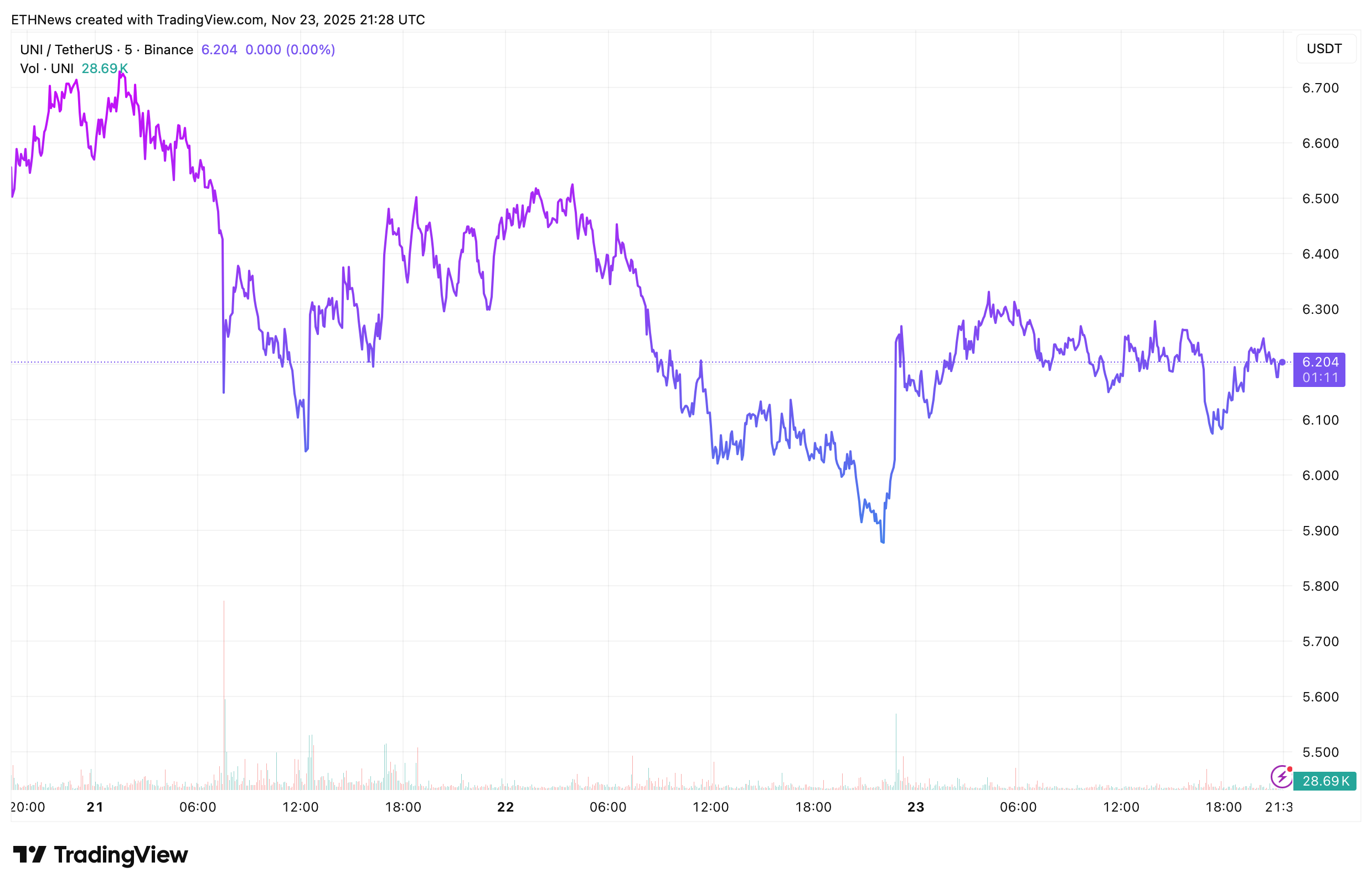
Volatility stands at 13.87%, categorized as very high, and UNI has only printed green days in 40% of its last monthly sessions. The 14-day RSI at 41.72 signals neutral momentum, meaning the asset is not deeply oversold yet, a condition that sometimes limits the speed of any recovery rally. Meanwhile, the 200-day SMA sits far higher at $8.11, reinforcing how much ground UNI has lost during the November downturn.
Sentiment Shifts as Long-Term Narratives Take a Back Seat
Before this week’s volatility, the governance discussions around fee-switch activation and Uniswap’s potential shift toward stronger token-holder value capture had energized the market. But that narrative has been pushed aside by the reality of outsized liquidations, fading derivative participation, and macro uncertainty.
Analysts warn that large player exits often signal deeper concerns than just short-term volatility, particularly when they occur in clusters around governance announcements. Without clear accumulation signs from institutional or long-term holders, UNI’s price action may continue to chop within a bearish structure.
Outlook: Recovery Possible, But Market Wants Stability First
Despite the pressure, UNI’s medium-term forecast remains mixed rather than fully pessimistic. The projected move toward $7.79 suggests there is room for technical relief once market liquidity stabilizes. However, the path to a sustained uptrend requires renewed confidence in Uniswap’s fundamentals, reduced whale-side selling, and a clear shift in sentiment across altcoins.
For now, the charts show a market still processing a significant liquidity shock, and waiting to see whether buyers are willing to defend key support levels.