


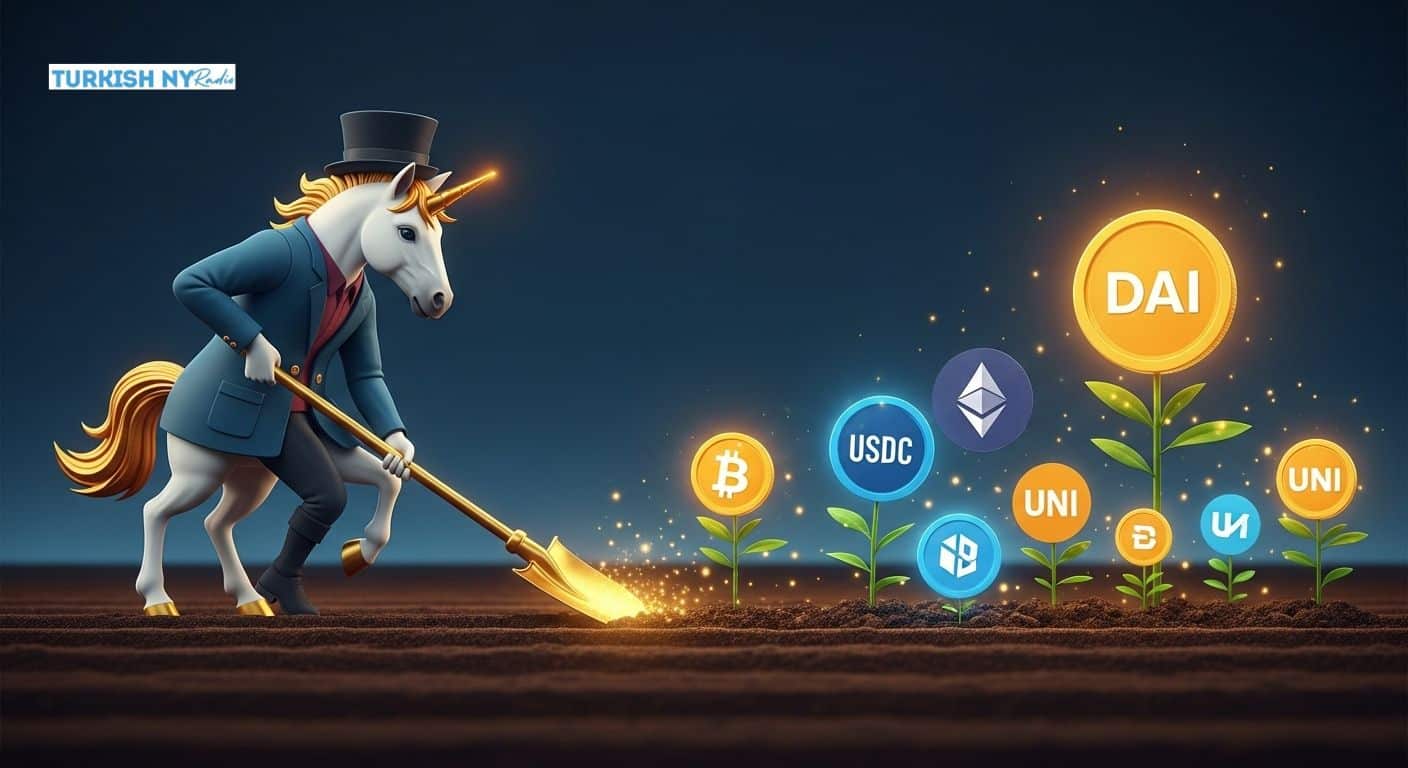
Uniswap yield farming is a method for earning passive cryptocurrency rewards by acting as a liquidity provider (LP) on the Uniswap decentralized exchange. When users supply matching token pairs to a Uniswap pool, they receive a small fee for every trade that utilizes that liquidity.
As of 2025, Uniswap remains a dominant platform in decentralized finance (DeFi), having processed over $1.6 trillion in trades since its inception. This substantial volume translates into millions of dollars in daily fees distributed among liquidity providers.
What is Uniswap Yield Farming?
Uniswap yield farming fundamentally involves providing liquidity to Uniswap pools to earn trading fees. On Uniswap, any user can deposit two tokens, such as ETH and USDC, into a liquidity pool. In return, they receive LP tokens that represent their proportional share of that pool.
Every time a trader swaps tokens within that pool, Uniswap charges a fee, typically 0.3% of the trade value. This fee is then distributed proportionally among all active liquidity providers in that pool, based on their share. In this manner, LPs earn a yield, in the form of fees, for contributing to the market's liquidity.
Uniswap yield farming shares similarities with liquidity mining, though the term "yield farming" often encompasses additional token rewards. In the past, some Uniswap protocols offered LPs extra tokens, like the UNI token, as an incentive to attract liquidity.
Currently, the primary source of yield comes directly from trading fees. However, Uniswap's design continues to reward LPs. For instance, Uniswap V3's concentrated liquidity feature allows LPs to focus their capital within specific price ranges, thereby amplifying their fee returns. Research indicates that V3 LPs, on average, earn approximately 54% more in fees compared to their counterparts on the older V2 version for comparable pools. In essence, Uniswap yield farming entails locking assets into a Uniswap pool to earn a share of the accumulated swap fees.
Uniswap Versions
| Feature | Uniswap v2 | Uniswap v3 (2021–2024) | Uniswap v4 (2025+) |
| Capital Efficiency | Basic constant-product model (X × Y = k) | Introduced concentrated liquidity, LPs can choose specific price ranges for capital deployment | Combined concentrated liquidity with custom “hooks”, automated strategies like limit orders and time-based liquidity |
| Fee Returns (Passive) | Baseline fee split among all liquidity providers | Around 54% more passive LP returns than v2 | Expected to be even more efficient with lower gas fees and dynamic fee adjustments |
| Fee Tiers | Single pool with 0.30% fee | Multiple fee tiers per pair (0.01%, 0.05%, 0.3%, 1%) | Flexible fee rates (0-100%) per pool, configurable via governance or hooks |
| Gas and Transaction Costs | High, each pair had a separate contract | High, each pool managed by unique smart contracts and NFT-based positions | Much lower gas usage; single pool and batched accounting, more scalable |
| LP Token Type | Fungible ERC-20 LP tokens | NFT-based LP positions, unique liquidity ranges | Maintains NFT position model but with hook-enabled customization |
| Customization and Flexibility | None, all pools were the same | LPs could only choose price ranges | Highly customizable: limit orders, dynamic fees, custom oracles through programmable hooks |
How Uniswap Yield Farming Works
To engage in yield farming on Uniswap, several steps are typically followed:
Choose a token pair: You need two tokens of equivalent value (e.g., 1 ETH + $X USDC) to contribute to a Uniswap pool. Many liquidity providers opt for popular pairs like ETH/USDC or stablecoin pairs such as USDC/USDT. Pools with higher trading volume generally result in greater fee generation.
Supply liquidity: Deposit your chosen tokens into a Uniswap V3 pool via the web application or a connected wallet. In return, you will receive LP position tokens, which are NFTs in V3, representing your deposit and the specific price range you've selected.
Uniswap V3 allows you to define a price range for your liquidity. Your liquidity remains active and earns fees only as long as the market price stays within this specified range.
Earn fees: For every trade executed within the pool, Uniswap levies a small swap fee, commonly 0.30% on many pools. This fee is then distributed among all liquidity providers in that pool.
The smart contract automatically adds these accrued fees to each LP position. Over time, these accumulated fees contribute to the overall value of your position.
Monitor and rebalance: If the market price moves outside your selected range, your liquidity will cease to earn fees until the price returns. Some advanced liquidity providers choose to rebalance their positions by adjusting their price range or migrating to different pools.
Even without active management, Uniswap V3 has demonstrated the ability to provide approximately 54% higher passive fee returns on average compared to V2.
Withdraw funds: To exit your position, your LP tokens are burned, allowing you to retrieve your original deposited tokens along with any accumulated fees. It is important to be aware of impermanent loss, which can occur if the prices of the deposited tokens fluctuate significantly. Withdrawals always include the initial tokens plus all earned fees.
In summary, Uniswap yield farming enables liquidity providers to earn a share of Uniswap's trading revenue. Analysis suggests that top Uniswap pools, such as ETH/USDC, have at times offered Annual Percentage Yields (APYs) ranging from 5% to 40%, contingent upon market conditions and volatility.
Stablecoin pairs, like USDC/USDT, generally offer lower APYs, often in the single digits, due to minimal price fluctuations. The actual yield realized is influenced by pool fees, trading volume, and the total liquidity present in the pool. Tools like DeFiLlama or Uniswap analytics can provide estimates of current Annual Percentage Rates (APRs) for various pools.
Uniswap Yield Farming Strategies
Experienced DeFi users have developed various strategies to enhance their Uniswap farming returns:
Many liquidity providers begin with stablecoin pairs, such as USDC/USDT. These pools experience minimal price volatility, thus significantly reducing the risk of impermanent loss. The trade-off is typically a lower APY, often below 5% in the current market, as trades primarily involve stablecoin swaps. However, participants can still earn trading fees with minimal risk. Some protocols also offer bonus rewards for stablecoin LPs, though Uniswap itself rarely distributes additional tokens beyond standard fees.
Providing liquidity to high-volume pools, like ETH/USDC or WBTC/ETH, can lead to higher APYs, particularly during periods of increased cryptocurrency market volatility. For instance, an ETH/USDC pool might currently yield an estimated 5-10% APY in fees. However, if the price of ETH experiences significant upward or downward movement, impermanent loss can occur. Many LPs in such pools accept moderate price risk in exchange for potentially higher fee earnings.
Some advanced yield farmers utilize bots or specialized tools to automate rebalancing or the auto-compounding of fees back into the liquidity pool. This practice can slightly increase the effective yield by reinvesting earned fees periodically. Platforms like Yearn Finance offer automated Uniswap V3 LP vaults that manage these processes for users, which can reduce gas costs and potentially improve returns.
A sophisticated DeFi strategy might involve combining Uniswap LPing with other protocols, such as borrowing against LP tokens. For example, one could deposit USDC/ETH into Uniswap, earn fees, then use those LP tokens as collateral to take out a loan on Aave. This loan could then be redeposited into Uniswap or another protocol. While these advanced strategies can amplify yield, they also carry increased risk.
Occasionally, projects or blockchain networks partner with Uniswap to incentivize specific pools by offering additional token rewards. For example, in late 2022 and early 2023, Uniswap ran a UNI reward program for LPs on the Optimism chain. Experienced yield farmers actively seek out such opportunities, as these incentives can dramatically boost APY in the short term, sometimes reaching triple-digit percentages, although they are often temporary.
Risks of Uniswap Yield Farming
While Uniswap yield farming offers potential profitability, it is crucial for participants to understand the associated risks:
Impermanent Loss (IL): This is the most significant risk. If the prices of the two tokens within a pool diverge relative to each other, the total value of the deposited assets might end up being less than if the tokens had been held individually. For example, if a user provides ETH and USDC to a pool and the price of ETH increases by 50%, their LP position will rebalance to hold less ETH and more USDC. Upon withdrawal, the total value could be lower than the initial investment plus accrued fees. While IL is minimal in stablecoin pairs due to price stability, it can be substantial in volatile pairs, especially during significant market swings.
Low Volume / Returns: Not all pools are highly active. If a liquidity provider chooses a small or illiquid pool, the trading fees generated may be negligible. Some farms advertise exceptionally high APYs, but these often rely on reward tokens or initial speculative interest. Without sufficient trading volume, earnings can be minimal. It is advisable to examine the pool's daily volume in relation to the total value locked (TVL). If your deposit constitutes a large fraction of the TVL, you will receive a larger share of the fees; conversely, a tiny share may result in low yields.
Gas Fees: Conducting transactions on the Ethereum mainnet, where Uniswap is primarily deployed, incurs gas fees. Each deposit, withdrawal, or adjustment requires paying in ETH. For smaller positions, these fees can significantly erode any potential yield. High gas price spikes, which can occur during network congestion, may temporarily negate small gains. While Uniswap V4 aims to reduce gas usage for certain operations, it remains a cost factor.
Smart Contract Risk: Although Uniswap is a widely audited and reputable protocol, the possibility of bugs or exploits, however small, always exists. It is essential to use the official Uniswap interface or trusted wallet applications. For newer or custom pools, the risk of malicious tokens or hacks is considerably higher. Diversifying deposits across multiple, well-established pools is generally recommended.
Regulatory/Tax Risk: Yields generated from cryptocurrency activities are often taxable. In many jurisdictions, earning trading fees or receiving incentives is considered income or capital gains. It is crucial to maintain accurate records of your yields and consult with a tax professional for guidance.
In summary, Uniswap yield farming can be profitable, but it is important to recognize that higher potential yields often correlate with higher risks. Stablecoin pools offer safety but typically lower APYs, while volatile pairs may generate more fees but carry the risk of impermanent loss. Gas fees and potential smart contract vulnerabilities can also impact net gains. A thorough assessment of fees versus risks is advisable before engaging in yield farming.
Conclusion
Uniswap yield farming continues to be a viable strategy for generating passive income within the DeFi ecosystem. The introduction of Uniswap V3's concentrated liquidity model has demonstrably enhanced returns for liquidity providers, and upcoming features in V4, such as hooks and flash accounting, are expected to further improve efficiency.
Employing data-driven strategies, such as selecting pools with high trading volume and automating processes, is crucial for success. Targeted liquidity incentives on Uniswap have proven effective in generating strong ROI, and the protocol's cumulative trading volume exceeding $1.6 trillion ensures a continuous stream of fee revenue for LPs.
Successful yield farmers adopt a cautious approach, optimizing for fee income while diligently managing impermanent loss and gas costs.
Uniswap yield farming can be a profitable endeavor when approached correctly, and staying informed about the latest protocol updates and analytical insights is highly beneficial for liquidity providers.
Glossary
Liquidity Pool: A smart-contract-based pool containing two tokens (e.g., ETH and USDC) that facilitates token swaps. Liquidity providers deposit these tokens and earn fees.
Liquidity Provider (LP): A user who deposits tokens of equal value into a Uniswap pool.
Automated Market Maker (AMM): A protocol, such as Uniswap, that uses a mathematical formula (e.g., X·Y=k) to determine asset prices, rather than relying on traditional order books. Traders swap assets directly against the pool's reserves.
Impermanent Loss: A risk where a liquidity provider experiences a potential loss in value because the prices of the deposited tokens change relative to each other. This loss is termed "impermanent" as it can disappear if prices revert to their original levels. However, if funds are withdrawn while prices remain significantly divergent, the loss becomes realized.
Concentrated Liquidity: A feature introduced in Uniswap V3 that allows liquidity providers to allocate their funds within specific price ranges, thereby increasing capital efficiency and potential fee earnings.
Hook (Uniswap V4): A customizable module that developers can integrate with a pool to implement advanced functionalities like limit orders or dynamic fee structures, enhancing LP strategy flexibility.
Frequently Asked Questions About Uniswap Yield Farming
How to start yield farming on Uniswap
To begin yield farming on Uniswap, select a token pair and approve them using an Ethereum wallet. Navigate to the "Pool" section on app.uniswap.org, choose "Add Liquidity" for your desired pair, and enter equal values of each token. Confirm the transaction to receive your LP tokens, which will then begin earning fees until you withdraw them.
Is Uniswap yield farming profitable?
Profitability on Uniswap yield farming is contingent upon factors such as pool volume, fee structures, and price volatility. Stablecoin pools provide consistent but modest returns, whereas pairs with higher volatility can generate more substantial fees, sometimes in the double digits APY, but they also carry the risk of impermanent loss. Uniswap's own data suggests that V3 LPs achieve approximately 54% higher fee returns compared to V2, indicating that participation can often be financially rewarding.
What is impermanent loss?
Impermanent loss occurs when the price ratio of the deposited tokens changes. If this ratio shifts, the resulting combination of tokens in the pool may be worth less than if the tokens had been held individually. The term "impermanent" signifies that the loss can be recovered if the prices return to their initial levels. However, withdrawing funds when prices are significantly different results in a permanent loss.
Can multiple blockchains be used for Uniswap yield farming?
Yes, Uniswap is deployed on Ethereum and several layer-2 scaling solutions, including Arbitrum, Optimism, and Base. Fee structures and trading volumes can vary across these chains. For instance, Uniswap on Base or Arbitrum often features lower gas costs, which can enhance yields, particularly for smaller LP positions. It is essential to verify the blockchain where your tokens are held and confirm the existence of the desired pool on that specific chain.