


Key Developments in Government Funding
The U.S. House Rules Committee is scheduled to convene today at 6:00 PM ET to deliberate on a government funding plan, which will be followed by a vote. This procedural meeting is critical for ensuring federal budget continuity.
While the committee's discussions are focused on federal operations, they have not shown any immediate impact on the cryptocurrency markets. The primary concern remains the stability of the federal budget.
No Direct Impact on Cryptocurrency Markets
According to a report from Politico, the U.S. House Rules Committee, under the leadership of Chairman Tom Cole, is reviewing measures related to the federal budget. This committee plays a significant role in establishing legislative procedures, and its members comprise experienced federal lawmakers.
The immediate financial implications of this meeting are centered on maintaining the continuity of federal operations. It is important to note that no provisions or influences concerning cryptocurrencies such as Bitcoin or Ethereum have been mentioned in the ongoing discussions.
Market responses have remained muted, with no significant activity or commentary from prominent figures like Arthur Hayes or Vitalik Buterin. The digital asset community is not exhibiting heightened sentiment or anticipation regarding this particular meeting.
Historical Context: Government Budgets and Digital Assets
Did you know? Past discussions surrounding government budgets have occasionally led to risk-averse behavior in financial markets. However, the absence of direct policy actions related to cryptocurrencies has kept digital asset prices stable.
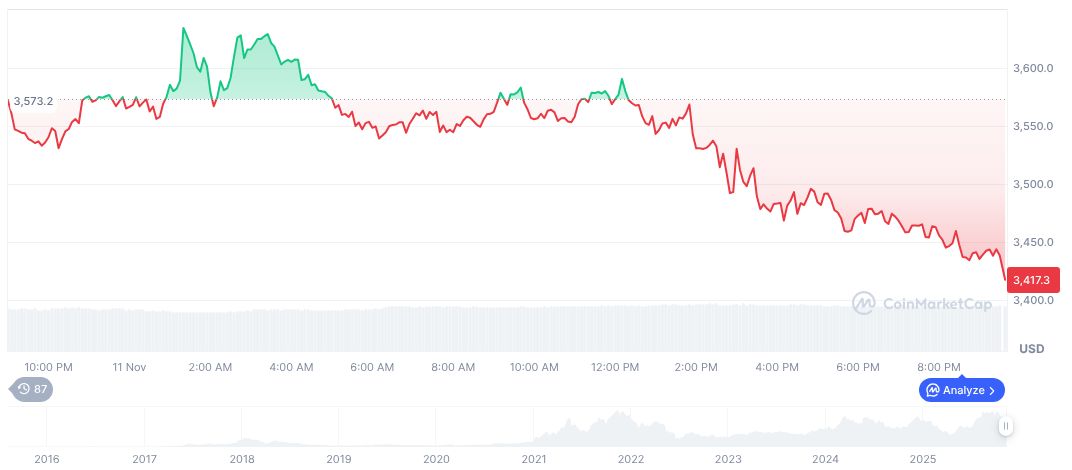
Ethereum's current metrics show a price of $3,408.21 with a market capitalization of $411.36 billion. The trading volume over the past 24 hours was $37.57 billion, reflecting a 3.99% price decrease in the last day. Ethereum has experienced a 17.50% decline over the last 30 days.
Insights from the Coincu research team suggest that federal budget decisions often exert background pressure on capital markets. Nevertheless, without direct crypto-related actions, the impacts tend to be modest. Historical analysis indicates that government fiscal decisions primarily influence traditional financial markets, rather than digital assets.