


Fiscal Maneuver to Address Government Shutdown
U.S. House Speaker Mike Johnson is planning a Wednesday vote on a stopgap funding bill aimed at ending the government shutdown. This legislative action seeks to stabilize the fiscal environment, which has implications for both U.S. and cryptocurrency markets.
The proposed bill intends to provide a temporary extension of government funding, which could lead to a reduction in market uncertainty. Institutional investors and the broader crypto market are closely observing these developments, as fiscal decisions of this nature often trigger immediate shifts in market sentiment.
Market responses have indicated resilience, with neutral funding rates for Bitcoin and Ethereum, possibly influenced by expectations of curtailed government shutdown effects. Statements from Circle’s CEO Jeremy Allaire concerning liquidity management through USDC mints highlight proactive measures being taken by significant entities in the crypto space.
Previous U.S. government shutdowns in 2013 and 2018–2019 resulted in increased market volatility, greatly impacting cryptocurrencies like BTC and ETH with notable trading spikes.
Bitcoin's Stability Amidst Shifting Fiscal Policies
As of November 10, 2025, Bitcoin (BTC) is priced at $105,446.93, with a market capitalization of $2.10 trillion and a 24-hour trading volume of $74.42 billion. Data indicates that BTC's price saw a 1.66% increase within a 24-hour period, though longer-term trends have shown a decline.
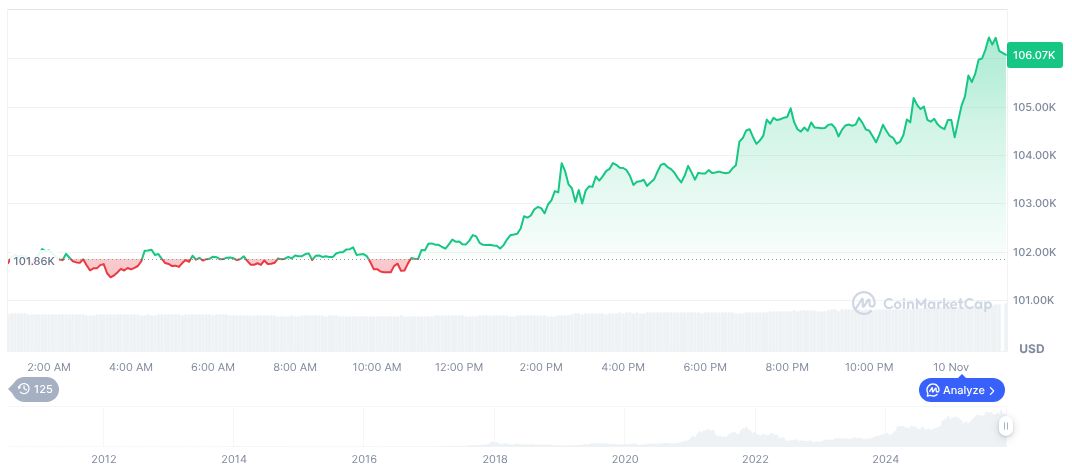
Analysis suggests that U.S. fiscal policies significantly influence crypto markets, particularly stablecoins like USDC. Historical data shows an increase in stablecoin issuance during periods of fiscal standoff, which substantially alters liquidity conditions. These patterns underscore Bitcoin's stable price movements even during times of monetary instability.