



New Guidance for Crypto ETP Staking Rewards
On November 11, U.S. Treasury Secretary Scott Bessent announced new guidance from the Treasury Department and IRS clarifying tax treatment for crypto ETP staking rewards. The guidance provides a clear regulatory path for crypto ETPs, potentially increasing institutional participation and innovation in proof-of-stake assets like Ethereum, Solana, and Avalanche.
Clarifying Tax Treatment for Staking Rewards
The U.S. Treasury Department, together with the IRS, has clarified the tax treatment of staking rewards within ETPs. According to Scott Bessent, this guidance provides an "explicit path" for asset management firms to offer digital asset yields without immediate tax implications for investors. This development aims to drive innovation and uphold the U.S.'s leadership in blockchain technology. The policy also removes a significant legal hurdle previously faced by fund sponsors, as noted by Bill Hughes, Senior Counsel at ConsenSys.
The implications include increased staking participation, improved liquidity, and enhanced network decentralization.
Positive Market Reception and Global Influence
Market reactions have predominantly been positive. The community anticipates increased asset management involvement, as reflected in favorable sentiment across various platforms. Key industry voices have welcomed the move, seeing it as a validation of mainstream staking models and a catalyst for fresh product launches.
The introduction of this policy is a first for the U.S. regulatory environment, potentially setting a precedent for global crypto ETP staking models.
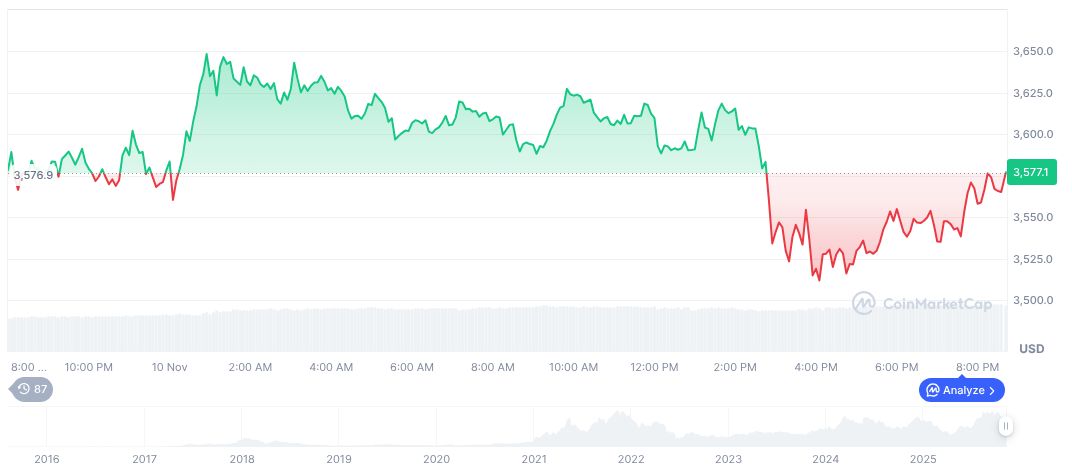
Ethereum (ETH), with a current price of $3,607.10, has seen a 0.57% price decrease over the past 24 hours. The cryptocurrency maintains a substantial market dominance of 12.12% with a 24-hour trading volume of $36,346,691,908.
The Coincu research team anticipates the updated policy to broaden the scope of regulated investment products. This may spur more entities to engage in decentralized networks, possibly catalyzing staking adoption not only in the U.S. but globally. Increased staking flows could further alter investment trust dynamics.