



Key Takeaways
- •Vitalik Buterin highlights the risks associated with relying on off-chain validators.
- •A 51% validator majority cannot execute asset theft within the blockchain's core consensus.
- •Developers and the community are urged to strengthen on-chain security measures.
Buterin's Warning on Off-Chain Trust
Ethereum co-founder Vitalik Buterin recently addressed concerns regarding blockchain security, specifically focusing on the potential vulnerabilities introduced by reliance on off-chain data and validators. On October 26, Buterin posted on the X platform, emphasizing that while Ethereum's consensus mechanism is resilient against 51% attacks that could compromise block validity, significant risks emerge when systems trust validators for actions outside the blockchain's direct control.
Buterin's caution is particularly relevant for protocols that depend on external data feeds, often managed by validator sets. He underscored that if these validators are entrusted with responsibilities beyond the blockchain's inherent security guarantees, the system becomes susceptible to manipulation. This scenario means that a colluding majority of validators could provide incorrect information, leading to detrimental outcomes for users with no recourse.
Ethereum's Market Performance and Expert Analysis
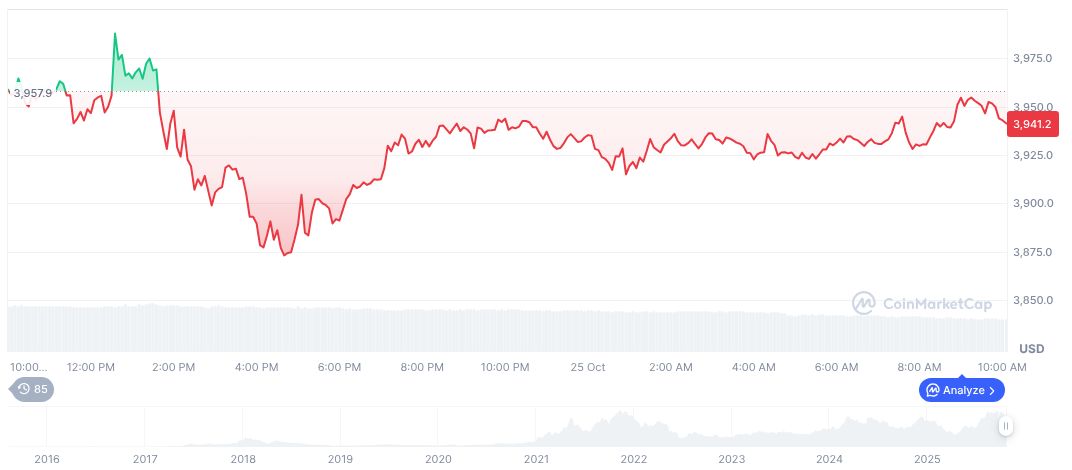
As of October 26, 2025, Ethereum (ETH) was trading at $3,934.51, marking a 4.85% increase over the preceding 24 hours. Its market capitalization stood at $474.89 billion, representing 12.63% of the total cryptocurrency market. Despite this recent upward trend, Ethereum has experienced a notable decline of 13.75% over the past 60 days.
The Coincu research team has echoed these concerns, suggesting that an increased reliance on off-chain trust mechanisms could elevate exposure to systemic risks within the cryptocurrency ecosystem. They advocate for a reevaluation of how protocols depend on validator-driven oracles, stressing the importance of enhancing the robustness of on-chain data. Developments in this area could significantly influence Ethereum's price stability and overall investor confidence.
"A key feature of blockchains is that even a 51% attack cannot render invalid blocks valid. This means that even if 51% of validators collude (or suffer a software vulnerability attack), users' assets cannot be stolen. However, if you start trusting your validator set to do other things outside the blockchain's control (off-chain), then this feature becomes invalid—at that point, 51% of validators could collude and give incorrect answers, and you would have no recourse." — Vitalik Buterin, Co-founder, Ethereum
Historical Context and Security Imperatives
Historically, failures in off-chain oracle systems have resulted in substantial financial losses. Prominent examples include the 2020 incidents involving bZx and Compound, which highlight the exact nature of the risks that Buterin is currently warning against. These past events serve as stark reminders of the vulnerabilities inherent in relying on external data sources.
The current market data indicates that Ethereum (ETH) is trading at $3,934.51, showing a 4.85% increase within the last 24 hours. This price action occurs against the backdrop of ongoing discussions about security and trust within decentralized systems.
Experts in the field are emphasizing the critical need for the community to remain vigilant and proactive in safeguarding against these off-chain risks. Reaffirming the importance of robust on-chain security mechanisms is paramount to maintaining the integrity and trust of decentralized platforms.