


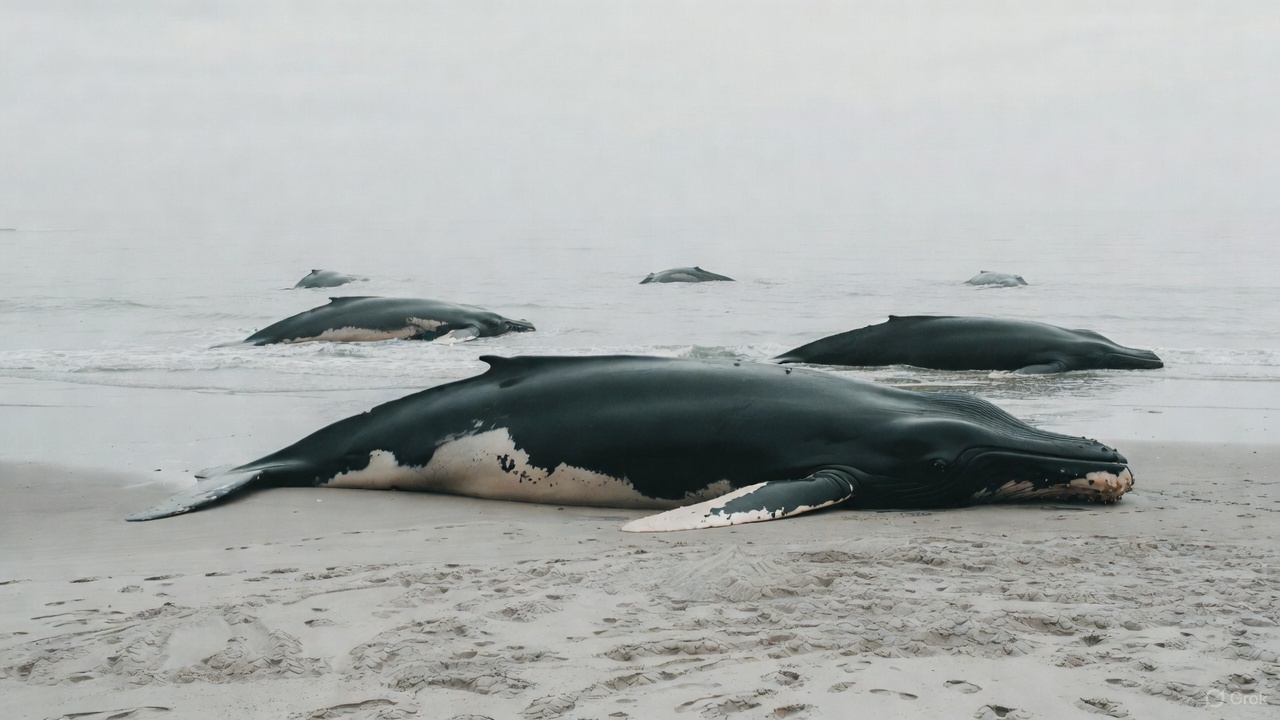
In the treacherous waters of the cryptocurrency market, where fortunes rise and fall like tidal waves, a brutal crash in 2025 has laid bare a savage truth: the very greed that propelled whales—those colossal institutional holders—to amass digital fortunes is now beaching them on the unforgiving sands of financial despair. As Bitcoin (BTC) holders bask in the glow of unrealized profits, Ethereum (ETH) and Solana (SOL) behemoths are flailing, their overleveraged hoards dragging them into the abyss. This isn't just a market correction; it's a morality tale of hubris, where the pursuit of exponential gains has left these titans gasping for air, their own avarice turning predator.
Picture the scene: a crypto ecosystem bloated by years of speculative frenzy, fueled by low-interest loans, margin trading, and the intoxicating promise of "to the moon." Whales like Michael Saylor's MicroStrategy (rebranded as Strategy in a nod to its crypto pivot) dove headfirst into BTC, betting the farm on its status as digital gold. But while Saylor's crew emerges relatively unscathed, their ETH and SOL counterparts—emboldened by the same greedy impulse to chase higher-risk, higher-reward plays—are now paying the piper. The divide isn't random; it's a direct consequence of unchecked ambition, where whales piled into volatile altcoins, leveraging up to eye-watering levels in hopes of outpacing BTC's steady climb. Now, as the tide recedes, they're exposed, their bloated positions forcing desperate sales that only accelerate the downturn.
The Bitcoin Maximalist's Advantage
Let's start with the winners, if only to highlight the folly of the losers. Strategy, the poster child for BTC maximalism, sits pretty with 649,870 BTC acquired at an average price of $74,433. Even amid the crash, with BTC hovering around $84,000, their unrealized profits clock in at a cool $6.15 billion—a 12.7% gain that would make any traditional investor green with envy. Saylor's philosophy? Treat BTC not as a speculative toy but as "productive capital," issuing innovative instruments like Stretch (STRC) preferred shares to fund further accumulation. It's a masterclass in restraint: buy low, hold tight, and let the network effects do the heavy lifting. No flashy side bets on meme coins or layer-1 hype trains—just pure, unadulterated Bitcoin conviction. In a market where fear, uncertainty, and doubt (FUD) reign supreme, this approach has kept them afloat, their greed tempered by a singular focus.
Ethereum Whales Face Devastating Losses
Contrast that with the plight of ETH whales, where greed morphed into a high-stakes gamble on scalability dreams that never quite materialized. Take BitMine Immersion Technologies, helmed by the once-bullish Tom Lee, who amassed the largest public ETH treasury: 3.56 million tokens scooped up at an average of $4,010 per ETH. Fast-forward to today's bloodbath, with ETH languishing below $2,700, and the math is merciless—unrealized losses of $4.52 billion, a gut-wrenching 31.7% wipeout. Lee's crew didn't stop at spot holdings; fueled by visions of DeFi dominance and NFT booms, they layered on leverage, borrowing against their stack to double down. It was a classic whale move: why settle for ETH's steady utility when you could juice returns with derivatives and yield farms? But as liquidity dried up and margin calls echoed through the exchanges, that greed turned toxic. Forced liquidations began in earnest, with BitMine offloading chunks of their position just to stay solvent, creating a feedback loop of selling pressure that sank ETH further. It's as if these titans, blinded by the allure of 10x gains, sailed their ships straight into a reef, only to watch them splinter under the weight of their own cargo.
Solana's Altcoin Avarice Leads to Ruin
The SOL saga is even more poignant—a stark emblem of how altcoin avarice can capsize even the fastest vessels. Forward Industries, the self-proclaimed SOL sovereign with 6.83 million tokens (the biggest public stash), bought in at $232.08 on average, riding the wave of Solana's "Ethereum killer" hype. Promises of blazing-fast transactions and dirt-cheap fees lured them like sirens, and greed did the rest: leveraged positions ballooned as they chased the next big dApp or meme token frenzy. Now, with SOL trading under $130 amid network outages and investor flight, Forward's ledger bleeds red to the tune of $711 million in losses— a 44.9% evisceration. Their story is the crash's cruel punchline: these whales didn't just hold; they overextended, using SOL as collateral for wild bets on ecosystem tokens that evaporated overnight. When the market turned, it wasn't a gentle ebb—it was a riptide. Automated deleveraging kicked in, stranding illiquid assets and forcing fire sales that devalued the very holdings they were meant to protect. Greed, once their propeller, became the anchor dragging them under.
Systemic Greed and On-Chain Data
This self-inflicted stranding isn't isolated; it's systemic. Whales across the board—pension funds, hedge shops, and corporate treasuries—succumbed to the same delusion: that crypto's upside was limitless, and leverage was just a tool to amplify it. Data from on-chain analytics paints a grim picture: ETH whale addresses with over 10,000 tokens have seen a 25% drop in net position value since the crash's peak, while SOL's top holders have liquidated 15% of their stacks in panic mode. BTC whales? They've barely flinched, their conservative stacking strategy yielding a 18% unrealized gain on average for holders with similar scale. The irony bites deep: the very pursuit of alpha over BTC's beta has left these giants high and dry, their greed exposing the fragility of overbuilt empires.
Future Outlook and Regulatory Scrutiny
Looking ahead, the fallout promises more pain. Regulatory scrutiny looms, with potential MSCI and Nasdaq 100 reclassifications by mid-2026 threatening to label high-crypto-exposure firms as "investment funds," forcing divestitures worth billions. Strategy alone could face a $2.8 billion sell-off mandate if thresholds aren't met. And as margin calls cascade, expect a culling: the article's prophecy rings true—prices are still inflated, meme coins will mostly perish, and only a lean 3,000 projects with real utility will survive the purge.
A Reckoning for Whale-Sized Egos
In the end, this crash isn't just about market mechanics; it's a reckoning for whale-sized egos. Greed drove them to the depths of speculation, and now it's beaching them on the shore of regret—exposed, diminished, and a cautionary tale for the next wave of dreamers. For the BTC faithful, it's vindication: sometimes, the greediest play is knowing when to stop. As for the ETH and SOL survivors? They'll need more than prayers to refloat their fleets. In crypto's wild seas, hubris doesn't just sink ships—it leaves the wreckage as a warning to all.