


Understanding Decred
Decred (DCR), short for Decentralised Credit, is a cryptocurrency built upon the foundational principle of genuine decentralized governance driven by its community, rather than centralized power structures. Emerging from the insights of early Bitcoin developers, Decred was conceived to address the inherent challenges observed in Bitcoin's decision-making process. These challenges included slow, often contentious upgrade pathways and a tendency for control to concentrate among a limited number of actors. The risk of disruptive hard forks and community fragmentation due to stalled major upgrades was a significant concern that Decred aimed to resolve.
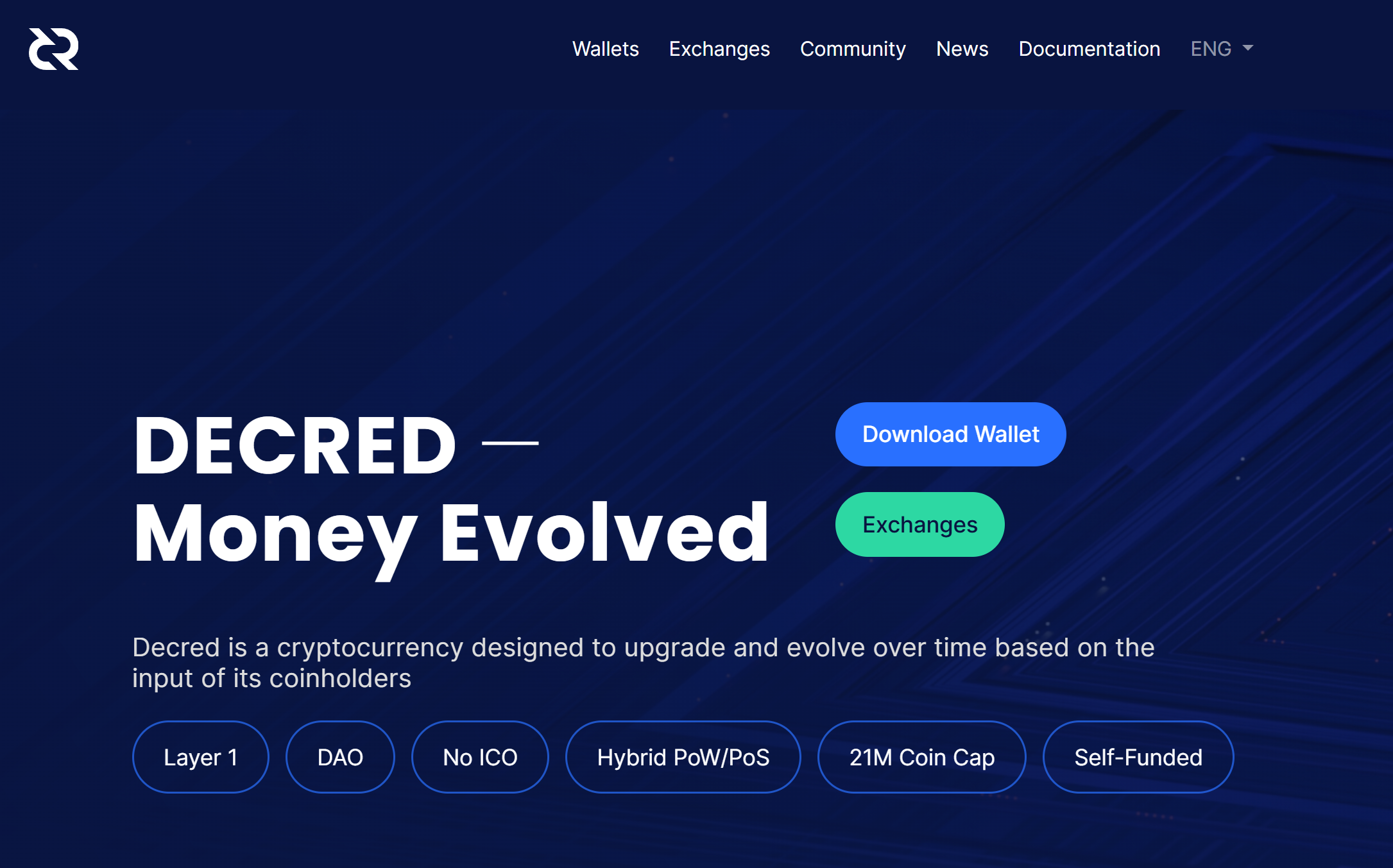
With the goal of creating a network that evolves transparently, equitably, and sustainably, Decred began by leveraging Bitcoin's codebase. It then underwent significant re-engineering to empower token holders and contributors with direct influence over protocol development and upgrades. This approach aims to achieve what many believed Bitcoin could have become in terms of on-chain democracy.
The core of Decred's architecture is a hybrid consensus system that harmoniously integrates Proof-of-Work (PoW) and Proof-of-Stake (PoS). In this model, PoW miners are responsible for securing the network and validating transactions. Concurrently, PoS participants play a crucial role in proposing and voting on governance decisions. This layered structure is designed to prevent any single entity from dominating the network, ensuring that those who hold and actively support the ecosystem have a meaningful say in its direction.
Governance within Decred is facilitated through Politeia, its dedicated proposal and voting platform. This system allows community members to submit proposals, allocate project funds, decide on new initiatives, and approve protocol-level changes. All these actions are conducted through transparent on-chain voting, establishing a functional model of decentralized decision-making where community consensus is not merely encouraged but is a prerequisite for progress.
In essence, Decred transcends the definition of a typical cryptocurrency; it represents a forward-thinking experiment in democratic blockchain governance. Its objective is to cultivate a network that evolves in tandem with its users, maintains resilience against centralization, and adapts continuously without compromising its fundamental values. Decred strives to embody the ideal of decentralized money that many envisioned for Bitcoin: a system that is fair, adaptable, and truly autonomous.
How Decred Works
Decred originated by forking Bitcoin's codebase, inheriting many of its fundamental characteristics. However, it has been enhanced with critical upgrades specifically designed to improve governance, increase flexibility, and ensure long-term sustainability.
Key Differences from Bitcoin
- •Block time: 5 minutes (compared to Bitcoin's 10 minutes)
- •Difficulty adjustment: approximately every 12 hours (compared to Bitcoin's 2 weeks)
- •Block reward distribution: shared among miners, stakers, and the treasury (whereas Bitcoin's reward goes solely to miners)
These modifications were implemented to foster a more balanced incentive structure and grant the community greater oversight over the network's evolution.
Hybrid Consensus: PoW + PoS
The cornerstone of Decred's operation is its hybrid Proof-of-Work (PoW) and Proof-of-Stake (PoS) consensus mechanism, which is instrumental in maintaining the security and decentralization of its blockchain.
PoW Miners
- •Utilize computational power to validate transactions.
- •Are responsible for building and proposing new blocks.
PoS Stakers
- •Lock DCR tokens to acquire non-transferable "tickets."
- •Participate in block verification and governance voting.
- •Act as a safeguard against malicious actions by miners.
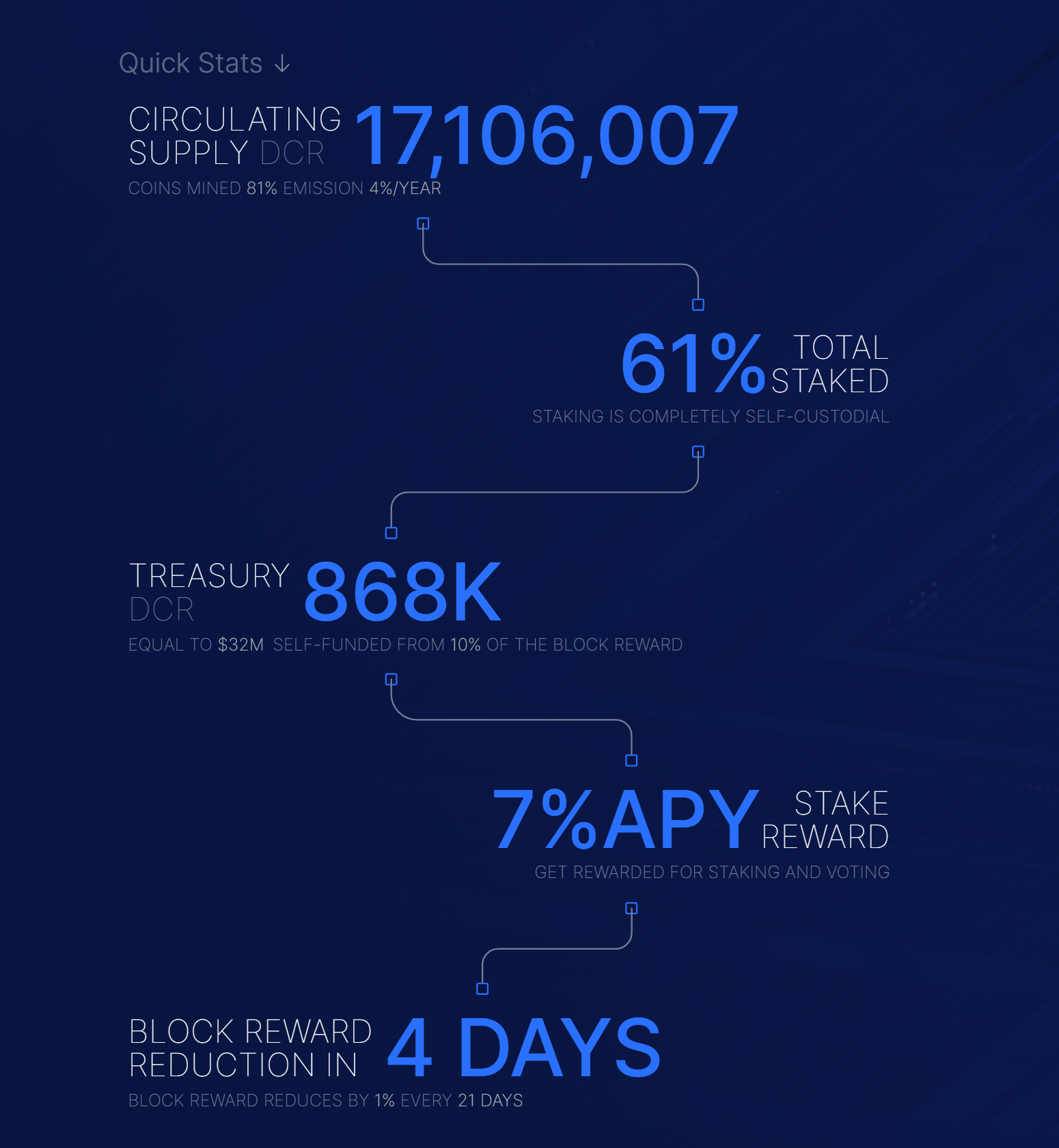
Each block generated includes 20 tickets, with 5 randomly selected to validate the block proposed by the miner. Upon successful verification and finalization, the block rewards are distributed according to the following allocation:
- •60% to PoW miners
- •30% to PoS stakers
- •10% to the Decred treasury
This dual-layer system effectively merges the security strengths of PoW with the democratic participation offered by PoS, thereby mitigating the risk of network centralization.
Politeia Governance Platform
Politeia serves as Decred's dedicated governance platform, enabling the proposal, discussion, and voting on network changes and funding allocations.
Through Politeia, Decred community members have the ability to:
- •Submit proposals for upgrades or policy changes.
- •Request funding for development initiatives.
- •Monitor proposal discussions and the outcomes of votes.
Every decision, ranging from feature development to the utilization of treasury funds, is conducted transparently and guided by the community, ensuring that governance remains free from insider control.
Pros and Cons of Decred
Decred Pros
Hybrid consensus for balanced incentives
Decred employs a hybrid PoW + PoS model, fostering a balanced ecosystem where miners, stakers, and users collectively contribute to network security and governance.
Active community-driven development
The project actively solicits input from its community, encouraging feedback and proposals to continuously enhance the protocol and its governance framework.
Transparent and democratic governance
Miners, users, and stakers can influence network upgrades through a clear and structured voting process, ensuring that decisions reflect the collective will of the participants.
Open participation and contribution model
Decred is designed around user empowerment, allowing anyone interested to contribute as a volunteer or contractor, thereby assisting in the development and maintenance of the ecosystem.
Decred Cons
Strong reliance on community participation
The project's success is significantly dependent on the active involvement of DCR holders. A lack of consistent and engaged community support could lead to slower decision-making and potentially weaken the network over time.
The BEST ways to get $DCR:
🏦 High Volume: @binance
⚡ Quick Access: @MEXC_Official
🛡️ Atomic-Swaps: @BisonWallet (no KYC)
💵 Fiat on-ramp: @AlchemyPayFor maximum security and privacy, use Bison Wallet (DCRDEX). Non-custodial atomic swaps mean you maintain full control of… pic.twitter.com/uHUQUWqTo6
— Decred (DCR) (@decredproject) October 12, 2025
Decred Conclusion
Decred represents one of the most ambitious endeavors to resolve the persistent challenge of blockchain governance, an issue that has significantly shaped discourse within the cryptocurrency space, particularly concerning Bitcoin's upgrade limitations and contentious forks. By integrating the security of PoW with the voting capabilities of PoS, Decred has established a system where network participants not only share value but also share responsibility. The outcome is a transparent, self-funded, and self-governing ecosystem engineered for evolution without compromising decentralization.
Nevertheless, like all systems driven by community participation, Decred's long-term viability hinges on the sustained engagement and involvement of its stakeholders. For individuals who champion decentralized autonomy and democratic blockchain governance, Decred stands as a significant experiment and potentially, a foundational model for future decentralized networks aiming to align incentives, participation, and protocol evolution effectively.