


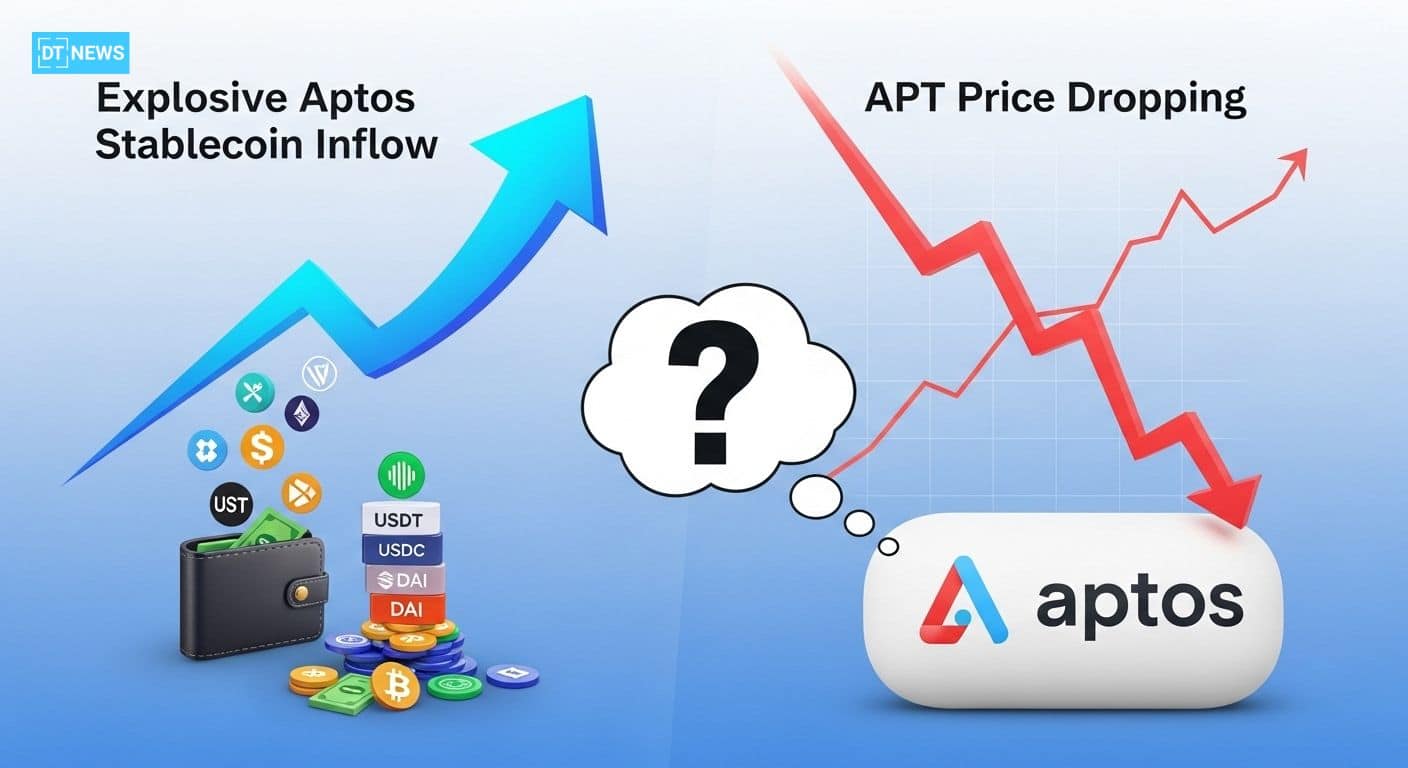
Aptos (APT) is currently experiencing a significant increase in its stablecoin supply, a trend that has even surpassed Ethereum's 24-hour inflows and indicates substantial on-chain liquidity. However, despite this influx of capital, the price of $APT has been declining. Experts attribute this divergence to a disparity between the expanding stablecoin supply and weaker fundamental metrics such as Decentralized Exchange (DEX) volume, transaction throughput, and sustained demand.
Stablecoin Inflows: Aptos Outpaces Ethereum and Solana
Aptos has witnessed a massive surge in stablecoin inflows, outperforming prominent blockchains like Ethereum and Solana. Recent on-chain data revealed that Aptos accumulated $528 million in stablecoins within a single day. Furthermore, reports from late October indicated that daily inflows had reached as high as $545 million.
This substantial increase in Aptos stablecoin inflows positions the network among the more active chains in terms of stablecoin activity, suggesting a significant rotation of capital into its ecosystem. This growth has fueled optimism that Aptos could develop into a key liquidity hub. However, this influx of capital has not been sufficient to bolster the price of APT.
Weak Fundamental Flows Amidst Rising Liquidity
While stablecoins are pouring into Aptos, the network's underlying fundamental metrics are not showing equivalent growth. According to DeFiLlama, Aptos's Total Value Locked (TVL) currently stands at approximately $525.7 million.
On-chain volume dynamics present a mixed picture. Despite the booming stablecoin inflows, the usage of decentralized exchanges (DEXs) has not grown proportionally. This suggests that a portion of these inflows may be passive, meaning capital is entering the ecosystem but not necessarily being actively traded or utilized in productive Decentralized Finance (DeFi) activities.
Upgrades and Scaling: Capacity Exists, but Demand Lags
Aptos boasts significant engineering strengths, particularly in its network speed. Following the AIP-131 (velociraptür) upgrade, block times improved to 94 milliseconds, representing an impressive 40% gain. Data from the Aptos Foundation reports 870,000 inputs and successful deployments within the last six months.
Under the hood, Aptos features a theoretical throughput of up to 160,000 transactions per second (TPS). However, real-world performance indicates an average of 44.91 TPS. This discrepancy suggests that the increased capacity has not yet been fully utilized, and actual demand and usage have not reached the network's maximum potential.
This gap between advanced technology and sub-par on-chain economic activity is a primary reason why $APT's price is not reflecting the substantial liquidity being provided to the network.
Price Dynamics: Selling Pressure and Market Sentiment
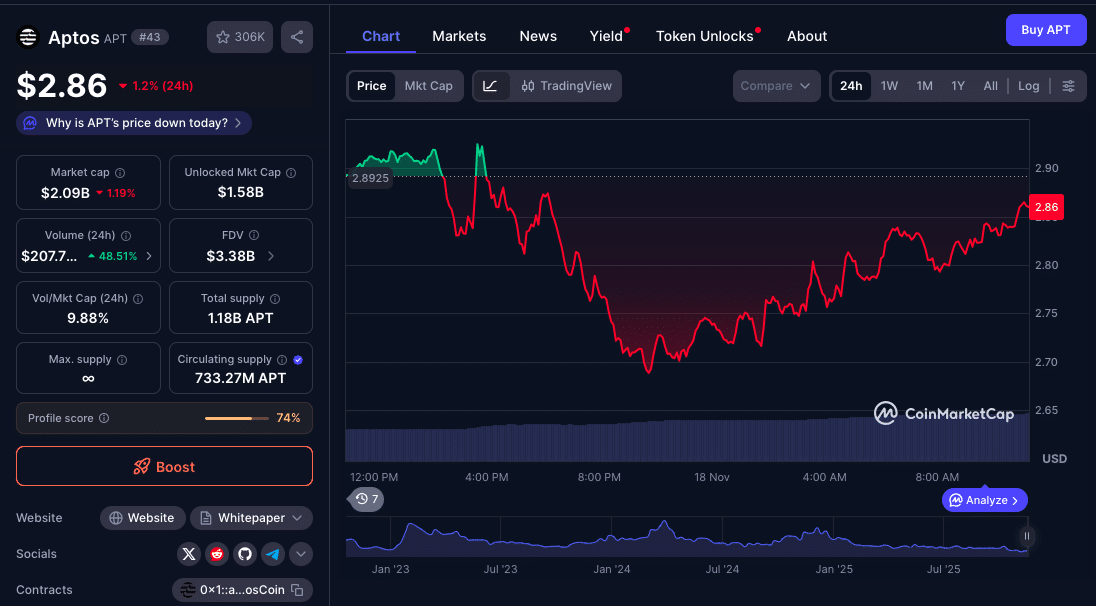
$APT's price is currently facing downward pressure. The token experienced a drop of over 10% in early November and has fallen below key HODL support levels around $3. On-chain traders and analysts interpret this as weak buyer demand, despite the notable inflows and on-chain usage.
A portion of the inflows appears to originate from stablecoins themselves, indicating that liquidity may not be translating into long-term accumulation or utilization of APT. This suggests that capital might be circulating through Aptos without generating lasting value, creating what could be described as a "liquidity illusion."
Implications for $APT Investors and the Network
The divergence between stablecoin inflows and price performance has several significant implications for investors and the Aptos network:
- •Liquidity Does Not Equal Price Support: High Aptos stablecoin inflows do not automatically translate to upward price pressure unless that capital is deployed productively within the ecosystem.
- •Underutilized Capacity: While Aptos's high throughput is a significant advantage, it remains underutilized if the demand for DeFi and DEX activity does not scale in parallel.
- •Developer Opportunity: The current situation presents an attractive window for developers. The network offers a fast, low-fee chain with substantial capital inflows but a depressed token valuation.
- •Key Metrics for Long-Term Health: Metrics such as TVL, DEX volume, block times, and active addresses will be more indicative of the network's long-term health than inflows alone.
Conclusion
There is no doubt that Aptos's stablecoin inflows are impressive, in some respects even exceeding those of major blockchains like Ethereum. However, the price of $APT is declining because this liquidity is not leading to sustained usage or value capture on the network. While technological upgrades have significantly improved network speed, basic operations and demand have not kept pace.
For both investors and developers, the critical question remains: can the Aptos network effectively convert its on-chain capital into real value-creating activity, or was this recent surge in liquidity merely superficial?
Glossary
- Aptos (APT)
- A Layer-1 blockchain focused on high throughput and low fees, utilizing the Move programming language.
- Inflows of Stablecoins
- The quantity of stablecoins, such as USDT and USDC, entering an ecosystem or blockchain over a specific period.
- Total Value Locked (TVL)
- The total value of assets locked within Decentralized Finance (DeFi) protocols on a blockchain.
- Block Time
- The average time it takes for a blockchain network to generate a new block of transactions.
- Throughput (TPS)
- Transactions per second, indicating the number of transactions a blockchain can process within a given second.
- DEX Volume
- The volume of trades executed on decentralized exchanges powered by a blockchain, serving as an indicator of user activity.
Frequently Asked Questions About Aptos Stablecoin Inflows
Why does Aptos have so many stablecoin inflows on its platform?
Stablecoin flows are increasing due to a robust on-chain and enterprise movement of capital into Aptos, solidifying its position as a network of choice for stable value transfer.
Why is $APT's price dropping when liquidity is high?
Much of the inflow may not be converting into long-term usage. While liquidity is growing, DEX usage, TVL, and overall demand are not rising at the same pace.
Is Aptos's technology that fast?
Yes, following the AIP-131 upgrade, Aptos's block time decreased to 94 milliseconds, enabling extremely high theoretical TPS. However, practical TPS remains lower.
What should investors watch to understand Aptos's future?
Investors should monitor key on-chain metrics, including Aptos stablecoin inflows, TVL, DEX volume, daily active addresses, and transaction throughput.