



Digital tools are increasingly acting as the great equalizer for small businesses, empowering them to compete effectively with larger corporations. The U.S. Chamber of Commerce highlights technology's role in leveling the playing field for smaller enterprises.
From cloud services to mobile payment solutions, small businesses across the United States are embracing technology to enhance their operations and expand their customer reach. A recent survey indicated that 99% of small businesses utilize at least one digital platform, a significant increase compared to the 72% of companies that use minimal or no technology. Notably, 89% of tech-savvy small businesses reported an increase in profits during 2023. Tools like e-commerce websites and online point-of-sale systems provide entrepreneurs with real-time sales data, enabling them to make informed adjustments to their marketing strategies and inventory management.
U.S. Small Businesses Embrace Digital Transformation
The digital transformation journey for U.S. small businesses has accelerated significantly since the onset of the pandemic. Today, nearly every small business employs some form of technology, including payment applications, social media platforms, accounting software, and collaboration tools.
Adoption rates are exceptionally high, with surveys showing that 96% of small business owners intend to adopt emerging technologies such as artificial intelligence and blockchain. Furthermore, 84% plan to increase their utilization of existing digital platforms.
Generative AI tools, for instance, are now used by 58% of small businesses, a substantial rise from 40% a year ago. Businesses that are early adopters of technology express optimism, with 82% of small and medium-sized businesses (SMBs) that use AI reporting an increase in hiring last year. Moreover, eight out of ten of these businesses credit technology with helping them navigate challenges posed by inflation and supply chain disruptions.

Businesses that lag in digital innovation often find themselves falling behind. Data consistently shows that small businesses with high technology adoption experience stronger sales and profit growth compared to their less tech-enabled counterparts. A report by the U.S. Chamber further substantiates this, finding that small businesses utilizing multiple tech platforms have seen increased profits.
Another survey reveals that 77% of SMBs plan to integrate metaverse and AI tools into their operations. This trend signifies a growing reliance on online marketing, cloud software, CRM systems, and digital payment solutions for daily business activities. Whether custom-built or off-the-shelf, these digital tools are fundamentally reshaping the landscape for small businesses across the United States.
Digital Payments and Data Insights Drive Efficiency
Digital payment and point-of-sale systems represent some of the most impactful tools available to small businesses. As consumer preferences shift towards cashless and mobile transactions, small retailers are increasingly adopting card readers, smartphone payment applications, and even cryptocurrency gateways.
These systems offer more than just transaction processing; they generate valuable data. Mastercard reports that small businesses using digital payment platforms can gain insights into their best-selling products, manage inventory more effectively, and refine their social media marketing efforts based on real-time sales data.
Digital payments also contribute to cost savings and faster fund availability. PayPal's "Pay with Crypto" feature exemplifies this trend, allowing U.S. merchants to accept over 100 cryptocurrencies. These can be instantly converted to USD or stablecoins, potentially reducing transaction fees by up to 90% compared to traditional credit card payments.
According to PayPal CEO Alex Chriss, this innovation enables a small gift shop in Oklahoma City to accept crypto payments, thereby increasing profit margins, lowering transaction fees, and gaining near-instant access to funds.
Digital Tools and Their Benefits for Small Businesses
| Tool Category | Examples | Business Impact |
|---|---|---|
| Payment Systems | Square, PayPal, Coinbase Commerce | Faster, lower-cost transactions (fees up to 90% lower with crypto); rich sales data for inventory and marketing. |
| Social Media & Email | Facebook, Instagram, Mailchimp | Customer outreach; drives brand awareness and repeat sales. 90% of SMBs use social media and 53% rely on email marketing. |
| Cloud and Collaboration | Zoom, Slack, AWS | Enables remote work and team coordination; provides scalable infrastructure, improving efficiency with no local hardware costs. |
| AI and Automation | ChatGPT, ML Tools, BI Analytics | 58% of SMBs use AI; automates tasks (chatbots, scheduling), boosts productivity, and provides predictive insights. |
| CRM & Analytics | Salesforce, QuickBooks, Tableau | Centralizes customer data and finances, enabling data-driven decisions for better targeting and inventory management. |
Smart Marketing and Customer Engagement
Digital marketing tools have empowered small businesses to connect with customers far beyond their immediate geographic area. Approximately 90% of U.S. small businesses now leverage social media for product promotion and customer engagement as part of their marketing strategy.
Consumers frequently research brands on platforms like Facebook and Instagram before making purchases, with 78% of shoppers engaging in this practice. Businesses that actively interact with customers on these platforms often see positive results. For instance, content from a local café can gain viral traction within a community at no cost, generating valuable word-of-mouth business.
Email marketing remains a potent digital tool, with over half (53%) of small business owners identifying it as their primary method for customer acquisition and retention. These platforms allow business owners to distribute newsletters, promotions, and reminders with minimal expense.
Additional web-based tools for managing customer relationships and sales funnels include Customer Relationship Management (CRM) software, such as HubSpot or Zoho. These systems centralize contact information, manage email campaigns, and automate follow-up processes.
Analytics platforms, including Google Analytics and those integrated into social media services, provide insights into which advertisements or posts are driving clicks and engagement.
In essence, digital tools transform traditional advertising expenses into highly targeted and measurable campaigns for small businesses.
AI, Cloud, and Enhanced Operational Efficiency
Beyond payments and marketing, numerous small businesses are adopting technologies like cloud computing and artificial intelligence. Cloud services, such as Google Workspace, Microsoft 365, and AWS, offer cost-effective infrastructure solutions. Businesses can manage their email, file sharing, and website operations through subscription-based services without the need for on-site server hardware.
This shift facilitates collaboration, allowing employees and contractors to work from any location while reducing IT overhead.
Artificial intelligence is increasingly accessible to small businesses. Currently, 59% of U.S. small businesses utilize AI-powered tools, a significant increase from the previous year. These applications range from simple uses like employing ChatGPT for marketing copy or customer service inquiries to more advanced AI-driven solutions for inventory forecasting and automated ordering systems.
The initial results of AI adoption are promising, with 82% of SMBs using AI reporting workforce growth, suggesting improvements in productivity or revenue. AI and automation can manage routine tasks such as scheduling, bookkeeping, and customer support, freeing up business owners to concentrate on strategic initiatives.
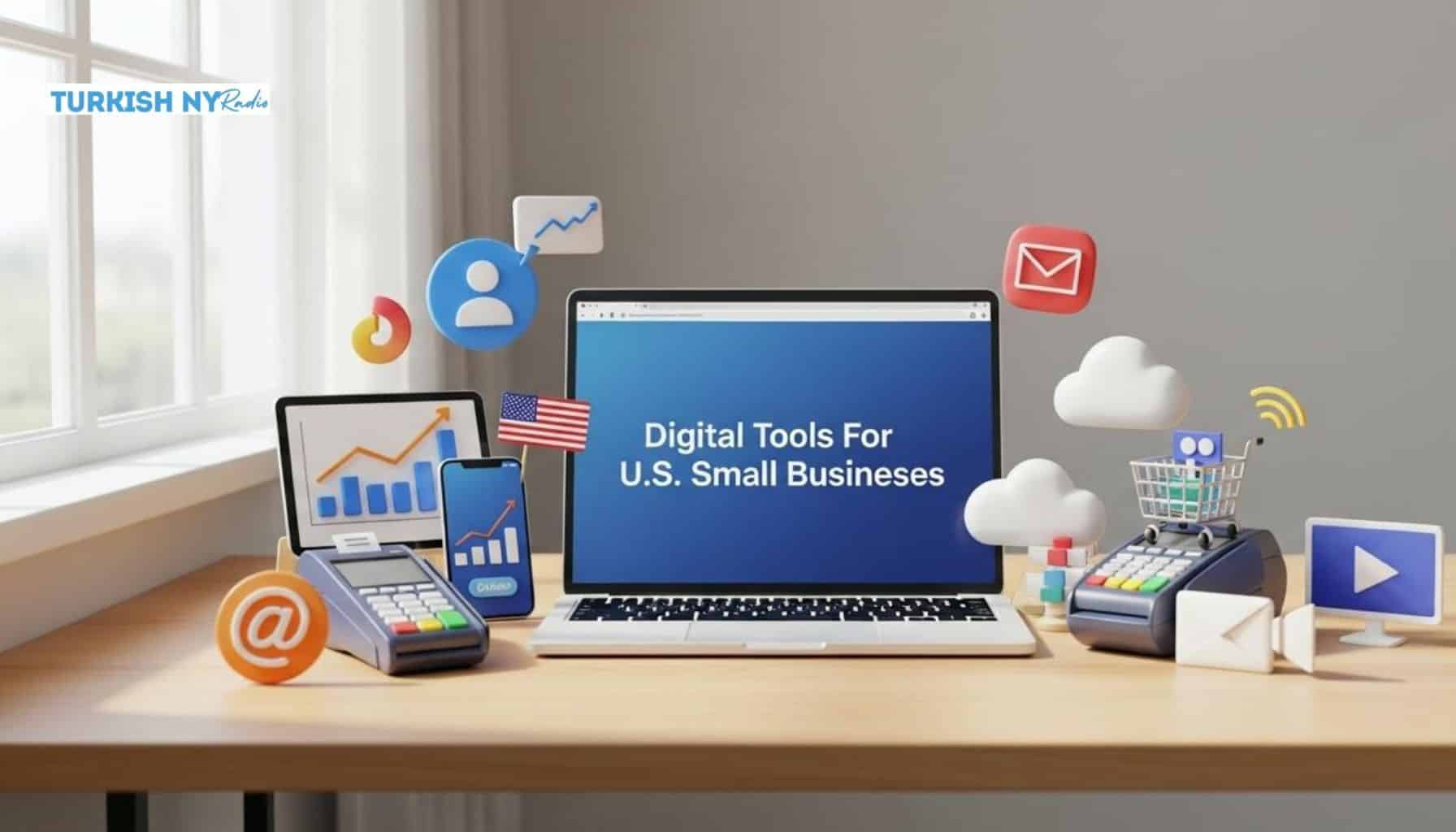
Collectively, cloud and AI tools enable small businesses to enhance their performance. For example, an independent bookstore can utilize cloud-based point-of-sale software to synchronize inventory across multiple locations and transmit updates to suppliers.
An online retailer can leverage machine learning to provide personalized product recommendations or optimize pricing strategies. The outcome is a more efficient and data-driven operational model, which is rapidly becoming the standard.
Today's digital tools for small businesses encompass not only basic applications but also sophisticated analytics and AI capabilities that were once exclusively available to large enterprises.
Expert Analysis: Opportunities and Challenges
Experts note that while digital tools offer significant growth potential, they also introduce new challenges. A report by the Information Technology and Innovation Foundation (ITIF) suggests that U.S. small manufacturers could achieve productivity gains ranging from 7% to 50% by adopting advanced digital technologies such as IoT sensors, robotics, and 3D printing.
However, realizing these benefits requires overcoming several obstacles. Small businesses often lack the financial resources for equipment upgrades or staff training on new software. Policymakers and industry groups emphasize the need for support and training initiatives to assist Main Street businesses in their technological advancement.
Regulatory uncertainty also presents a concern. A survey indicates that 65% of small businesses fear that complex state and federal AI regulations will increase their compliance costs. Many owners express interest in cryptocurrency tools but remain cautious due to policy developments.
Approximately 70% of small business owners are interested in using cryptocurrencies or stablecoins in their operations but are closely monitoring policy shifts. Experts, including U.S. Chamber vice president Tom Sullivan, advocate for sensible regulations, stating, "Small businesses that fully embrace technology outperform their peers and are more optimistic about the future."
On the technological front, cybersecurity is an escalating concern. As small businesses increasingly rely on cloud and AI technologies, securing their data becomes paramount. Consequently, many are adopting security-as-a-service solutions or engaging managed IT providers.
Analysis suggests that while digitalization enhances the competitiveness of small businesses, it also significantly increases their vulnerability to cyber risks. Therefore, balancing innovation with robust security measures is essential.
In conclusion, experts view the digital shift as overwhelmingly positive, provided that businesses and regulators effectively address education, infrastructure, and security. When implemented correctly, digital tools can level the playing field for small businesses and foster innovation across all sectors.
Conclusion
Digital tools have transitioned from being optional conveniences to essential components for small businesses. Companies that fully embrace digital platforms experience accelerated sales and profit growth, while those that do not risk falling behind.
From mobile payment applications and e-commerce sites to AI-driven marketing and cloud services, the appropriate combination of tools empowers U.S. small businesses to reach a wider customer base, operate more efficiently, and better withstand economic fluctuations.
Current data strongly suggests that the businesses poised for future success are those that consistently invest in and integrate digital technology today.
Glossary
Digital Transformation – The process of using digital technology, such as cloud computing, AI, and mobile applications, to improve business operations and services.
Fintech – Financial technology tools, including online lending platforms, mobile wallets, and cryptocurrency payment solutions, designed to make financial services faster and more accessible for businesses.
Cloud Computing – An internet-based computing model where data and software are stored on remote servers (the "cloud") and accessed online, eliminating the need for on-site physical servers.
Customer Relationship Management (CRM) – Software that helps businesses manage customer information and interactions, track leads, and automate marketing efforts (e.g., HubSpot, Salesforce).
E-commerce Platform – Online marketplaces or website builders (e.g., Shopify, WooCommerce) that enable businesses to sell products and services online.
Frequently Asked Questions About Digital Tools for Small Businesses
What are digital tools for small business?
Digital tools for small businesses include mobile payment apps (like Square, PayPal), e-commerce websites (like Shopify), marketing tools (social media, email marketing), cloud software (such as Zoom, CRM systems), and AI assistants (like ChatGPT).
How do digital tools help small businesses?
Digital tools facilitate faster transactions, reduce costs, and enable data-driven decision-making. For example, businesses that utilize technology have seen profit increases in 89% of cases. Tools like digital payments and analytics provide crucial insights for adjusting inventory and marketing strategies.
Are U.S. small businesses using new tech (AI/crypto)?
Yes, U.S. small businesses are increasingly adopting new technologies. Over half now use AI tools, and 70% of SMB owners express interest in using cryptocurrencies or stablecoins for their businesses. Adoption is growing as owners seek greater efficiency and new payment options.
What marketing tools do small businesses use?
Small businesses commonly use social media for promotion, with 90% utilizing these platforms. Additionally, 53% rely heavily on email marketing. These digital channels allow small businesses to reach a broad customer base cost-effectively.