



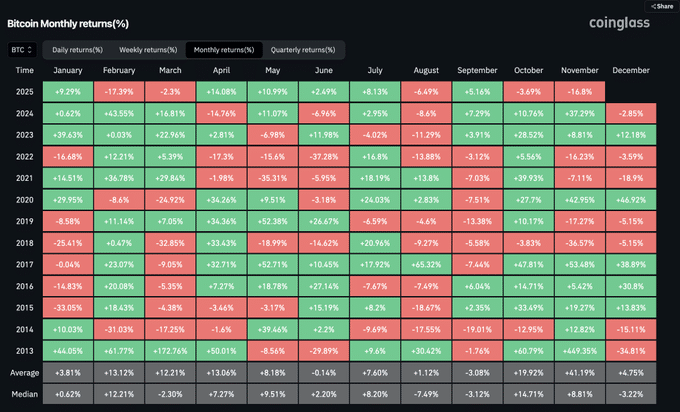
The Bitcoin price closed November with a steep 18.93% loss, a decline that caught many traders off guard as most had expected a late-year rally. Instead, the market shifted into caution.
The drop also raised concerns about the strength of Bitcoin’s short-term momentum. The November slump stemmed from several overlapping pressures.
Macroeconomic uncertainty was a significant factor, compounded by increased regulatory scrutiny. Additionally, many investors took profits after October’s robust rally. These catalysts collectively drove the Bitcoin price to one of its most significant monthly declines in 2025.
Historical Trends Signal Possible December Recovery
Even with recent weakness, long-term optimism remains steady. Historical data offers a small boost for bullish traders. Over the last decade, December has produced an average gain of 4.75% for Bitcoin.
Many of Bitcoin’s strongest months have also occurred in December. Seasonal patterns, retail participation, and rising holiday liquidity often drive these gains. This trend leads analysts to watch December 2025 closely.
If the pattern repeats, the Bitcoin price may recover a portion of its losses. Some analysts even believe new highs are possible if sentiment improves.
Bitcoin Price Nears a Key Weekly Demand Zone
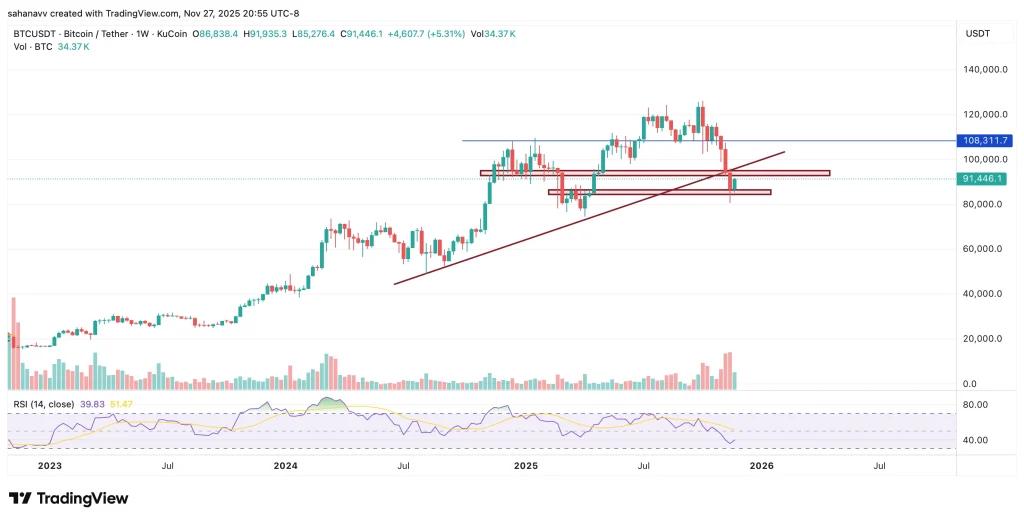
The Bitcoin price now trades near $91,358, an area situated within a major weekly demand zone.
The range between $89,500 and $92,000 held strong earlier this year and fueled the breakout above $95,000. Traders are now watching this area closely, with many seeing it as the next major pivot point for the market.
Why the $89,500 Support Matters
The $89,500 level is an important structural zone, marking the last confirmed higher low on the weekly chart. As long as the Bitcoin price holds above this level, the market maintains its bullish structure. A rebound from this area could lift the price back toward $93,800.
A clean move above that level could push BTC to retest $95,200. Market analysts note that this zone often attracts strong spot demand, with buyers having stepped in here before. Bulls are now hoping to see the same reaction.
What Happens if Support Fails
A breakdown below $89,500 would shift the outlook, potentially causing the zone to flip into supply. This scenario would open the door for a deeper correction.
The next major support sits near $86,700. A drop toward that range would signal weak demand and a short-term bearish shift. This move would also mark the first major structural breakdown of the current cycle.
Momentum Indicators Show Cooling Demand
Momentum metrics indicate a slowdown, with spot flows having eased and derivatives remaining neutral. This creates a balanced setup where increased liquidity on both sides often precedes volatility. As long as the Bitcoin price forms a higher low above $89,500, the broader structure remains intact.
| Month | Min. Price | Avg. Price | Max. Price | Change |
|---|---|---|---|---|
| Nov 2025 | $ 89,991 | $ 94,398 | $ 98,000 | 7.06% |
| Dec 2025 | $ 90,095 | $ 90,153 | $ 90,195 | -1.47% |
The weekly RSI has also moved near its lower threshold, a condition not seen since December 2022. This reading suggests the recent rally may be exhausted and hints at a possible technical rebound.
Trend Line Break Adds Pressure
Bitcoin recently broke its long-standing ascending trend line, which had been held as support since July 2024. This break increased caution across the market. Bulls attempted to stage a rebound, but the recovery lacked strength, and sellers continue to defend the upper range.
To regain momentum, the Bitcoin price must clear resistance between $93,000 and $97,000, a zone that has blocked several attempts to climb higher. Breaking above it would open the door toward new highs. Failure to move past it may keep BTC in a consolidation phase.
Conclusion
November delivered a sharp setback for Bitcoin, but December still holds potential. Strong historical performance, seasonal liquidity, and key support zones may help stabilize the Bitcoin price.
Traders are now watching macro signals, institutional flows, and key price levels. The next few weeks could define Bitcoin’s path into early 2026.
Appendix: Glossary of Key Terms
Bitcoin Price: The current market value of Bitcoin across major exchanges.
Demand Zone: A price area where buyers usually show strong interest.
Support Level: A key price floor that helps prevent further decline.
Resistance Zone: A price ceiling where sellers often block upward moves.
Momentum Indicators: Tools that measure the strength of price movement.
RSI: A technical indicator that shows overbought or oversold conditions.
Trend Line: A line that tracks the overall direction of the market.
Liquidity: How easily an asset can be bought or sold without large price changes.
Frequently Asked Questions Bitcoin Price
1. Why did the Bitcoin price fall in November?
Macroeconomic pressure, regulation, and profit-taking caused the decline.
2. Does Bitcoin usually rise in December?
Yes. December averages a 4.75% gain over the past decade.
3. What is the most important support level now?
The $89,500 zone is the key level for the Bitcoin price.
4. What if Bitcoin breaks below $89,500?
It may drop toward $86,700 and signal a bearish shift.