


Ethereum, the second largest cryptocurrency by market value, is experiencing price movements that are closely watched across the crypto landscape. By the end of September 2025, ETH products are projected to be trading around $3,163, reflecting a recovery from lower prices but still below the ambitious highs anticipated by many long-term investors. This raises the question of Ethereum's performance trajectory for 2025 and 2026, considering recent technological advancements, ETF inflows, and broader market trends.
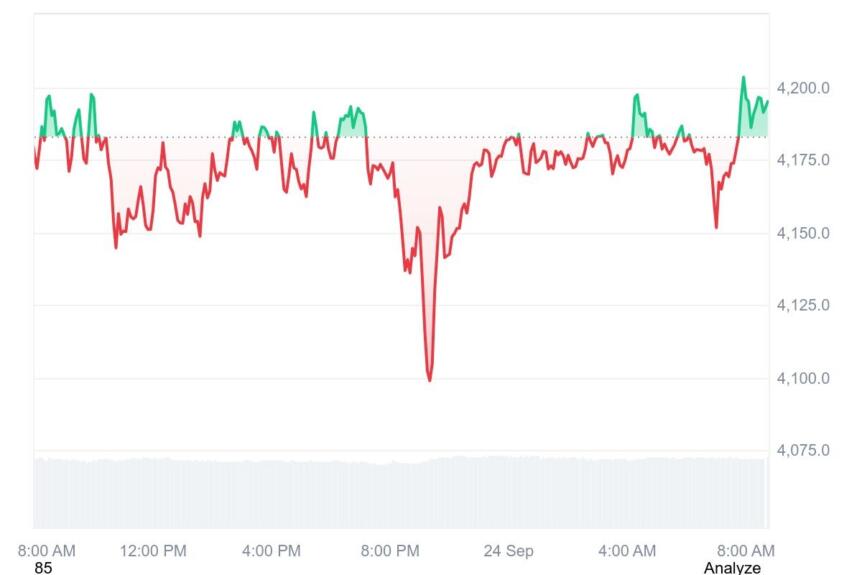
Current Position
Ethereum has navigated significant volatility throughout 2025. The Pectra upgrade, implemented in May, marked a step towards cheaper and faster transactions, building upon the previous Dencun update. The introduction of spot Ethereum Exchange-Traded Funds (ETFs) has also created a new investment avenue, with products like the one from BlackRock attracting billions in assets. Concurrently, only approximately 30 percent of ETH is staked, which restricts liquidity and offers a yield incentive to long-term holders.
These developments are setting the stage for Ethereum's next phase, although the global economic climate will ultimately play a decisive role. The allocation of capital between cryptocurrencies and traditional assets continues to be influenced by inflation, interest rates, and global risk sentiment.
Key Drivers Ahead
Several factors will influence whether Ethereum's price increases, stabilizes, or declines:
- •ETF flows: Sustained inflows into spot ETH ETFs could establish a consistent demand base, particularly from institutional investors who previously abstained from direct crypto exposure.
- •On-chain activity: High network usage results in more ETH being burned through transaction fees, which tightens supply. This dynamic was a significant factor during previous bull markets.
- •Staking participation: With nearly one-third of ETH locked in staking, any increase in staking rates will further constrain supply, while a decrease could release liquidity back into the market.
- •Macro conditions: A favorable economic environment, such as interest rate cuts or a resurgence of risk appetite, would likely boost ETH's price. Conversely, recessionary fears or a liquidity crunch could negatively impact prices.
Price Scenarios for 2025
Analysts generally foresee three primary price directions for Ethereum in 2025. In a bearish scenario, ETH could trade between $2,500 and $4,500 if the macroeconomic environment deteriorates, regulations become restrictive, or ETF inflows decline. A base case scenario anticipates ETH trading between $4,500 and $7,000, reflecting stable growth, moderate inflows, and healthy on-chain activity. In a bullish scenario, ETH might surpass $7,000 and potentially reach $10,000, driven by high ETF demand, seamless network upgrades, and an accelerated pace of crypto adoption.
Outlook for 2026
Over the next year, Ethereum's price trajectory is expected to be marked by uncertainty. An unfavorable economic climate could limit ETH's price to approximately $5,500, while a moderate growth trend might place it in the $5,500 to $10,000 range. The most optimistic predictions suggest prices could reach $15,000 and beyond, which would require the simultaneous occurrence of multiple positive factors: strong institutional inflows, significant network usage leading to ETH burns, and the widespread adoption of new areas like real-world assets, restaking, and advanced DeFi protocols.
Balanced View
A more grounded perspective suggests that Ethereum will continue to serve as the foundational layer for decentralized finance and on-chain applications, while also becoming an investable asset class through ETFs. This implies a steady upward trend rather than a parabolic surge. A price range of $5,000 to $7,000 is plausible for 2025 if current trends persist, with $8,000 to $10,000 becoming conceivable in 2026 amid continued growth.
However, investors must remain cognizant of potential risks. Confidence could be significantly undermined by stringent regulations, macroeconomic downturns, or major security incidents. Conversely, a surge in demand for decentralized applications, restaking protocols, or tokenized assets could accelerate Ethereum's price appreciation.
Conclusion
The price trend of Ethereum in 2025 and 2026 will be shaped by a confluence of technological upgrades, institutional investment flows, and global market dynamics. While some optimistic forecasts predict prices reaching $15,000, a more pragmatic outlook suggests ETH will likely trade within the $5,000 to $10,000 range over the next two years. The realization of these catalysts will ultimately determine whether Ethereum surpasses these levels or struggles to maintain its current standing.