


For over a decade, United States crypto firms have navigated a complex web of overlapping regulations. Different agencies have applied distinct interpretations to digital assets, with one viewing a token as a commodity, another as a security, and a third focusing solely on anti-money laundering measures. The Securities and Exchange Commission's (SEC) revised 2025 regulatory plan seeks to move beyond this history of enforcement-driven confusion and establish a more structured framework for digital assets.
This new roadmap promises more than just additional rules. It connects the SEC's agenda to a broader policy reset in Washington, a leadership change within the agency, and a coordinated initiative known as Project Crypto. The collective aim of these efforts is to provide token issuers, exchanges, custodians, and investors with clear, forward-looking expectations, something they have rarely experienced in the United States.
A New 2025 Roadmap After Years of Regulatory Fog
The Spring 2025 Regulatory Flexibility Agenda positions crypto assets prominently on the near-term rulemaking list. The agenda outlines potential rules concerning the offer and sale of crypto assets, crypto market structure, custody, transfer agents, and broker-dealer responsibilities. The stated objective, while simple to articulate, presents significant practical challenges: the SEC aims to establish clear rules for the issuance, trading, and safekeeping of digital assets while simultaneously combating fraud and market abuse.
Legal analyses suggest that this plan extends beyond the introduction of new restrictions. It also intends to scale back or postpone several legacy items from the previous administration and to reduce unnecessary disclosure burdens for public companies. This includes companies that hold crypto on their balance sheets or develop token-based products, indicating a shift toward supporting capital formation and market efficiency, rather than solely focusing on punitive measures.
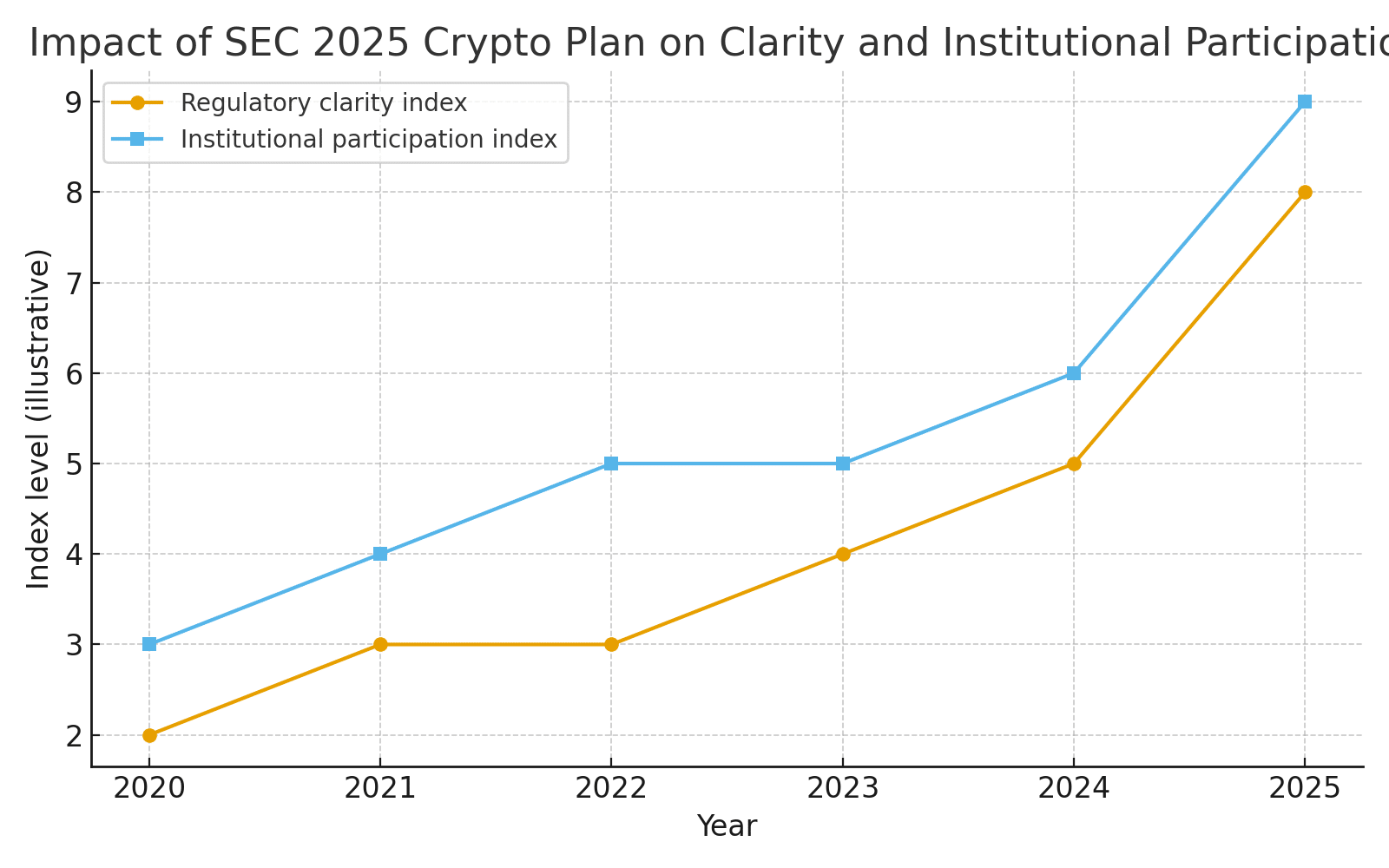
Recent actions reinforce this narrative. In early 2025, the SEC rescinded a controversial accounting bulletin that required custodians of digital assets to list those assets as liabilities. Banks and trust companies had argued that this bulletin made it prohibitively expensive to serve crypto clients. The removal of this bulletin signaled a willingness from the new leadership to reconsider past decisions that had discouraged institutional custody.
Inside Project Crypto and the Crypto Task Force
Alongside the formal agenda, Project Crypto has emerged as the public face of the SEC's new regulatory philosophy. In recent speeches, the SEC chair has described Project Crypto as a multi-year endeavor to apply federal securities laws based on the functional operation of tokens, rather than on their labels or on fear-driven narratives. The SEC Crypto Task Force, which existed prior to the current chair's tenure but has recently gained increased authority, is undertaking several key responsibilities. These include drawing a clearer distinction between securities and non-securities, developing tailored disclosures for token projects, and mapping out practical registration pathways for both assets and intermediaries. The task force also aims to ensure that enforcement resources are directed towards genuine misconduct rather than technical violations stemming from regulatory uncertainty.
Commentary from regulatory specialists highlights that Project Crypto is closely aligned with a broader effort to harmonize regulations with the Commodity Futures Trading Commission (CFTC). The CFTC has been moving towards permitting spot crypto trading on registered futures exchanges, coordinating with the SEC to prevent firms from being caught between conflicting standards. This coordination is crucial for supporting tokenized products that may straddle the lines between securities and commodities.
What the 2025 Plan Means for Exchanges, Brokers, and Custodians
The 2025 agenda could significantly impact trading venues. The SEC is considering amendments to crypto market structure rules that would clarify how national securities exchanges and alternative trading systems can handle crypto asset securities, and potentially certain non-security tokens, on regulated platforms. Currently, a substantial portion of spot volume is processed through offshore or less regulated venues. Moving more activity into regulated environments, equipped with surveillance and reporting rules similar to those in the equities market, would alter the risk profile of the entire market.
Broker-dealers and custodians are central to this transition. Draft policy proposals include updated custody rules specifically addressing digital assets, clearer criteria for identifying qualified custodians, and revised financial responsibility rules that reflect the practical realities of token settlement and wallet technology. Legal observers anticipate that the SEC will recognize a broader range of bank and trust models as eligible custodians, thereby enabling more traditional financial institutions to serve crypto clients on a larger scale.

For decentralized projects, questions remain. If a protocol handles order routing, price discovery, or automated market making, at what point does it become classified as an exchange or an alternative trading system under securities law? The agenda indicates that these issues will be addressed through more explicit guidance, rather than solely through case-by-case enforcement. This guidance will be critical for determining the extent to which DeFi platforms can operate while remaining accessible to United States users.
How the Plan Could Change Market Behavior
If the SEC successfully implements its 2025 roadmap, the practical implications could be substantial. Token development teams may gain well-defined offering pathways, including exemptions and safe harbor models that permit early innovation while still safeguarding buyers. Asset managers might receive clearer authorization to hold spot crypto and tokenized instruments within funds catering to retail investors. Large institutions may finally feel confident transitioning from pilot projects to full product lines.
This does not imply the elimination of risk. Projects that disregard disclosure rules or mislead investors are still likely to face enforcement actions. However, the emphasis will shift from navigating ambiguous rules to strategic planning around established guidelines. Over time, this is expected to lower the cost of capital for credible projects and encourage weaker ones to improve or withdraw from the market. For a market that has experienced numerous boom and bust cycles, a more predictable policy environment could prove as valuable as a single positive market headline.
Key Crypto Indicators That Matter Even More Under the New Rules
Regulation does not supersede market fundamentals. Under a clearer 2025 framework, several indicators will become even more critical for analysts and long-term participants. Trading volume and liquidity are paramount. Deep order books on regulated venues suggest that institutions are comfortable with both the asset and its surrounding regulatory framework. Thin liquidity, particularly when accompanied by significant promotional activity, remains a classic warning sign.
Volatility is another key metric. While crypto is likely to remain more volatile than most traditional asset classes, the pattern of volatility is important. A market that reacts sharply to every regulatory announcement indicates a lack of clarity. As the new rules are finalized, sustained price spikes in response to routine policy news may gradually subside, leading to calmer market reactions.
On-chain flows and stablecoin activity also provide valuable insights. An increase in stablecoin supply and active on-chain transfer volumes can signal growing utilization of crypto networks for payments, collateral, and settlement. In an environment with formal custody and market structure rules, these flows may increasingly connect with regulated institutions rather than solely with offshore operations.
Market dominance and rotation tell a parallel story. Changes in the proportion of total market value held by the largest assets often reflect risk appetite. If clear regulation attracts more conservative capital to the market, dominance measures for established assets may increase relative to smaller, speculative tokens. None of these indicators should be viewed in isolation, but collectively they can illustrate whether the new regulatory framework is attracting patient capital or merely fueling another short-term bubble.
The Global Picture and Competitive Pressure
The United States is not developing its crypto regulatory regime in isolation. Other jurisdictions already have comprehensive frameworks in place for digital assets and tokenization. The European Union has established extensive rules, several Asian financial centers operate licensing systems for exchanges, custodians, and token issuers, and a number of Gulf and offshore hubs are actively competing to attract high-growth projects.
If the SEC successfully finalizes a coherent 2025 rulebook, the United States will be better positioned to compete for high-quality firms seeking both innovation and legal certainty. Conversely, if the process falters, talent and capital may continue to migrate to regions with already established regulatory frameworks. For global investors, the structure of the United States regime is significant because it will influence where the most liquid and transparent markets emerge in the next market cycle.
Conclusion
The SEC's revised 2025 plan, coupled with Project Crypto and a more collaborative approach with other regulators, represents a significant turning point for digital asset oversight in the United States. The transition from an enforcement-first approach to a rulemaking-first strategy is ongoing, and key details remain open for public discussion. However, the direction is clear: the agency is moving towards a landscape where token classification, custody, trading, and disclosure are governed by explicit rules, rather than inferred from courtroom filings. For a market that relies on trust, liquidity, and long-term capital, this shift may prove more impactful than any short-term price movement.
Frequently Asked Questions
What is the main goal of the SEC 2025 crypto plan
The main goal is to create a consistent framework for issuing, trading, and safeguarding crypto assets, so that firms and investors can rely on written rules instead of case by case enforcement.
What is Project Crypto
Project Crypto is a multi year initiative inside the SEC that focuses on digital assets. It coordinates policy work on token classification, disclosures, custody, and market structure, and it works with other agencies to reduce overlapping or conflicting rules.
How could the new rules affect crypto exchanges
The agenda signals that regulated exchanges and alternative trading systems may receive clearer permission to list crypto asset securities and possibly some non security tokens, with stricter surveillance and reporting standards. This could shift more volume from offshore venues to regulated platforms.
Will DeFi platforms be covered by the plan
DeFi platforms are not excluded. The SEC intends to address when protocol based trading functions cross the line into regulated exchange or broker activity. Exact rules are not final yet, but guidance is expected as part of the 2025 agenda.
Glossary of Key Terms
Crypto asset
A digital token that can represent a payment asset, a utility feature, a right to cash flows, or other economic interests on a blockchain network.
Custody
The service of holding assets on behalf of clients. In crypto, custody often involves secure key management, wallet infrastructure, and compliance controls.
DeFi
Short for decentralized finance. A set of applications that use smart contracts instead of intermediaries to provide services such as trading, lending, and derivatives.
Market structure
The legal and technical architecture of a market, including exchanges, brokers, custodians, clearing systems, and the rules that connect them.
Project Crypto
An SEC initiative that focuses on how federal securities laws apply to digital assets, with a goal of providing clarity on token classification, disclosure, and market oversight.
Regulatory agenda
A formal public list of rules that an agency expects to propose or finalize over a given period, often used as a roadmap by businesses and investors.
Stablecoin
A digital asset that aims to maintain a stable value, often by being backed by reserves or linked to a fiat currency such as the United States dollar.
Volatility
The degree of price change over time. Higher volatility means prices move more sharply, which can signal elevated risk or intense speculation.