


Concerns Over Potential Conflicts of Interest
U.S. Senator Elizabeth Warren has formally requested federal banking regulators to halt the review of a cryptocurrency bank application linked to former President Donald Trump. The application is from World Liberty Financial, a crypto firm co-founded by Trump and his sons. Warren's request centers on the need to pause the review until Trump completely severs his financial ties to the company. This development is becoming a significant factor in the ongoing debate surrounding stablecoin oversight.
In a letter dated January 13, Warren addressed OCC Comptroller Jonathan Gould, urging the Office of the Comptroller of the Currency (OCC) to suspend its review process. She cautioned that approving the application could lead the banking system into "uncharted territory," where a president's business interests could directly intersect with federal regulatory oversight.
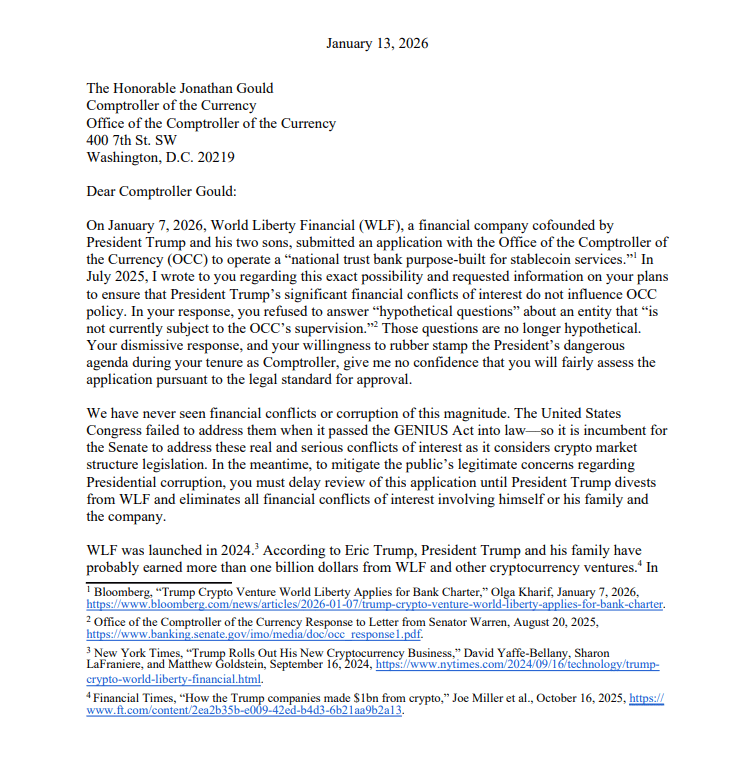
World Liberty Financial submitted its application on January 7, seeking approval to operate as a nationally chartered trust bank. The proposed structure is specifically designed to facilitate stablecoin-related services. If approved, World Liberty Financial would operate under the direct supervision of the OCC.
Warren articulated that the OCC would face an unprecedented conflict of interest if it were to approve this request. She argued that the agency would be tasked with approving, supervising, and potentially enforcing regulations against a company with direct ties to the sitting president. Such a scenario, Warren warned, could significantly erode public confidence in the regulatory process.
World Liberty Financial was established in 2024 and subsequently introduced a stablecoin named USD1. Public statements attributed to Eric Trump have indicated that the family has generated over $1 billion through crypto ventures associated with the firm. These claims have intensified the scrutiny surrounding the company's application.
Application Raises Significant Governance Issues
Senator Warren criticized the OCC for its prior reluctance to address potential conflicts of interest arising from Trump-linked crypto ventures. She emphasized that the current situation presents a direct and tangible conflict. In her assessment, approving the application could create the appearance that the president is effectively overseeing his own financial business interests.
This concern extends beyond political implications and delves into fundamental banking governance. The principle of regulatory independence is crucial, requiring agencies to investigate and enforce rules without undue influence or pressure. Warren asserted that the World Liberty Financial filing jeopardizes this essential balance.
Trust Bank Approval Could Expand Stablecoin Infrastructure
Obtaining a national trust bank charter would integrate World Liberty Financial into a regulated banking framework, enabling it to offer stablecoin services, including issuance and related operational activities. Such an approval could enhance the company's credibility and potentially open avenues for broader strategic partnerships within the financial sector.
An increasing number of cryptocurrency companies are seeking bank-like status, viewing it as a pathway to greater integration into mainstream finance. World Liberty Financial's application places it at the forefront of this trend. However, Warren contends that the direct political affiliation of this particular application distinguishes it from others.
The GENIUS Act and OCC's Stablecoin Role
Warren referenced the GENIUS Act, which was enacted into law in 2025. This legislation designated the OCC as the primary regulator for federally licensed stablecoin issuers. Warren pointed out that the act did not include provisions preventing elected officials and their family members from profiting from stablecoin activities.
She warned that under the current circumstances, the OCC could inadvertently find itself in a dual role of both supervisor and rule-setter for stablecoins. If World Liberty Financial is approved, the OCC would oversee the company's operations and simultaneously develop regulations that could directly impact the firm's profitability.
Call for Divestment Before Review Continues
Warren formally requested that the OCC pause its review process until President Trump and his family fully divest their ownership interests in World Liberty Financial. She also asked the agency to provide written confirmation of this pause. Her demand intensifies pressure on the OCC during a critical period, as stablecoin policy is increasingly being integrated into formal banking regulations.
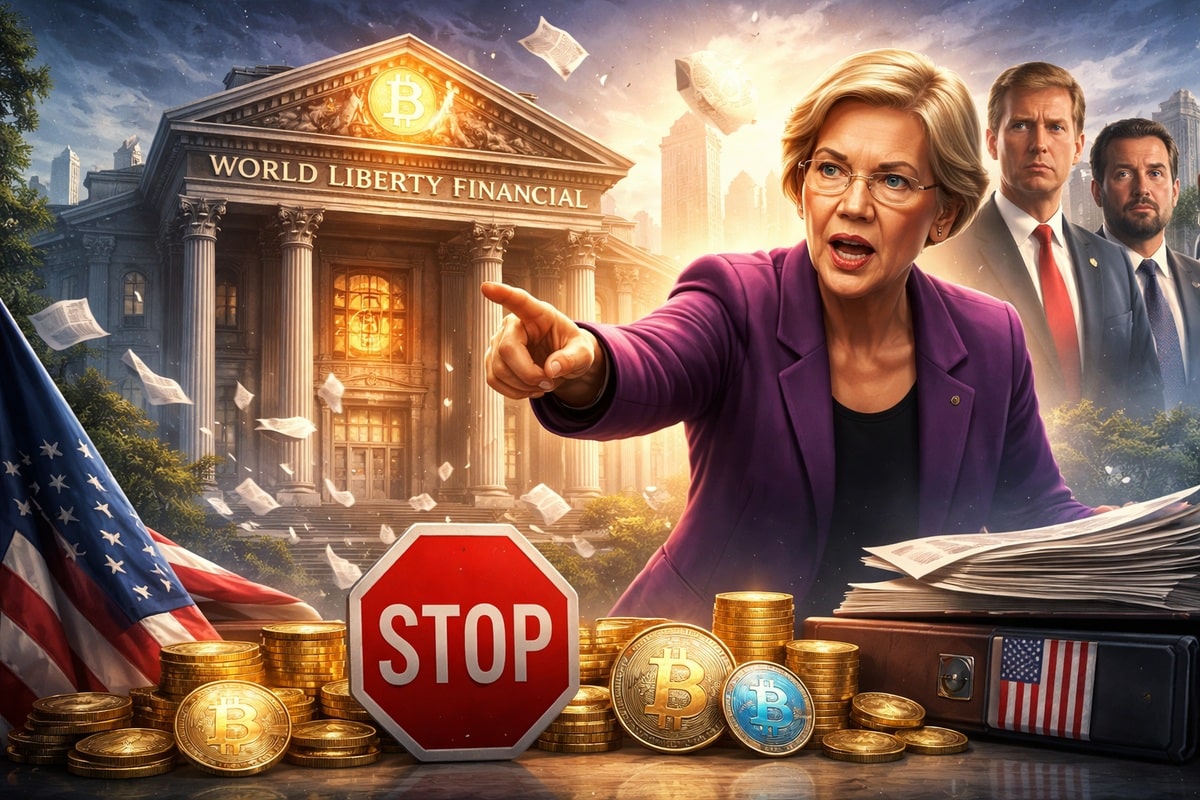
Democrats have been increasing their scrutiny of World Liberty Financial, citing concerns related to ethics, stablecoin exposure, and potential foreign ties. Warren's letter amplifies these concerns and raises the stakes for regulators considering the application.
Market Reaction and Attention
The market response to these developments has been varied. The WLFI token has experienced volatility, currently trading at $0.1807, which is more than 41% below its highest point. Data from CoinMarketCap indicates that the token's market capitalization is approximately $4.83 billion.
Trading activity has surged, with daily volume increasing by over 57% to around $171 million. This uptick in volume suggests significant speculative interest in the token. World Liberty Financial's market performance remains highly sensitive to regulatory news and pronouncements.
Conclusion
The controversy surrounding World Liberty Financial highlights the intersection of cryptocurrency regulation and political dynamics. Senator Warren's request could set a precedent for how regulators handle bank applications with ties to influential political figures. The OCC's decision and subsequent actions are likely to serve as an important indicator for future stablecoin oversight policies.
Appendix: Glossary of Key Terms
OCC: The primary U.S. regulator responsible for national banks.
National Trust Bank: A federally chartered bank that specializes in custody and related financial services.
Stablecoin: A type of cryptocurrency designed to maintain a stable value, typically pegged to a fiat currency.
USD1: The stablecoin issued by World Liberty Financial.
GENIUS Act: A law passed in 2025 that designated the OCC as the lead regulator for stablecoin issuers.
Divestment: The act of selling off assets or ownership stakes to eliminate financial ties or conflicts of interest.
Regulatory Review: The official process undertaken by regulatory bodies to evaluate and approve applications, such as for a bank charter.
Conflict of Interest: A situation where personal interests could improperly influence professional judgment or official duties.
Market Cap: The total market value of a cryptocurrency's circulating supply, calculated by multiplying the price per coin by the total number of coins in circulation.
Frequently Asked Questions About World Liberty Financial
1. What is World Liberty Financial applying for?
World Liberty Financial has applied for a national trust bank charter, which would allow it to operate as a federally regulated bank.
2. Why does Senator Warren want the review paused?
Senator Warren believes that President Trump's financial connections to World Liberty Financial create a significant conflict of interest that could compromise the integrity of the regulatory oversight process.
3. What role does the OCC play in this application?
The OCC is the regulatory agency responsible for reviewing and approving the application. If approved, the OCC would then be responsible for supervising World Liberty Financial.
4. How is the GENIUS Act connected to this situation?
The GENIUS Act established the OCC as the primary regulator for stablecoin issuers. This means the OCC has direct authority over companies like World Liberty Financial seeking to operate in the stablecoin space.