


Developer Dialogue: Incentives and XRPL's Core Design
Ripple developer J. Ayo Akinyele has reignited a dialogue concerning the potential for future incentive mechanisms to be layered onto the XRPL without altering its fundamental stability-first design. His analysis suggests that as the XRP Ledger (XRPL) expands beyond simple payments to encompass a global settlement layer for tokenized assets, liquidity, and enterprise-grade finance, new forms of network participation may emerge. The central question is whether these future roles should be accompanied by optional financial incentives and, if so, how to implement them without compromising the principles that have guided the XRPL since its inception.
Stability as the Foundation
The XRPL has historically operated without reliance on staking rewards, inflationary tokenomics, or yield-based incentives for its validators. Transaction fees are burned rather than distributed, and governance is prioritized based on reliability rather than token lockups. This deliberate design choice has ensured that XRP transactions remain predictable, fast, and efficient, even when subjected to significant transaction volumes. Akinyele has emphasized that this foundational philosophy remains non-negotiable.
Instead, the discussion revolves around whether new programmability features could eventually introduce fee flows that operate independently of the consensus mechanism. These could potentially support incentive pools for emerging use cases, allowing participation incentives to evolve around the Ledger without necessitating changes to the Ledger itself.
The broader ecosystem already provides a glimpse into this potential direction. External yield experiments, such as those involving wrapped XRP, Flare, and Doppler Finance, demonstrate that innovation does not require alterations to the base layer. Akinyele's exploration aims not to compromise XRPL's stability but to ensure that future growth does not preclude new participation models.
Market Focus: XRP's Crucial Support Level
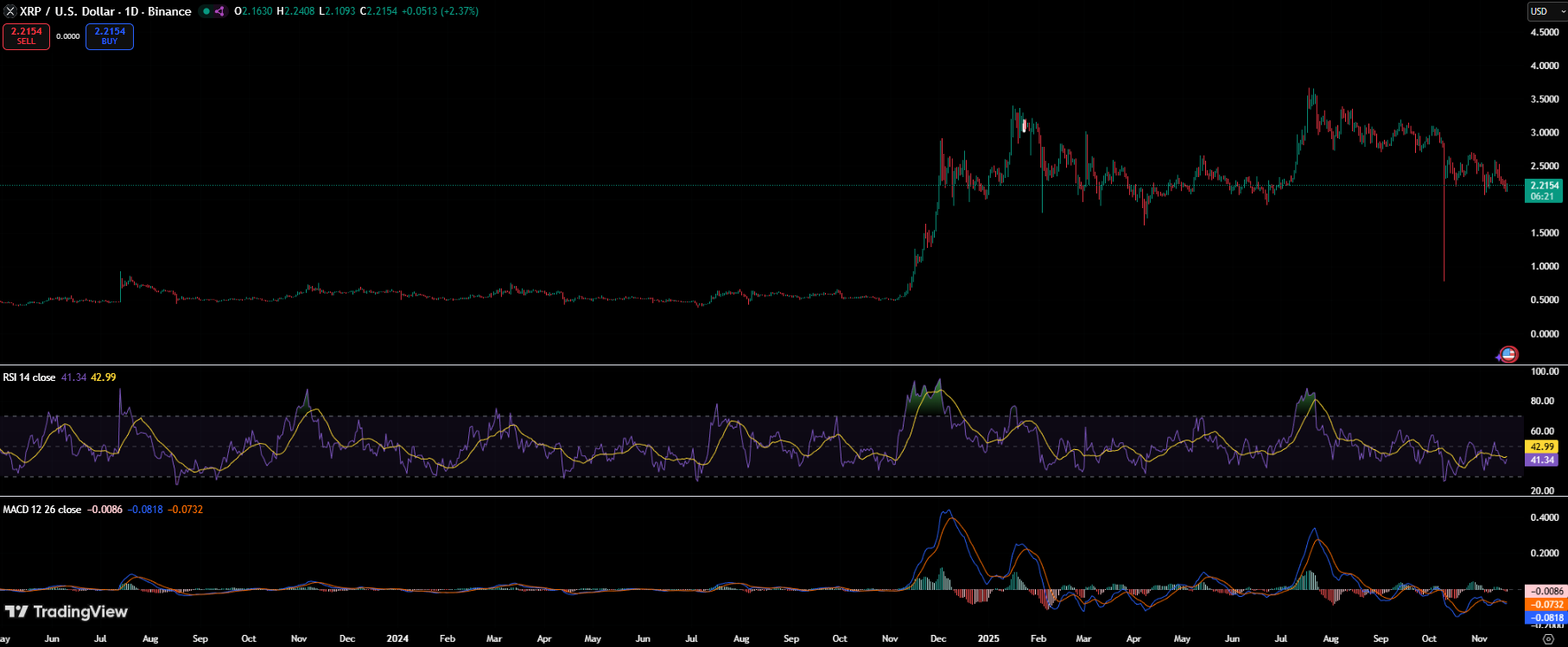
While the debate on incentives continues among developers, the market is closely observing a separate, critical development: XRP's price action is currently testing a crucial support level. The token recently experienced a pullback into the $2.15 zone, which has become the focal point for short-term market sentiment.
If XRP can maintain its position above this level, confidence is expected to return, with the immediate target shifting towards the $2.40 – $2.50 range. However, should $2.15 fail to hold, on-chain cost-basis data from analyst Ali (@ali_charts) indicates that the next significant bands of historical demand are located at $1.91 and $1.73. These levels represent zones where a substantial volume of XRP transactions previously occurred, suggesting that large groups of long-term holders are likely to defend these price points if they are reached.

Current momentum indicators suggest a neutral stance, with neither a confirmed capitulation nor a clear recovery in progress. The Relative Strength Index (RSI) remains near 41, indicating neutral emotional pressure among traders. Simultaneously, the Moving Average Convergence Divergence (MACD) shows a decline in bearish strength rather than an acceleration, a combination that often precedes an inflection point rather than a sustained trend continuation.
Converging Perspectives on XRP's Future
Developers are contemplating the long-term evolution of XRPL participation over the next decade, while traders are focused on whether XRP will hold the $2.15 support level in the coming days. Ultimately, both groups share a common interest in the long-term value of the asset.
The XRPL is unlikely to abandon its efficiency-first model in pursuit of incentives, and XRP's broader adoption trend is not expected to be derailed by a temporary price correction. The immediate concern is whether a breakout from the current support level will occur or if a deeper pullback into the next demand zone will take place. The more significant, long-term question is how the XRPL can continue to scale its use cases while preserving the reliability that institutions have come to trust.
Both the short-term price movements and the long-term network development will play a crucial role in shaping the asset's progression.