



ZCash now appears to be following a pattern that seasoned Bitcoin followers recognize instantly: a steep surge, a heavy collapse, and then a period of quiet trading that feels almost too quiet. Analysts like Brian Cohen believe this familiar structure is not a sign of weakness for ZEC, but rather the early part of a larger cycle that many have witnessed before.
ZCash garnered significant attention a few weeks ago after experiencing a more than 10x climb in a very short period. The ZEC price moved from a long phase of slow trading, surging towards $745 before losing momentum. At the time of writing, ZEC price had settled near $356. While this decline led some observers to assume the excitement was over, the structure of the move suggests a different narrative.
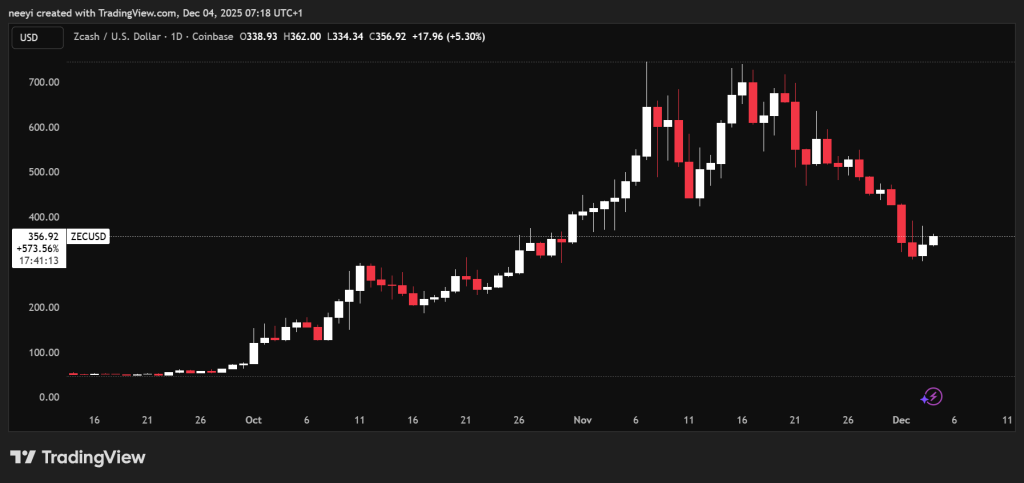
Brian Cohen noted a parallel that surprised many. ZCash declined from the $700 region to the $300 region in a manner similar to Bitcoin’s move from $1,200 to $250 during the 2013-2014 cycle. While the speed and scale differ, the underlying structure remains the same. Cohen explained that ZCash completed this emotional and technical arc almost five times faster than Bitcoin, with Bitcoin needing months while ZEC accomplished the same sequence within weeks.
The ZEC chart illustrates a breakout from a strong base near $25 to $40. ZCash then rallied quickly, reaching the $700 area before a sharp pullback brought the price near $300. Cohen directly linked this to Bitcoin’s move from $100 to $1,200 followed by a slump toward $250. BTC price followed a pattern of bubble, betrayal, and boredom, and ZCash appears to be mirroring this rhythm at an accelerated pace.
Forces Behind Price Collapses Differed for Bitcoin and ZCash
Brian Cohen believes the reasons behind both crashes are important to understand. Bitcoin fell in 2013 because the ecosystem lacked sufficient support. Early exchanges struggled to handle volume, and liquidity was thin. The Mt Gox collapse created fear, and BTC price dropped as the market adjusted to its own immaturity.
ZCash is currently facing a different type of pressure. Cohen described ZEC’s drop as a liquidity compression event, with ZCash’s float remaining thin and leverage positions unwinding rapidly. Automated systems moved faster than retail traders. These factors do not indicate weak fundamentals or an expanding supply.
Thin liquidity often leads to fast declines, but it also creates conditions for equally swift recoveries. This is why Cohen believes ZEC may not be entering a long-term downturn.
How Zcash’s $700 → $300 Crash Mirrors Bitcoin’s 2013–2014 Collapse — Only in Fast-Forward
Zcash’s $ZEC recent correction from roughly $700 down to $300 is the closest structural analogue to Bitcoin’s infamous 2013–2014 crash from $1,200 to $250 — but happening at 5× the speed…— Brian Cohen (@inthepixels) December 3, 2025
Analyst: ZCash Rebound Mechanics Resemble BTC Recovery After the 2014 Low
BTC found a bottom near $250 in early 2015 and entered a long consolidation phase, followed by a strong expansion. The climb from $250 to $20,000 over the subsequent years remains one of the most discussed phases in crypto history, helping Bitcoin transition from a niche digital asset to a global economic topic.
Brian Cohen believes ZCash could be entering a similar phase. He noted that ZEC has a capped supply of 21 million units, identical to Bitcoin’s structure. Development continues through the Zashi wallet, Halo2 upgrades, and NU6 progress. Cohen stated that fundamentals remain intact despite volatile price performance.
BTC price moved slowly during its recovery because the broader crypto ecosystem was still developing. ZCash now operates within a more mature environment, and faster cycles often lead to faster recoveries, meaning ZEC may not need years to rebuild strength.
ZCash (ZEC) Reflexive Cycles Grow Stronger, According to Brian Cohen
In 2013, Bitcoin lacked institutional structure; there were no ETFs, and institutional treasuries were not accumulating BTC. Narratives were limited, which slowed the reflexive cycle driving strong upside.
ZCash benefits from a different environment. Cohen explained that more Bitcoin holders are now examining privacy-focused assets as part of broader portfolio strategies. Some traders are exploring a dual-cap idea involving BTC and ZEC. ETF flows provide regulatory comfort across the market, and derivatives create tighter price responses. Liquidity remains thin enough to produce sudden upside movements when demand appears.
Situations like this often spark surprise green candles. Cohen compared this setup to Bitcoin’s rapid move from $250 to $1,000 before it began its long ascent towards $20,000.
Brian Cohen highlighted that sentiment plays a crucial role in major cycles. Bitcoin reached a point in 2014 where it seemed finished, confidence was low, and narratives turned negative. BTC price remained at the bottom long enough for doubt to spread, yet a major recovery followed.
ZCash appears to be entering that same emotional zone. Claims that ZEC will never revisit $700 are similar to comments that BTC would never recover from $250. Development remains strong, the privacy narrative continues to gain attention, and ZCash fundamentals keep improving. Market psychology seems to be repeating itself.
Cohen outlined the traditional sequence: undervaluation begins the cycle, enthusiasm builds, a sharp reset follows, and expansion returns as the final stage. ZEC has completed the first three steps, placing the expansion phase as the next potential direction.
ZCash (ZEC) Cycle Compression Explains Potential for a Fast Bounce
Brian Cohen highlighted another detail: Bitcoin needed several years to move from its 2013 high to its next major breakout. ZCash, however, moved through the same emotional pattern and structural shape within weeks. This level of compression often leads to faster reversals.
ZEC price shifted from accumulation to peak to collapse at a pace far quicker than Bitcoin ever did. Cohen explained that when cycles compress, recoveries can also compress, meaning the next phase could arrive sooner than expected.
A recovery is never guaranteed, but a sharp bounce remains a possibility. These patterns simply help explain why some analysts believe the ZCash story is not yet over.
ZCash currently stands at a point where fear feels prevalent, yet fundamentals remain steady. The pattern resembles an early Bitcoin chapter replayed at a higher speed. Time will reveal whether this compressed cycle becomes the start of a stronger period for ZEC.